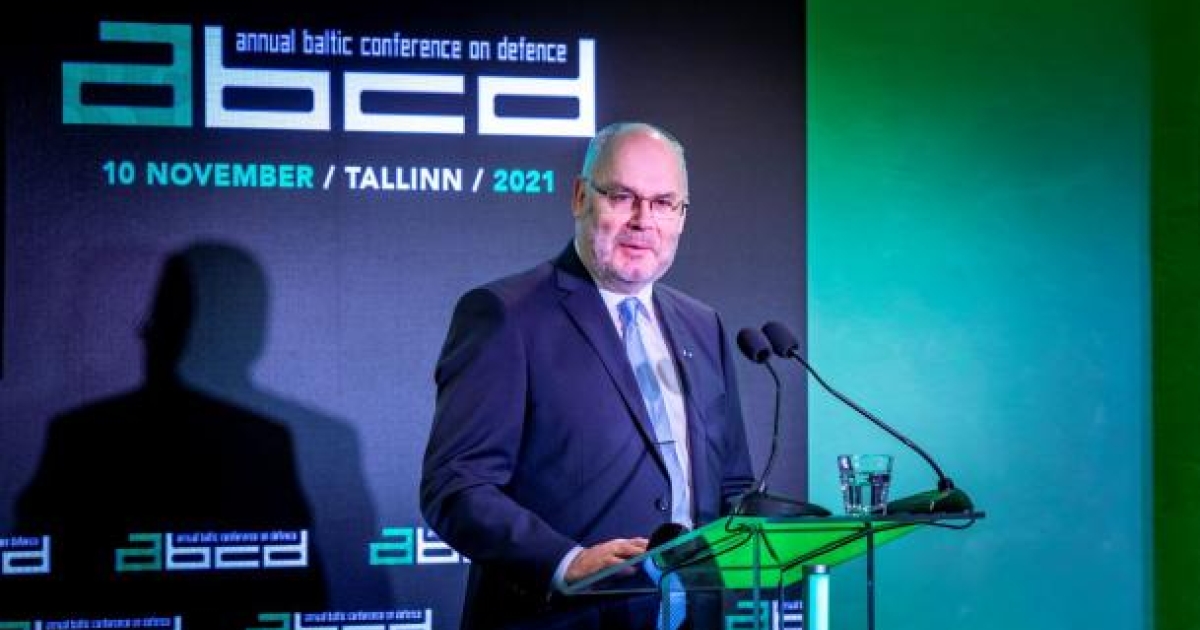
I am pleased and honoured to open the ABCD conference today. Especially, as it addresses such a timely topic – the future of NATO, our collective trans-Atlantic security, and the challenges that we face together.
I would like to thank the International Centre for Defence and Security and all those who have contributed to preparing this event.
Before addressing the more strategic concerns regarding NATO, I cannot remain silent on the escalating crisis on the borders of Latvia, Lithuania, and particularly, Poland. Unfortunately, it is a warning that we cannot take peace and stability in Europe for granted. It also reminds us, that there are dictators in Europe, who care little for human life and suffering. Make no mistake - what Lukashenka is doing, is an attack on the integrity of the borders and security of three European nations, three NATO allies. We must support them, and show that we are determined, and united. In NATO, in the EU, and on a national basis.
Now turning to our agenda today.
At its core, NATO is a forum, where Allies discuss, debate, and forge a consensus on a shared threat picture, and decide on how to respond. Likewise, the highest value of NATO’s Strategic Concept is the process itself of hammering out our common, forward-looking vision of NATO.
It is important that this vision is not just determined in the meeting rooms of the NATO Headquarters by Ambassadors. It should equally be shaped by politicians, officials and experts in national capitals, and ultimately by those very populations that the North Atlantic Treaty sets out to defend. Therefore, conversations like the ones we will have today, represent the essence of NATO.
Let me start by stating the obvious: NATO is and will be the cornerstone of Estonian, European, and Euro-Atlantic security.
This phrase has been so common in our discourse that it is said almost without thinking. After all, as we often emphasise, NATO has kept the peace in Europe for over 70 years. But as NATO proceeds to draw up its new Strategic Concept, we must not take this for granted.
Since its creation in 1949, NATO has shown its ability to adapt.
NATO faced tough questions at the end of the Cold War about its purpose in a world where its opponent, the Soviet Union, had ceased to exist. Then, through its role in the Balkans, and by enlarging to Central and Eastern Europe, NATO once again took center stage in European security.
9/11 and NATO’s participation in stabilizing Afghanistan brought new tasks and responsibilities to the Alliance, shaping NATO over the past 20 years.
Next, NATO became critical as the provider of deterrence and defence after the Russian invasion of Ukraine in 2014. The Alliance refocused its efforts on the Euro-Atlantic area, and strengthened its posture. In Estonia, we continue to experience the commitment and solidarity of our Allies every day, when we work together with our friends in the NATO battle group, the NATO staff element, and the NATO air policing crews in Ämari.
So NATO has always been there to address our most significant security challenges. It is tempting to think that as before, NATO will somehow adjust to whatever comes next. However, we can’t be complacent. In my view, we are, perhaps for the first time after the collapse of the Soviet Union, facing a new geostrategic reality.
First, autocratic regimes are eroding the international order based on rules and norms. They aspire to substitute it with a world where the strong do what they will, and the weak suffer what they must.
It seems to be increasingly normal to use any and all instruments in pursuit of political objectives, including military pressure, hybrid warfare, cyber weapons and information operations. As I already emphasised, this is happening in Europe as we speak. The Belarusian hybrid attack against Poland and Lithuania and Latvia. The build-up of Russian forces on the borders of Ukraine, and attempts to use energy blackmail in Moldova. Russian challenge to stability and security in Europe is less and less disguised. NATO cannot afford to miss a beat, and if needed, strengthen its posture in the Baltics and Poland.
Second, with the emergence of China’s global ambitions, international security is increasingly structured around the great power competition in the Pacific and further afield. In the past years, we have seen a jump not only in China’s assertiveness globally, but also in its military power. According to the new United States Department of Defense annual report, the Chinese Navy is now the largest in the world. This is just one example.
So what will the winning formula for NATO be in this context?
First of all, NATO has to stick to its values, and its guns. The ideals of democracy, rule of law and individual liberties that were a part of its founding treaty, remain the most important bonds that bind us. We are not always perfect in implementing these ideals. Yet, they remain what we believe is fundamentally desirable for our societies. The trans-Atlantic community is a community in the true sense of the word – we are united by our values, and by trust, friendship and solidarity.
This is also why I believe in the continued commitment of US to NATO, and a strong American role in European security. If there is a lesson learned from the past 70 years (although we can directly only speak for the past 17), is that we are stronger together. Europe needs the United States and the United States needs Europe.
It is also essential that in dealing with our opponents and competitors, NATO defends the security interests of the Alliance with a straight back. To be successful, and to ensure that our countries, people, and values remain protected, we can’t be afraid to take a stand when needed. Collective defence is in the DNA of NATO, and we must address the future requirements of deterrence and defence with the seriousness that it deserves. Including in the Strategic Concept.
But NATO also has to change. We have already seen the significant steps that have been taken since 2014 to boost our resilience, and our ability to fight. NATO has also already begun to acknowledge the shifting geopolitical balance and the implications to Euro-Atlantic security.
We are also starting to understand the new requirements of rapidly evolving technology. NATO has always had the technological edge, and we need to make sure that we are relevant not just in the realm of 20th century warfare but of the 21st. How well Allies do in developing new and disruptive technological capabilities will be a key factor in NATO’s ability to ensure the security of the Euro-Atlantic area.
So let’s lean in to those discussions over NATO’s strategic future. We have a solid bond based on values and solidarity, we have a political and military framework that has proven adaptable, and we have an understanding of the key issues ahead. And let me end with the words of Winston Churchill who said that the only thing that is worse than fighting with Allies, is fighting alone.
Thank you!