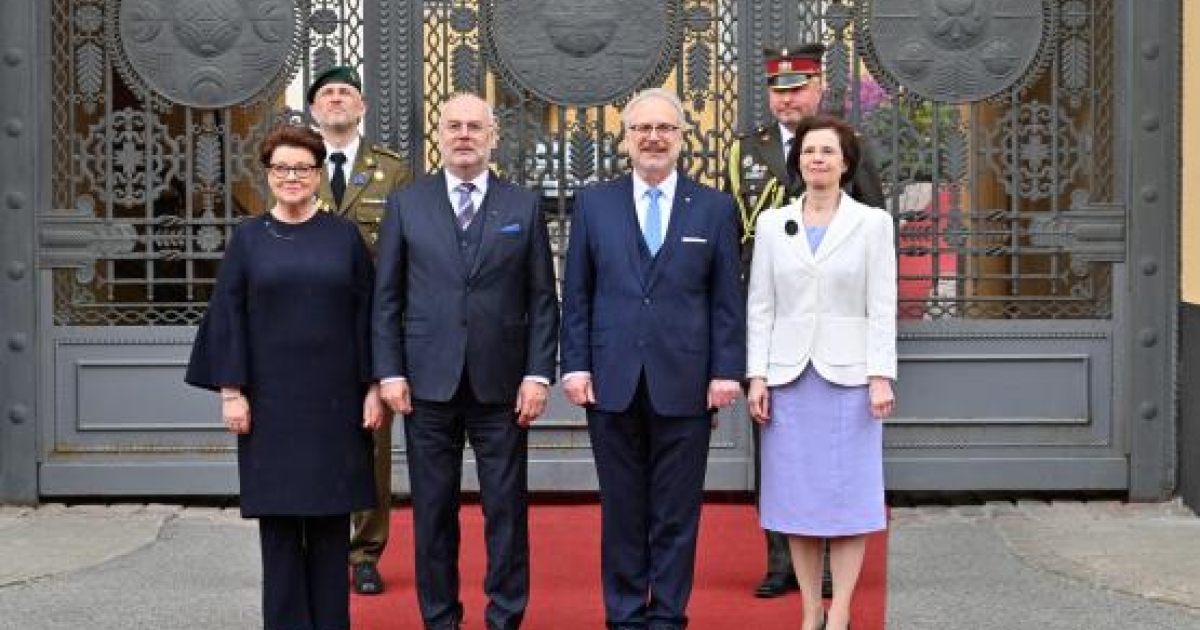
Esteemed President Levits, Mrs Levite,
Friends,
My home is close to Tartu, in the region we once both called Livonia. That entitles me to say that Latvia and Estonia are by no means ordinary neighbours. There are many similarities in our histories and much that is intertwined in our relationship. Our physical proximity and the fact that we view the world in much the same way has formed a close bond between us over the centuries.
That bond was described by former Estonian president Lennart Meri thusly: “We have been ruled by the same kings and emperors; we have been subject to the same courts and laws; we have fought in the same wars and shared in the same victories; we exist within the same climate zone; we border the same sea; we have the same fields and forests; we grow the same grains; we drive on the same roads; we manufacture the same industrial products.”
It can be argued that the idea of Estonians and Latvians as a single nation speaking two languages was first posited by writer and ‘peasant philosopher’ Reinis Kaudzīte, although the notion became more widespread thanks to the state visit of Latvian president Janis Čakste to Estonia in 1925. Indeed, modern research supports the theory, since Estonians and Latvians are genetically the most similar nations in Europe.
Yes, our languages are different, but we need to look behind the words to see the true picture of our native tongues. In these ‘two languages of our one nation’ words are cobbled together to make phrases and sentences in exactly the same way in most cases.
A key role in this was played by Livonian, thanks to which we can symbolically consider ourselves relatives. It has been wonderful to see Livonian language and culture making a comeback over the last few decades on the initiative of enthusiasts and with the support of Finno-Ugric peoples and the Latvian state. That rebirth was marked by 2023 being named the Year of Livonian Cultural Heritage. Since 2018 the Livonian Institute at the University of Latvia has been at the forefront of fostering Finno-Ugric studies in the country. Thank you, Valts Ernštreits, for unifying and promoting Estonian, Latvian and Livonian!
In 2009 a language prize was established to underscore the importance of our two languages and to draw them closer together. It encourages linguistic contact between our nations and translations from each other’s languages, which in turn brings our cultures closer together. The University of Latvia offers courses in Finno-Ugric languages, including Estonian, whose teaching is financially supported by Estonia.
As small nations we speak the same language when it comes to defending our values and interests in the international arena. I recall that Estonia and Latvia entered into a treaty of alliance in Tallinn in 1923 which obliged them to help each other in the event of an unprovoked attack by a foreign country. The treaty also set out the joint diplomatic and foreign policy approach of our two countries, with a promise to support each other in every way. At the time, the day on which the treaty was entered into came to be referred to as Estonia and Latvia’s wedding day. But it was still just a treaty between two small countries – one which could not protect us in the face of the secret protocols of dictators. Half a century later we both adopted the motto ‘Never again alone’, and now we are fellow members of a formidable military alliance which unites 31 countries.
My friends, Russia’s aggression in Ukraine has rewritten every rule. It has upended European security and left us all clouded with uncertainty. But we know that international law and rules-based order continue to be the shield that defends small nations. That is why we must not only maintain that shield, but reinforce it. We are dependable and visible allies who are supportive and trustworthy. We stand alongside Latvia, offering whatever advice and influence we can, in your efforts to secure a seat on the UN Security Council, in which we wish you every success.
This summer marks the 150th anniversary of your first national song festival. The spark for that festival was lit in Jānis Cimze’s school in Valka, which played a defining role during the national awakening in both Livonia and Estonia. Cimze was also one of the leading figures in Estonia’s first national song festival in Tartu in 1869. I am aware that we will soon get to see the Latvian-Estonian co-production In the Land that Sings, the story of Latvia’s first song festival.
When countries are geographically close to one another and think along much the same lines, they also tend to be bound together in economic terms. This is very true of Estonia and Latvia, whose economic relations have never been better. You are our second-biggest trading partner and our fourth-biggest target country for foreign investments. Estonian companies have poured money into your finance sector, real estate and industries. Since 2017 they have been awarding the Livonia Prize to one Estonian company in Latvia and one Latvian company in Estonia to recognise successful undertakings which boost exports to each other’s markets. In fact we will be presenting this year’s prizes tomorrow.
We have achieved a great deal in recent years. Our defence policy has been taken to the next level in terms of the presence of NATO allies, the joint armament procurements we have initiated and the contributions we have made to raising our own defence capabilities.
Last year saw the publication of the second Estonian-Latvian cooperation report, which was compiled by Janis Eichmanis and Ragnar Kond. May I just say in memory of Janis that he was a true friend to Estonia; he will always have my deepest respect. In his and Ragnar’s report, a number of proposals were put forward in regard to cross-border and digital cooperation and infrastructure projects. We must give them our consideration and implement those which will take our relationship further.
Allow me, however, to give you an example of one situation we have not managed to resolve in the last 100 years. In February 1921 the Estonian ambassador to Latvia, Aleksander Hellat, proposed to the Minister of Foreign Affairs that a special train be dispatched to Valga so that Latvian visitors on their way to Tallinn for the Estonian Independence Day celebrations would not have to wait five or six hours for their connecting train to the capital. Estonian statesman Jüri Jaakson travelled to Riga by train on his first state visit in 1925, and President Ilves did the same in 2012. At the start of the 20th and 21st centuries alike it took five-and-a-half hours to get from one capital to the other on a special train. Today it takes at least 10 hours. We must work as one for the completion of Rail Baltic so that we can travel by train from one capital to the other in a reasonable amount of time, but we must also think about how we can promote train travel between Tartu and Riga.
My fellow head of state President Levits, Mrs Levite, I thank you for the hospitality that Latvia always shows us. Latvia is a little bit like a second home: one you might not make it to all that often, but which you always look forward to and enjoy visiting. Thank you for being such a good neighbour. You will always be welcome in Estonia, and I look forward to seeing you again in my hometown, Tartu. My city will be a European Capital of Culture in 2024, and events will spread well beyond its borders, throughout all of Livonia in fact, and the ancient lands of Ugandi – from which Latvian gets its name for Estonia, Igaunija.
Pacelsim glāzes par Latvijas Republikas uzplaukumu un panākumiem! Lai dzīvo Latvija! (Let us raise our glasses to the success and prosperity of the Republic of Latvia! Long live Latvia!)