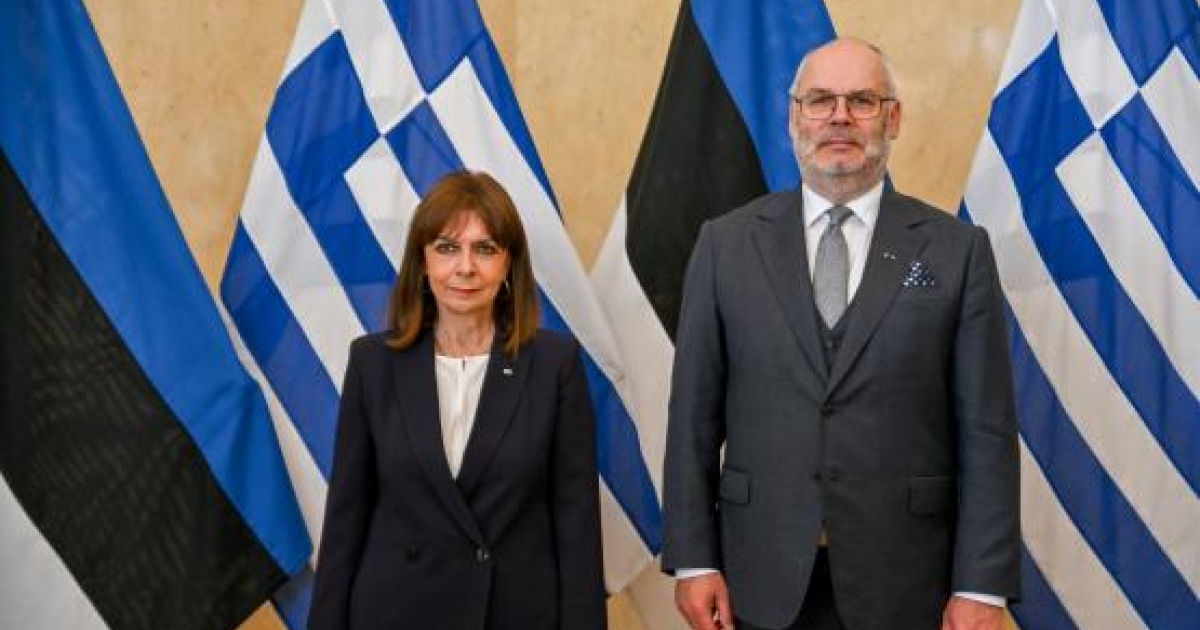
Dear Katerina, dear reporters, it’s a pleasure to welcome my colleague from Greece here.
This year, we can reflect on the moment a hundred years ago when the Republic of Estonia and Greece established diplomatic relations. Now, a century later, our cooperation as well as the influence of both countries have grown considerably, as we’re active members of the European Union and NATO. And as our conversations have shown, we agree on important issues.
We started with bilateral relations, which are very good. The Mediterranean and the Baltic Sea are on different sides of Europe, but our concerns and hopes are similar. As a successful digital state, Estonia can offer technological solutions that we’ve successfully implemented ourselves – here we can develop our bilateral cooperation further, in both the digital and maritime fields.
As in almost all areas of human activity, the issue of cybersecurity arises in the maritime sector as well. This is why we’re inviting Greece to join the Maritime Cybersecurity Centre to be established by TalTech University and the Maritime Academy.
Of course, we talked about the war in Ukraine as well. A whole nation is fighting for its freedom, but also for the core values of Europe, for all of us. Estonia and Greece are both working to ensure that the unity and unwavering support of the EU Member States for the Ukrainian people is maintained. In doing so, we’re defending common values.
Our position is well known – Estonia supports granting Ukraine candidate status for EU membership. Candidate status should be a sign of hope for Ukraine, because it’s hope that will help it withstand the enormous challenges that currently seem unending.
As long as the war continues, sanctions on Russia need to be tightened. We need to be even more united in isolating Russia politically and economically and in strengthening European security and energy independence. Russia’s opportunities to earn revenue from gas and oil must be ended.
I hope that the meeting of EU leaders that started today in Brussels will send a clear message to this effect. These decisions are obviously painful for both of us, for everyone, but I also know that freedom has a price.
But we can already think about how to help rebuild the towns and villages destroyed by Russian bombings and missile attacks, and support the victims of war, support the broken human fates. Supporting Ukraine in every way has been important to us since before the Russian invasion in February.
We can think about possible supply routes that would give Ukrainian agricultural products rapid access to the global market. This is important for food security worldwide.
For Europe, the war in Ukraine is a harsh lesson in how to strengthen its security and also its economic independence. The energy situation that prevailed before the war will never return. As in Greece, a floating terminal is under construction in Estonia to receive liquefied natural gas, with the challenging completion date of this autumn.
As maritime countries, we have high expectations for the offshore wind farms that are being planned. We can increase the share of green energy in our energy portfolio and make a decisive shift away from wasting non-renewable natural resources, while reducing carbon emissions. Accelerating the green transition through the energy transition is a security issue for us.
In many ways, Greece is emerging as a centre for energy interconnections in South-Eastern Europe and for helping to integrate the Balkans into the EU. We also discussed regional issues, where it’s important to respect international law and democratic principles.
Greece has shown tremendous hospitality over the years and has contributed a great deal to assisting refugees who’ve arrived in Europe from across the Mediterranean. The compassion and willingness of the Greeks to help them has been exemplary. In recent months, Estonia has hosted war refugees from Ukraine, and we understand the challenges each of us is facing.
Estonia now has one of the largest refugee caseloads in the European Union, and our people have shown determination and commitment in supporting them. It’s time to think about additional funding from the European Union for Member States bearing a heavier burden.
As someone from Southern Estonia, I am delighted, Katerina, that you’ll be able to get to know Tartu during your visit. You can see the e-solutions of the Estonian justice system at our Supreme Court. The memorandum of understanding on cooperation in the digital field signed last year will give an important boost to Estonian-Greek relations.
Once again, welcome to Estonia, have a lovely visit and happy birthday!