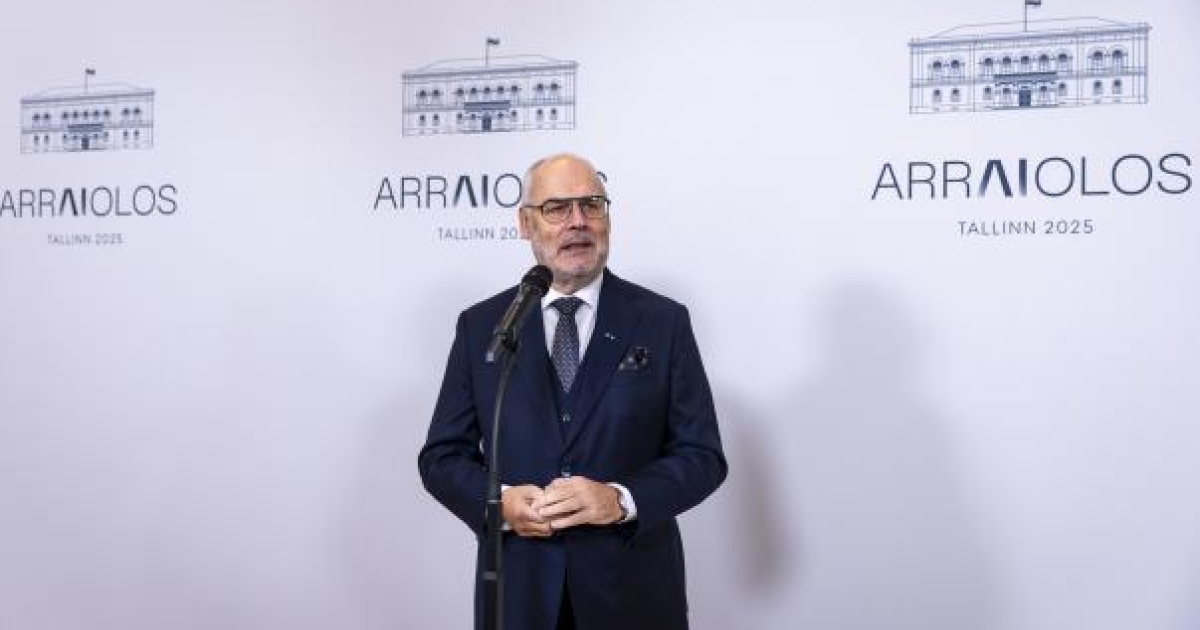
A total of 11 EU heads of state have joined me in attending the Arraiolos Group meeting here in Tallinn today and yesterday. The key issue of our meeting was the development of AI: its growing role in education, the social sphere, defence and economic development, and the creation of a framework to support its use. We also spoke at length about the security situation in Europe and the Middle East.
The heads of state of Europe grasp the importance of AI. Its adoption will change perceptions, the balance of power, societies and nations as a whole; how exactly, and to what extent, is for us to decide. Given what we currently know, we cannot rule out the possibility that AI will become the term we use to describe the 21st century.
It is important for us to understand the complexity of AI and the ongoing global competition to develop it in addition to the significance of its strategic deployment.
This does not mean we should impede its use: quite the reverse. We must support and encourage the use of AI every which way, in the public and private sectors alike. At the same time, we must be selective and strive to ensure that Europe plays a clear and determining role in this transformation.
Europe must carve out its own role in this story of global development. We should not think of ourselves as mere users of AI technologies or view Europe’s role as championing restrictions and regulations.
No company – indeed no country – can be entirely digitally sovereign, but we can be aware of and understand our interdependencies, and act accordingly. Instead of aiming for digital sovereignty, countries should work towards achieving conscious interdependence.
As with any global issue, when it comes to new technologies, human rights and fundamental freedoms must be our starting point. We need to find a way to make this new technology deliver on our wish to bolster democracy and the democratic way of life.
If we truly want Europe to be a global player, then building supercomputers or developing software is not enough. Whether it is a large language model or a specialised machine-learning tool, any credible AI system is dependent on high-quality data.
And let us not forget the linguistic dimension here: AI systems must be able to speak and understand our languages, no matter how small they are, if we are to preserve Europe’s cultural diversity.
Everything starts with education. If AI can be successfully adopted in education, it will be able to be used more effectively elsewhere as well. That is why we have launched an AI education programme in Estonia: an initiative inspired by Tiger Leap, which ushered us into the digital age.
This new programme, AI Leap, is not just about giving teachers and students new tools to work with – its aim is to level the playing field and ensure informed use, and more broadly to change the way young people learn so that they are ready to face the challenges the future brings.
During the second half of the day, the discussion among the heads of state gathered here in Tallinn turned to security. The world today is a harsher, more complex and less predictable place than it has ever been. In that situation, we are seeking something to fall back on: answers that will help to restore people’s confidence and faith.
I thank all of my fellow heads of state for coming to Tallinn and for the two very productive days we have had together. Many thanks also to the organisers of the Arraiolos Group meeting, and to its speakers, observers and contributors.