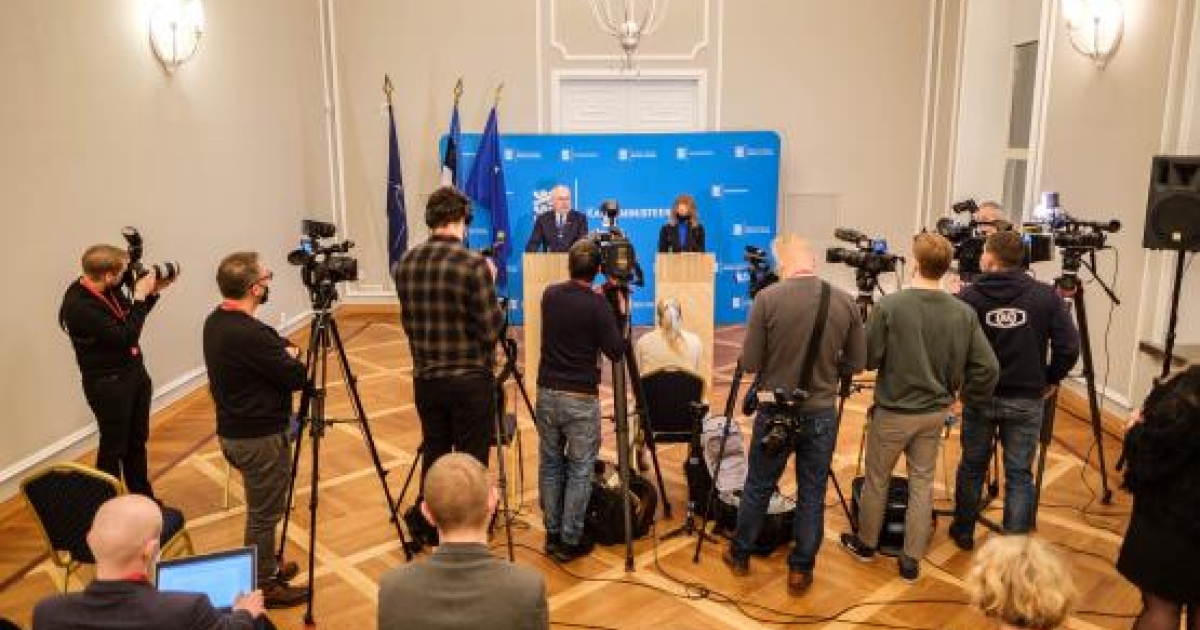
At our meeting of the National Defence Council today we discussed the security of Europe and Estonia. What would further military escalation on the part of Russia mean for us? How can we be better prepared as a country? What cooperation are we pursuing with our allies?
The Iron Curtain erected by the Soviet Union is no more. What does remain, as we can clearly see, is a desire in certain quarters to turn back the clock, to impose rules in Europe down the barrel of a gun and to significantly undermine EU and NATO unity. Moreover, Russia is approaching military readiness to attack one of its neighbours yet again, with a view to changing the European-minded course of Ukraine’s foreign and security policy.
I would stress that there is no direct military threat to Estonia at present. As a member of both NATO and the EU, Estonia is well defended.
However, the renewal of Russian military activity in Ukraine would have consequences for the whole of Europe, including Estonia, and we must be prepared for that eventuality – whether it be an influx of refugees, cybersecurity challenges, economic impact or energy security issues. In our session of the National Defence Council today, we were given an overview of the response of Estonian agencies to the current risk situation.
The country has done good work. That includes persuasive communication with its allies in order to maintain unity in NATO and the EU and to highlight among our allies the challenges faced by the Baltic region in particular in light of the current situation.
We have also determined some noteworthy ways of offering Ukraine practical support in a number of areas. EU and NATO allies lending Ukraine their assistance is important in guaranteeing the preservation of the democratic path chosen by the Ukrainians themselves and of their faith in Europe.
Of course, work has also been done to ensure Estonia’s readiness. In order to accelerate the pace of developments in national defence, the government took the decision to further invest in the field and is drafting measures that will enable us to be better prepared for a range of scenarios. I consider unity between political forces vital in ensuring the more rapid reinforcement of our defensive capabilities and flexibility of response.
In order for Estonia to be as prepared as it can be and to cope in such circumstances, it is not just the actions of the government or the state’s institutions that matter: everyone has their own part to play in it. Those who are prepared for a crisis can rest assured.
We could all give some thought – every day, not just on the anniversary of the Tartu Peace Treaty – to how prepared we are to cope in a crisis, whether it be a security situation, a power outage, a storm, a blizzard or some other natural event. Everyone can help themselves, for instance by making sure that they have a stock of basic supplies. Everyone can think about how better to support one another in our communities. That includes how local governments and state agencies work together.
I also continue to draw attention to the issue of cybersecurity. This is why I asked that Minister of Entrepreneurship and Information Technology Andres Sutt attend our session. The way we run our lives today is dependent on e-services and communication and information systems. For that reason, we have to think about cybersecurity all the time, and all the more so in the current situation. What crisis plans do companies have in the event of a cyber incident? Does everyone have strong passwords? Is everyone observing other important cyber hygiene practices? At the national level, I expect the security of the state’s information systems to be given as much attention as the country’s military defence.
The Tartu Peace Treaty gave us the chance to both build and shore up our own country. The challenges it now faces will only be solved through solidarity and cooperation. Let us be guided by the example set by our founding fathers, and may we never forget that it is our collective desire to uphold our nation which helps us overcome crises.
Thank you!