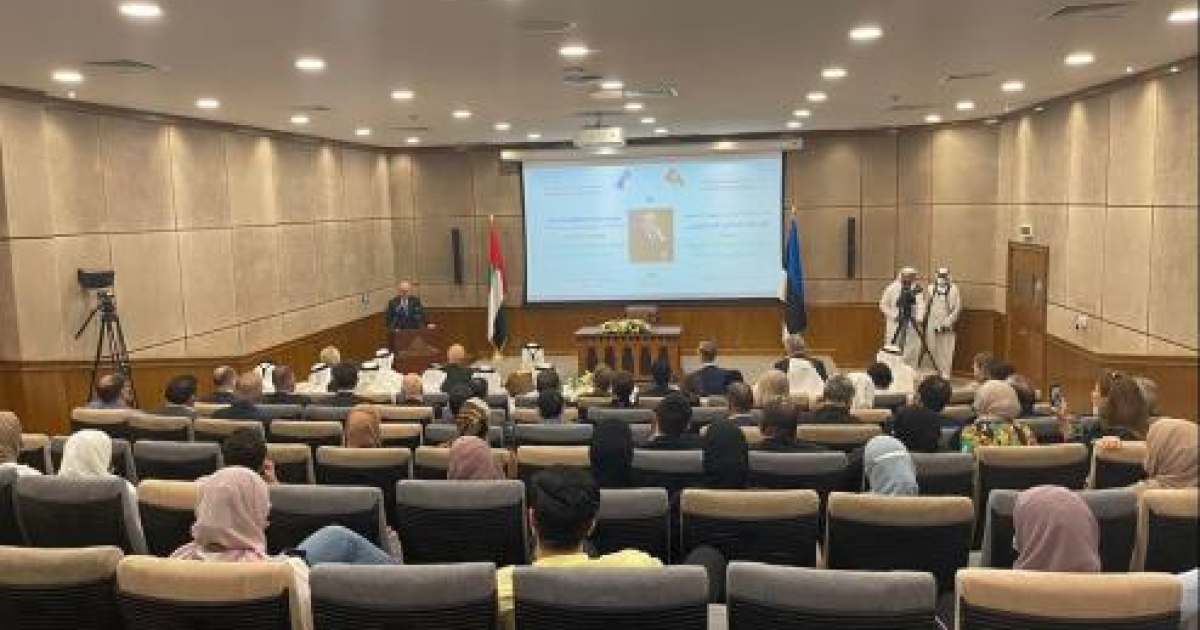
Since the head of state’s professional background is linked to developmental biology and genetics, he outlined the key aspects of the development of biotechnology and explained the choices that lie before those who are required to make significant political decisions. President Karis explained that just as the 20th century was the century of physics, the 21st century is the century of biology. He cited the visionary Steve Jobs, who predicted that the most important inventions of the 21st century would be made at the crossover point between biology and technology. The head of state added that computer power and the use of smart algorithms have enabled more and more data to be gathered and analysed and valuable information about biological processes to be derived from them.
“The mRNA vaccines being deployed against coronavirus were able to be taken into use relatively quickly because scientists have been developing the technology linked to them for decades,” President Karis explained. “The idea behind the theory is simple, but its implementation has proven a lot more complex.”
During his lecture the head of state showcased the Estonian Genome Project, which has amassed data from 200,000 gene donors, accounting for 20% of the adult population of Estonia. “We have now reached a point where the data we have gathered can start to be used in clinical practice,” he said. “In the coming years, individual gene data will become available to doctors, allowing them to determine more effective methods of treatment and enabling people to make smarter lifestyle choices.”
President Karis also met with Sheikh Sultan bin Ahmed Al-Qasimi, the president of the university and the sovereign ruler of the Emirate of Sharjah.