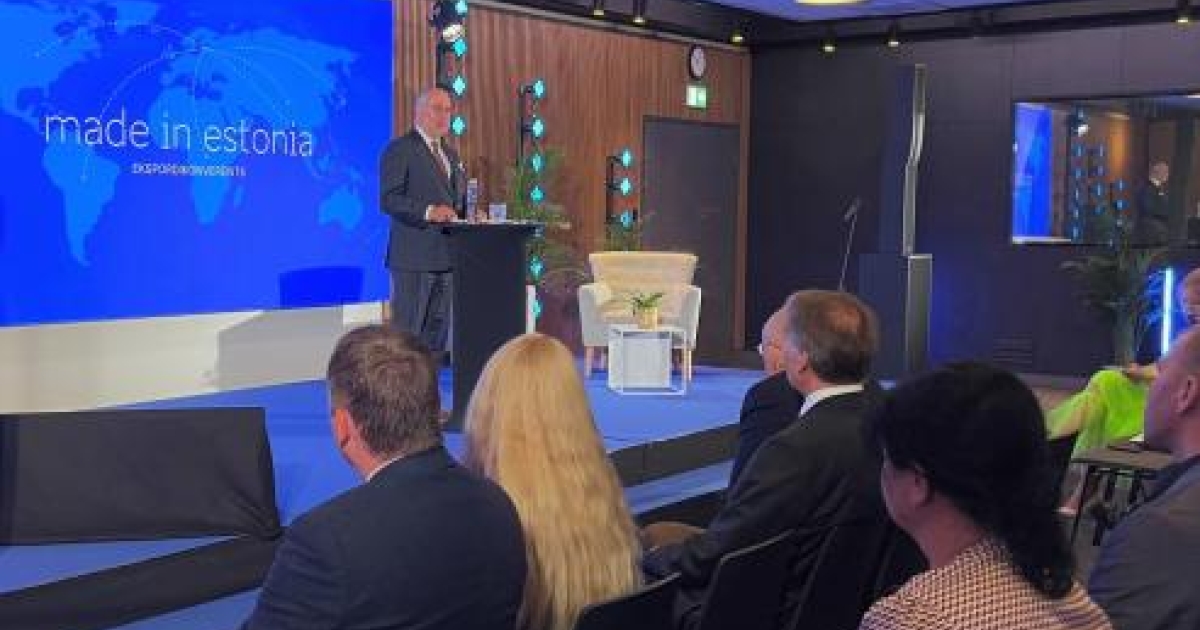
“Exports and the flexibility of entrepreneurs in finding new markets are what have led to new success stories in the midst of crises,” the head of state said. “Not only has the rapid rise in the price of commodities over the last 12 months raised input prices, but the output of many companies has grown in demand and value on the world market.”
The head of state explained that although the geopolitical situation has prompted many people, primarily outside of Estonia, to recall that we share a border with Russia, it can clearly be stated that in economic terms Estonia is much closer to the Nordic countries and Western Europe than it is to its eastern neighbour. “Our economic institutions are among the freest in the world, alongside the likes of Ireland and the Netherlands,” he said. “Our most important export markets are Finland and Sweden, although the United States and Germany are not far behind them. Our per-capita GDP is closer to that of France than it is to that of any other country.”
Touching on the biggest concerns facing the Estonian economy, President Karis mentioned the smallness and geography of and the labour shortage in the country, as reflected in the fact that 6000 fewer people are joining the labour market each year than are exiting it. He said that these problems would be alleviated by expanding beyond Estonia’s borders. “Working your way upwards in the value chain and achieving a certain financial strength enables companies to expand their production to countries where, unlike in Estonia, there is sufficient available labour,” he explained.
President Karis added that although Estonia is a successful digital state, that success has not reached every branch of the economy. “For that reason, Estonia needs greater integration between its rapidly growing digital and start-up sectors and its industry,” he advised.