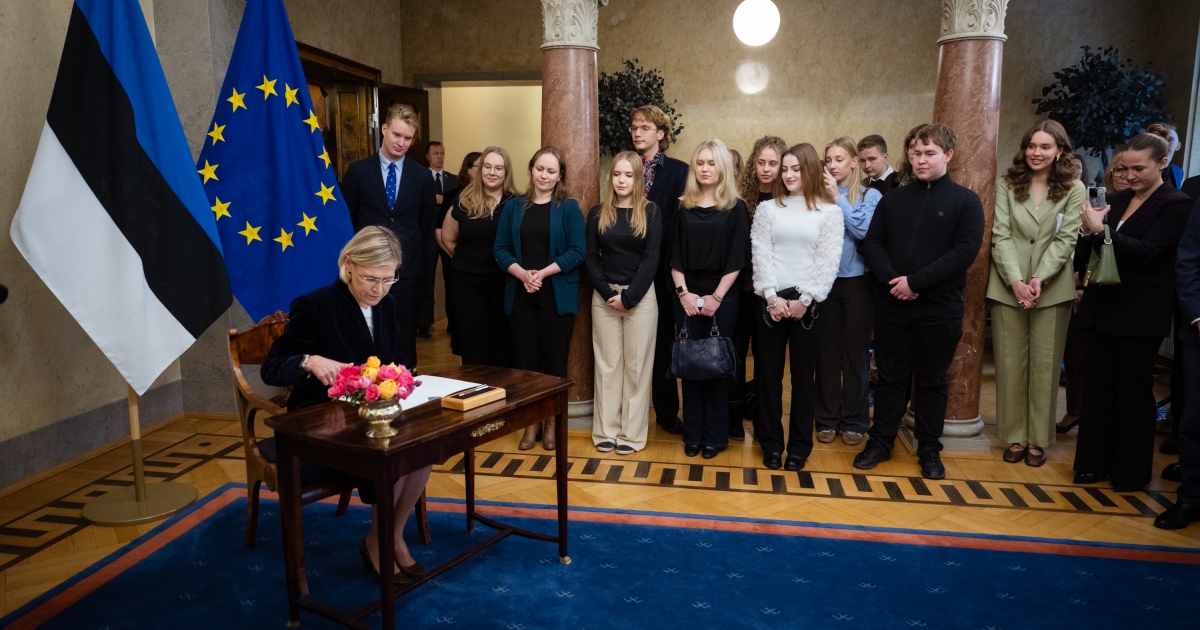
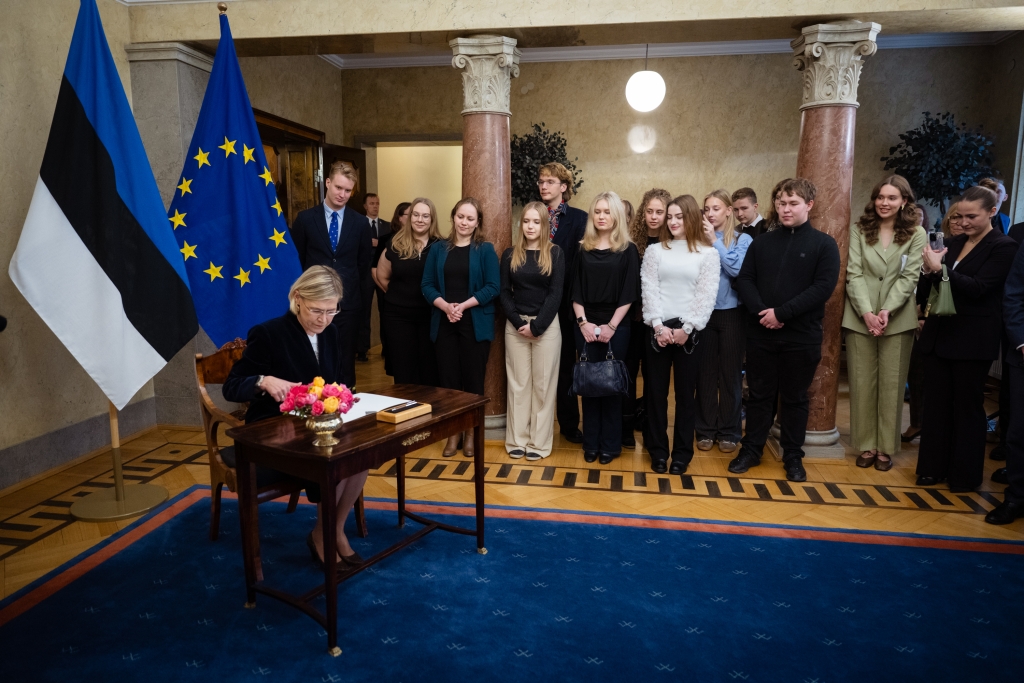
The head of state said she was delighted that younger people would now be able to more broadly exercise their civic rights and fulfil their civic duties. “Go about your day guided by your own worldview and sense of justice, just as we all do,” she advised, “but don’t let others tell you nothing more than what you shouldn’t like. Instead, insist on solutions being found to problems, and let’s all discuss them together.”
President Madise noted that in Austria, for example, the voting age was lowered to 16 in all elections as early as 2007, with research since then indicating that young people are participating in elections just as actively as other citizens. “The right to vote and the civic responsibility that comes with it don’t interfere with schoolwork or otherwise stop young people from living their lives,” she added.
The head of state is committed to ensuring that the voices of youngsters are amplified and that they are granted freedom for which the accompanying responsibility is a natural part of life. “This is how young people grow into active, dependable citizens,” she said, noting that young people in Estonia who have received a world-class education have shown that they deserve the opportunity to have a say in elections.
Speaking at the special event held to sign the act into law were Henry Kask, the Vice-Chairman of the Board of the Estonian National Youth Council (ENYC), and Maria Rannaväli, who has risen to prominence on social media for her comments on political issues. In his address, Kask pointed out that 16- and 17-year-olds have been more active in local government elections than those in the 18-35 age group. For her part, Rannaväli noted that the knowledge being imparted in primary education today was, until relatively recently, material that was only taught at university level.
Also speaking at the event was Enn Eesmaa, the oldest ever member of the Riigikogu, bringing an intergenerational dimension to the occasion. Other attendees included not only members of the ENYC, but also representatives of the Estonian School Student Councils’ Union and the Federation of Estonian Student Unions.
The head of state expressed her view that the Riigikogu should seriously consider allowing Estonian citizens to also vote in Riigikogu elections and referendums from the age of 16. The principle of universal suffrage, she said, means that as many citizens as possible should be invited to decide on the future of their nation. “Every member of our society and every citizen can, in one way or another, play a part in shaping public life and, from a reasonable age, also vote and stand in elections,” she remarked.
President Madise added that the state has a duty to provide voting methods that take into account the lifestyles of those eligible to vote. In this respect, she added, Estonia has every reason to be satisfied. “Countries where online voting isn’t available to everyone due to a lack of standardised and mandatory remote identification and digital signature systems have had to allow postal voting or a lengthy advance-voting period in the interests of upholding the principle of universal suffrage,” she explained. “It goes without saying that we must continue to organise elections with the utmost precision and fairness. Testing, observing and auditing are designed for that very purpose.”
Looking ahead to the Riigikogu elections, the head of state urged everyone to treat the right to vote as both an opportunity and a duty. “Make it clear who is standing for election and what values and interests they represent and promote,” she urged, recommending the use of election compasses. “You, too, should approach your civic duty as it ought to be carried out. School, family, work, friends, hobbies – all of these are a part of life, just like our duties as citizens.”
In Austria, Belgium, Germany and Malta, the right to vote was extended to 16-year-olds in the 2024 European Parliament elections, while the voting age in Greece is 17.
Gallery (Raigo Pajula/Office of the President)