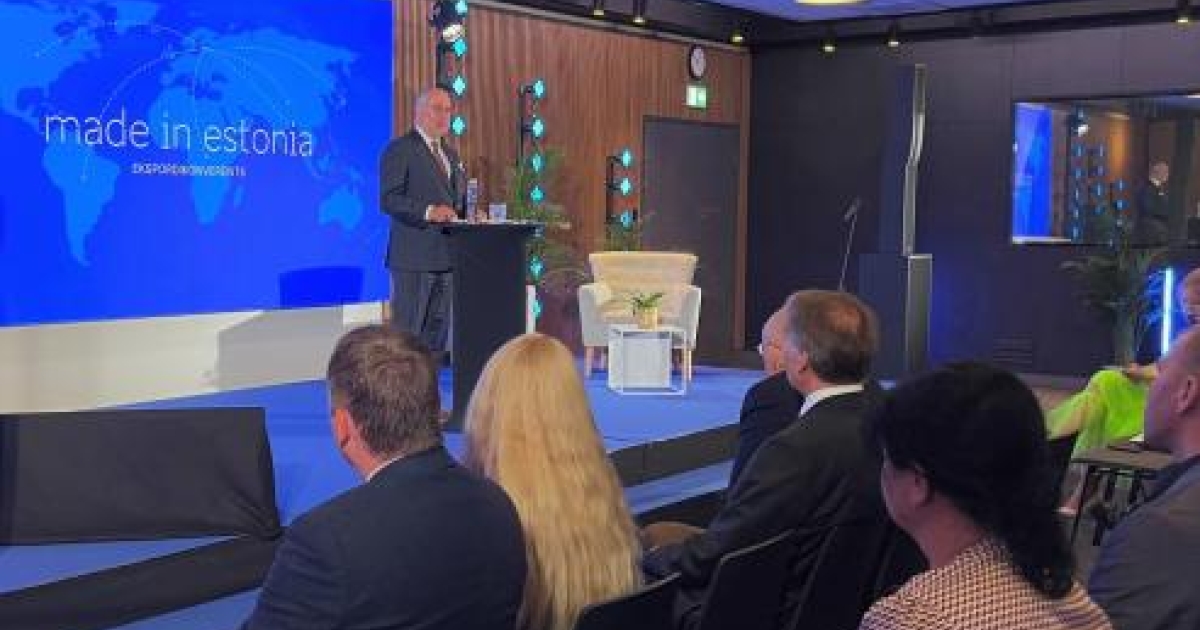
In recent months I have spoken a great deal about Ukraine, the war and its horrors. Today I would like to start by taking a more optimistic tack and talking about opportunities. For something good to happen, we must first believe that it is possible. Only that way will we be prepared to invest in it and do everything we can to make it work. Worrying has never made a success of anyone. Economic development requires a healthy dose of optimism.
Estonia is a small country and exports are important to us: they diversify our economy
and allow companies to grow larger than a modestly sized market otherwise allows. Our digital sector has come in for a lot of attention of late, as its exports are rising rapidly,
but a great deal of what we export is still linked to industry.
Questionnaires have shown that in the last few months, industrial companies whose directors are convinced their output will grow in the short term have played a much more important role than those who are certain it will drop off. Exports and the flexibility of entrepreneurs in finding new markets are what have led to new success stories in the midst of crises.
When I met with a variety of entrepreneurs in late February and early March, any talk of future development was rather muted. World events were rattling them. Since then,
my conversations with entrepreneurs have taken on a more optimistic tone. The forecasts drawn up in March saw Estonia falling into recession this year,
but more recent predictions are signalling growth. What sets entrepreneurs apart from many other people is that where they see problems, you see challenges which you then turn into business opportunities. That is enormously inspiring.
The biggest challenge we, and indeed the rest of Europe, will face in the near future is the spiralling cost of commodities and the worsening supply situation. This will be difficult for all of us, and yet those who are flexible and capable of quickly reorienting themselves to new supply chains and fuel sources will emerge the victors. I have heard stories about production companies swapping out gas for locally sourced fuels, and I hope that the obstacles and misunderstandings that have arisen with state agencies are overcome and resolved.
The state has a very important role to play in the economy at the moment in ensuring a viable frame of reference and connections. Not everything can be supported via the national budget, but the state can contribute to the functioning of the energy market, support the retraining of the unemployed and their being put to good use in branches of the economy currently experiencing labour shortages, and help companies find new markets when those to the east of us are closed off.
Indeed, we have been in much the same situation before: think back 23 years to when the loss of the Russian market forced Estonian companies to shift their focus westwards.
At the time we were much more closely tied to Russia than we are today, and yet our companies managed to reorient so quickly that all told, the economic downturn in 1999 was much smaller than expected – indeed, quite a few financial indicators, such as profits, even improved.
The current geopolitical situation has prompted many people, primarily outside of Estonia, to recall that we share a border with Russia. In so saying, it pays to remember that in economic terms we are much closer to the Nordic countries and Western Europe than we are to our neighbour to the east. Estonian companies’ business ties and exports anchor us firmly in Europe.
Our economic institutions are among the freest in the world, alongside the likes of Ireland and the Netherlands. Our most important export markets are Finland and Sweden, although the United States and Germany are not far behind them. Even our per-capita GDP is closer to that of France than it is to that of Russia.
We are in the same – luckily very sturdy – boat as countries facing similar challenges. We are members of NATO, the European Union and the OECD. Changes to supply chains do not solely affect us, but many European companies who are also looking for new partners. The situation at present also opens up new opportunities to businesses in Estonia. No doubt we ourselves produce goods whose availability elsewhere in Europe has worsened, meaning we are the ones who can alleviate that problem for others.
Not only has the rapid rise in the price of commodities over the last 12 months raised input prices, but the output of many companies has grown in demand and value on the world market. Uncertainty has shaken markets up, giving many companies the opportunity to increase their market share.
Besides the war taking place on European soil, we must not forget the long-term challenges facing the export sector.
The main problem for growing companies is how small our country is and its demographics. We have known for quite some time now that on average, almost 6000 fewer people are joining the Estonian labour market each year than are exiting it. We have to make up for that shortfall in numbers with higher quality: better education and flexible labour market rules. A higher proportion of well-educated specialists among young people will facilitate automation and greater productivity, meaning more can be done with fewer people.
One potential workaround for the smallness of our country and its labour shortages is to expand beyond its borders. Much has been said about foreign investment as regards incoming investments, but working your way upwards in the value chain and achieving a certain financial strength enables companies to expand their production to countries where, unlike in Estonia, there is sufficient available labour.
In terms of our economic development, we are currently at much the same level as Finland was in the 1990s, when they started expanding into Estonia.
Now it is our turn. Our companies’ knowledge of the European market could open doors here to countries with less experience of euro-requirements. Rebuilding Ukraine after the war need not be limited to providing ordinary forms of assistance either: establishing companies in the country would make it easier for them to enter the European market and also offer Estonian companies the chance to expand their operations.
Companies that are going international are Estonia’s calling card abroad. Mention to people in other countries that you are from Estonia and big up the enterprise environment that has helped you grow internationally!
Estonia is known the world over as a digital state, and we are exporting more and more digital services all the time. This is our economic success story. However, there are still many areas which digital success has yet to reach. The digital intensity of more than half of the companies in the Estonian processing industry remains very low. This must be improved if they are to remain competitive.
In the longer term, Estonia needs greater integration between its rapidly growing digital and start-up sectors and its industry. Our digital success is raising salaries and making the management of traditional industrial companies more complicated. In the past, similar developments led to the relocation of production to poorer countries. And yet greater synergy between the start-up sector and production companies could give both fields an advantage.
There are examples of successful cooperation between the new economy and the industrial sector in Estonia, but forgive me for not listing them lest I leave anyone out. Hopefully we will see more such examples in the future.
I would also like to talk very briefly about the green transition. At a time when the rising cost of gas has made electricity generated from oil shale very competitive and the state has increased felling in order to meet timber needs, it may seem as though the green transition has been shelved. On the contrary: the high cost of energy of late demonstrates the continued need for the transition and for energy independence from Russia. I would, however, like to mention that the green transition means more than just nice views and solar panels and wind turbines: it means major changes to the economy; it increases the need for new materials and production; and it creates a lot of opportunities for Estonian exporters as well, be they in the chemicals industry or IT firms offering digital solutions.
In summary, I wish you all a productive day’s debating and hope you get the chance to discuss not only pressing issues related to Russia, rising prices and broken supply chains, but also the long-term prospects and development opportunities of the export sector.
Enjoy the conference!