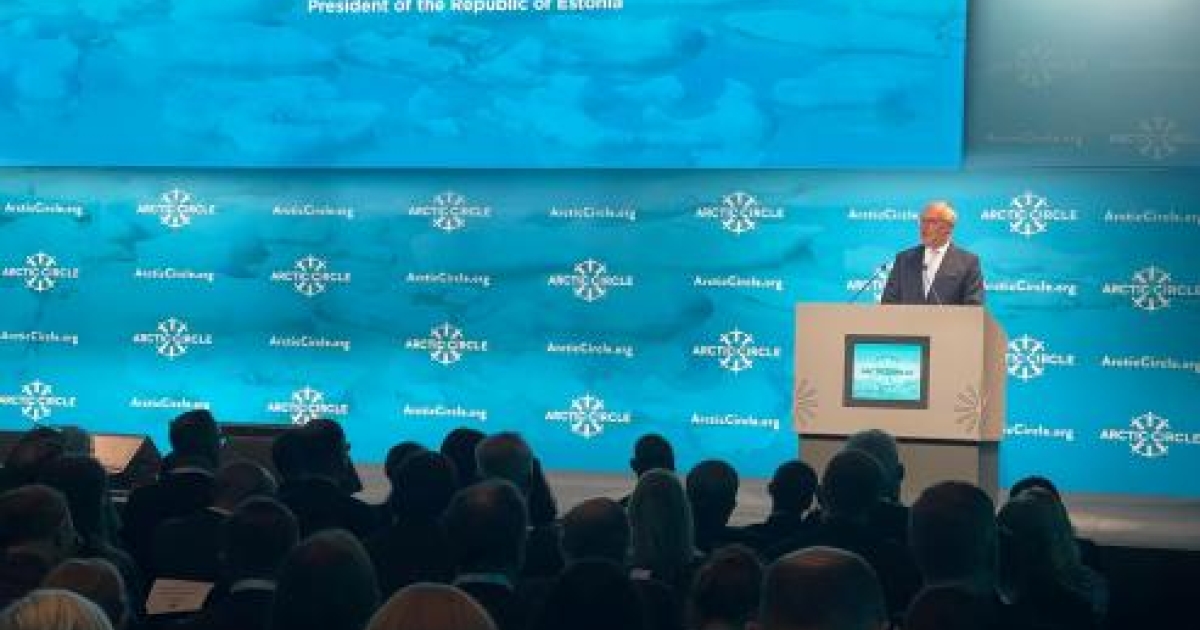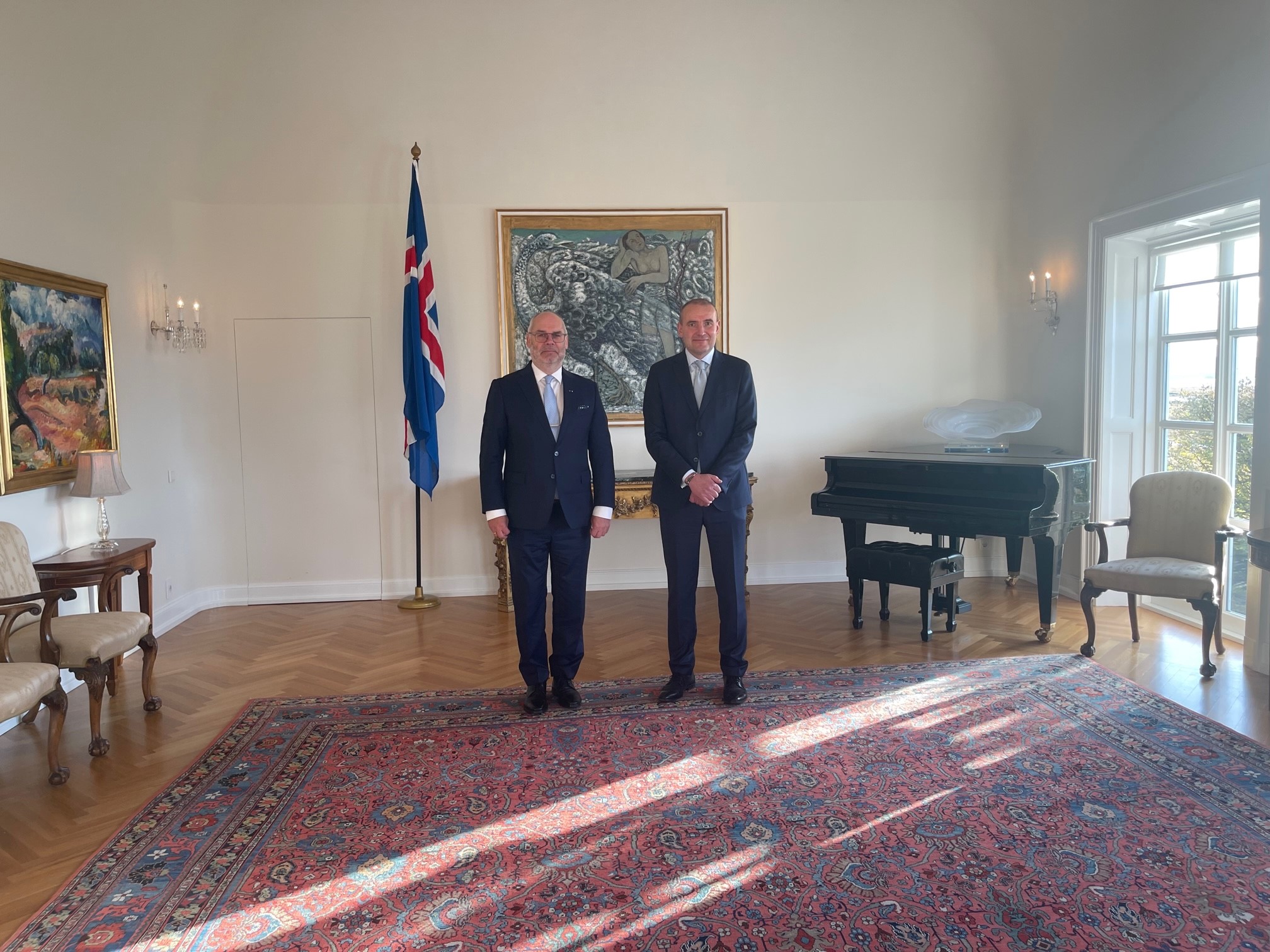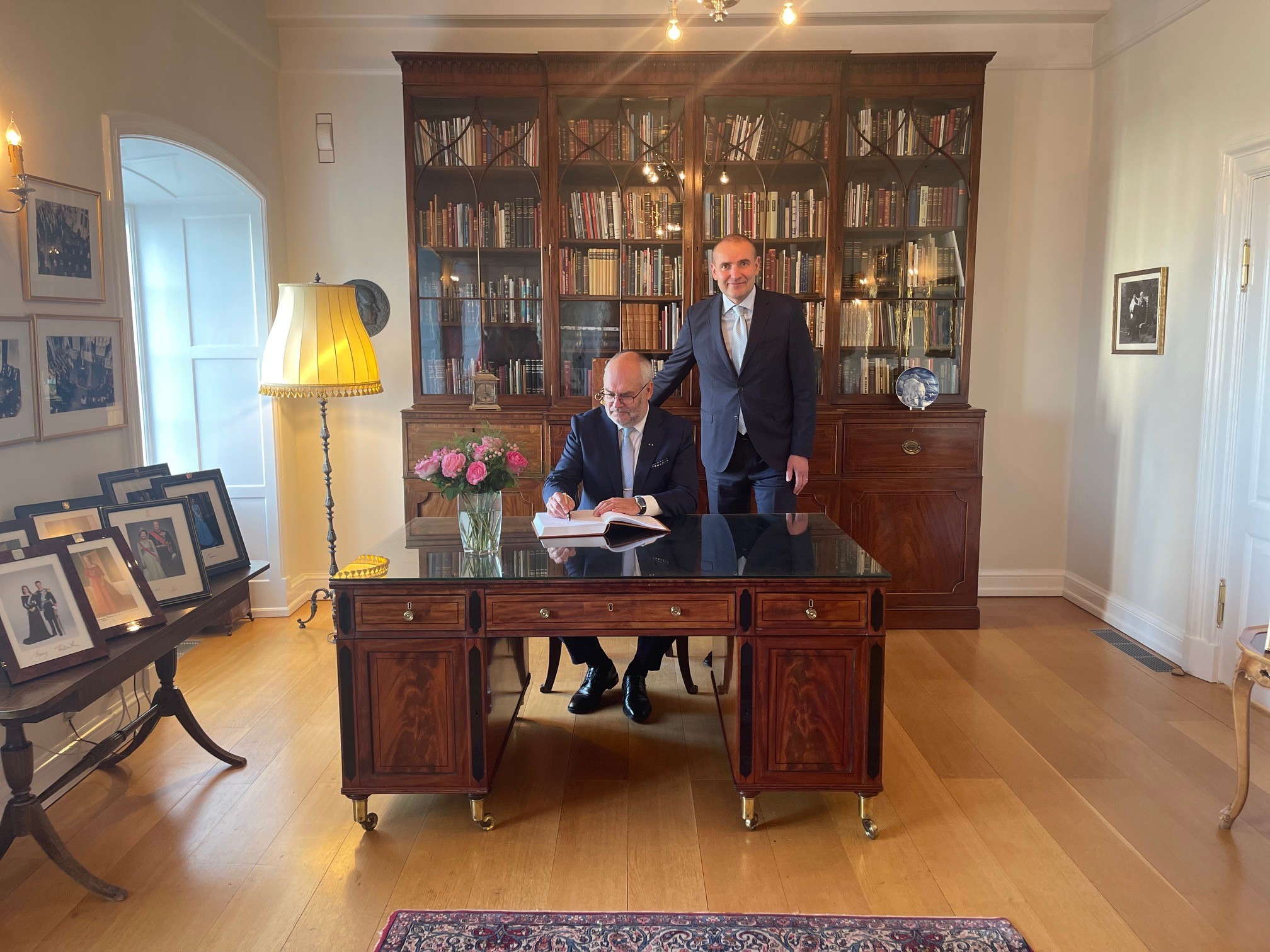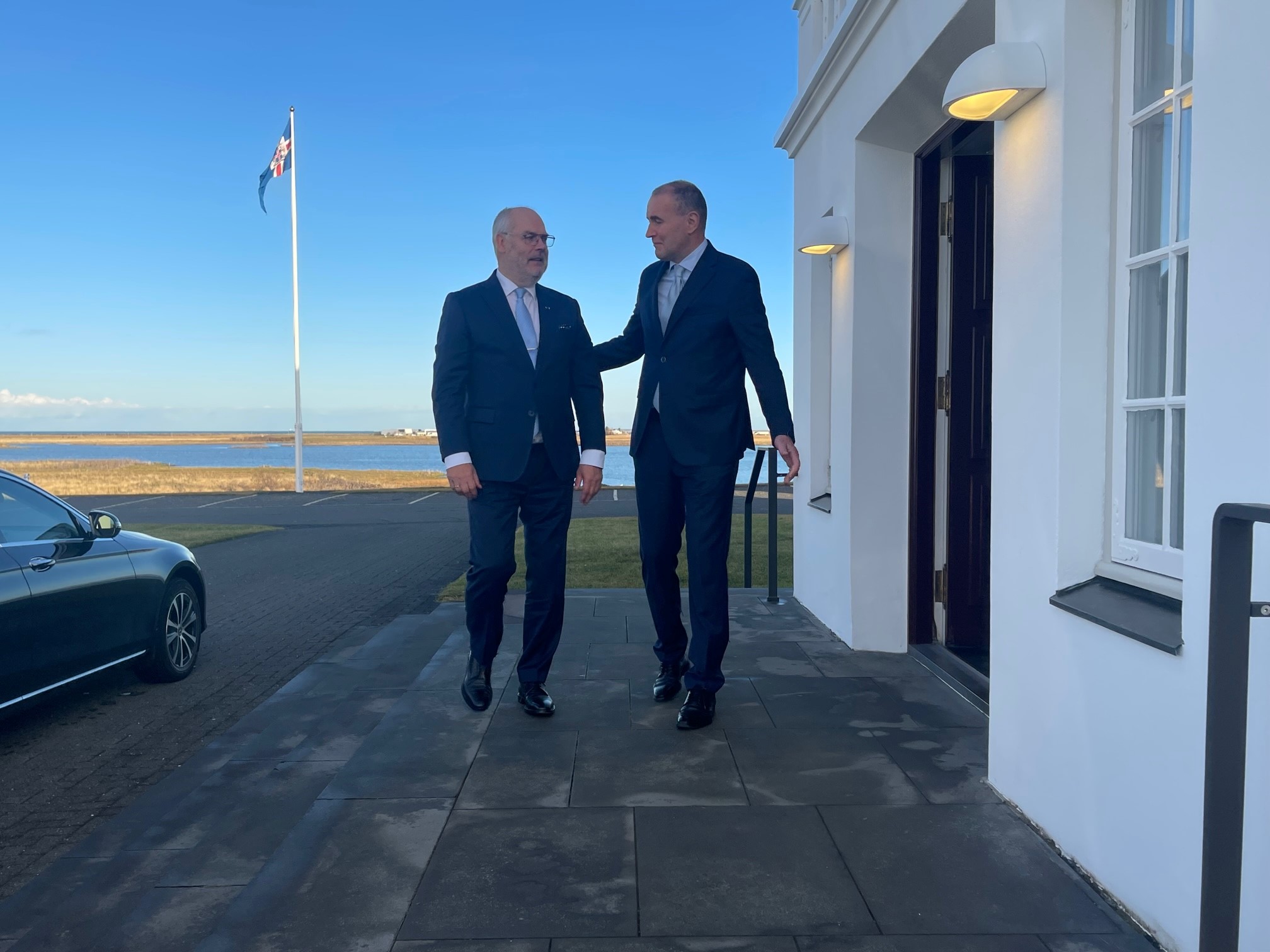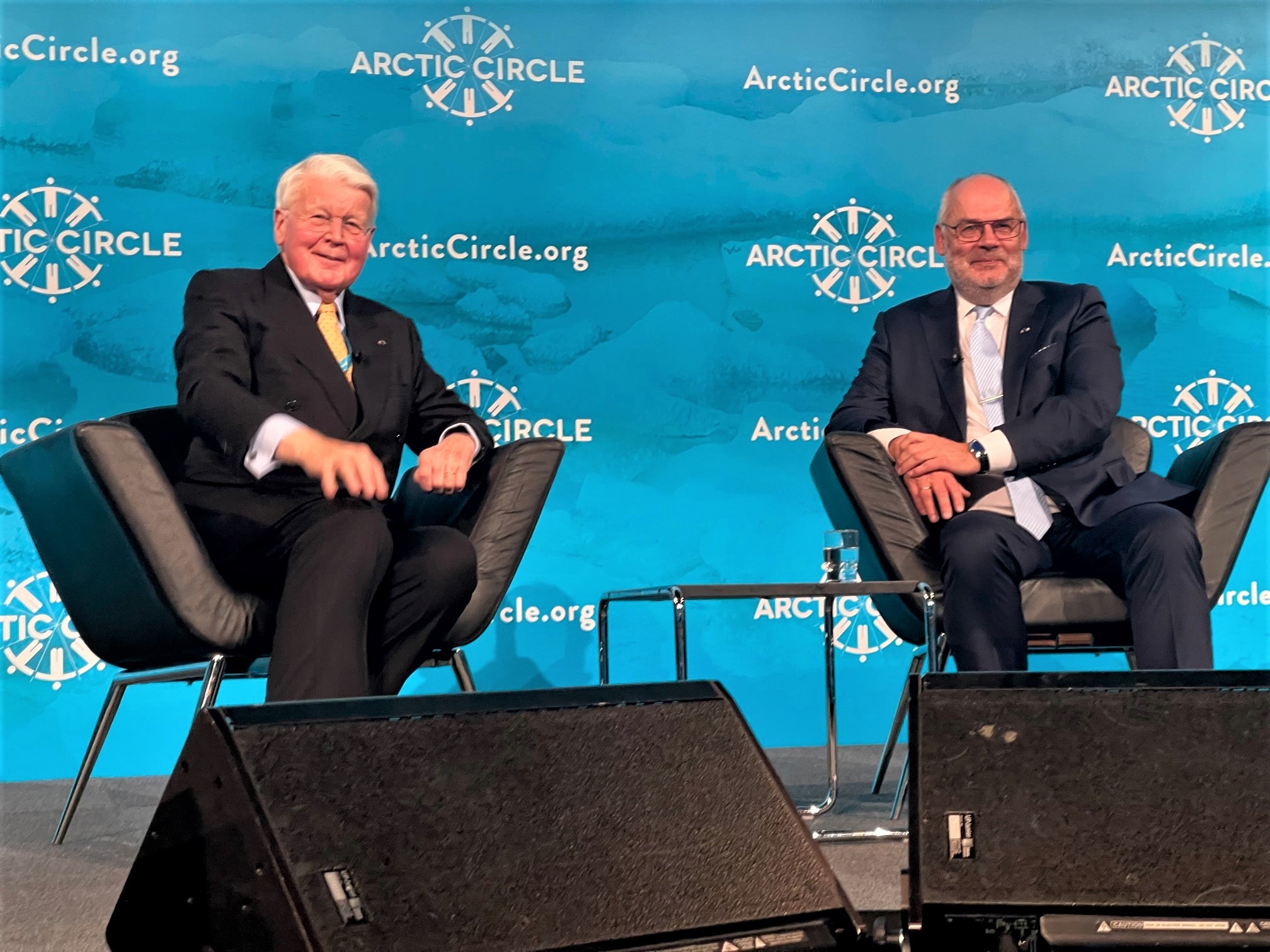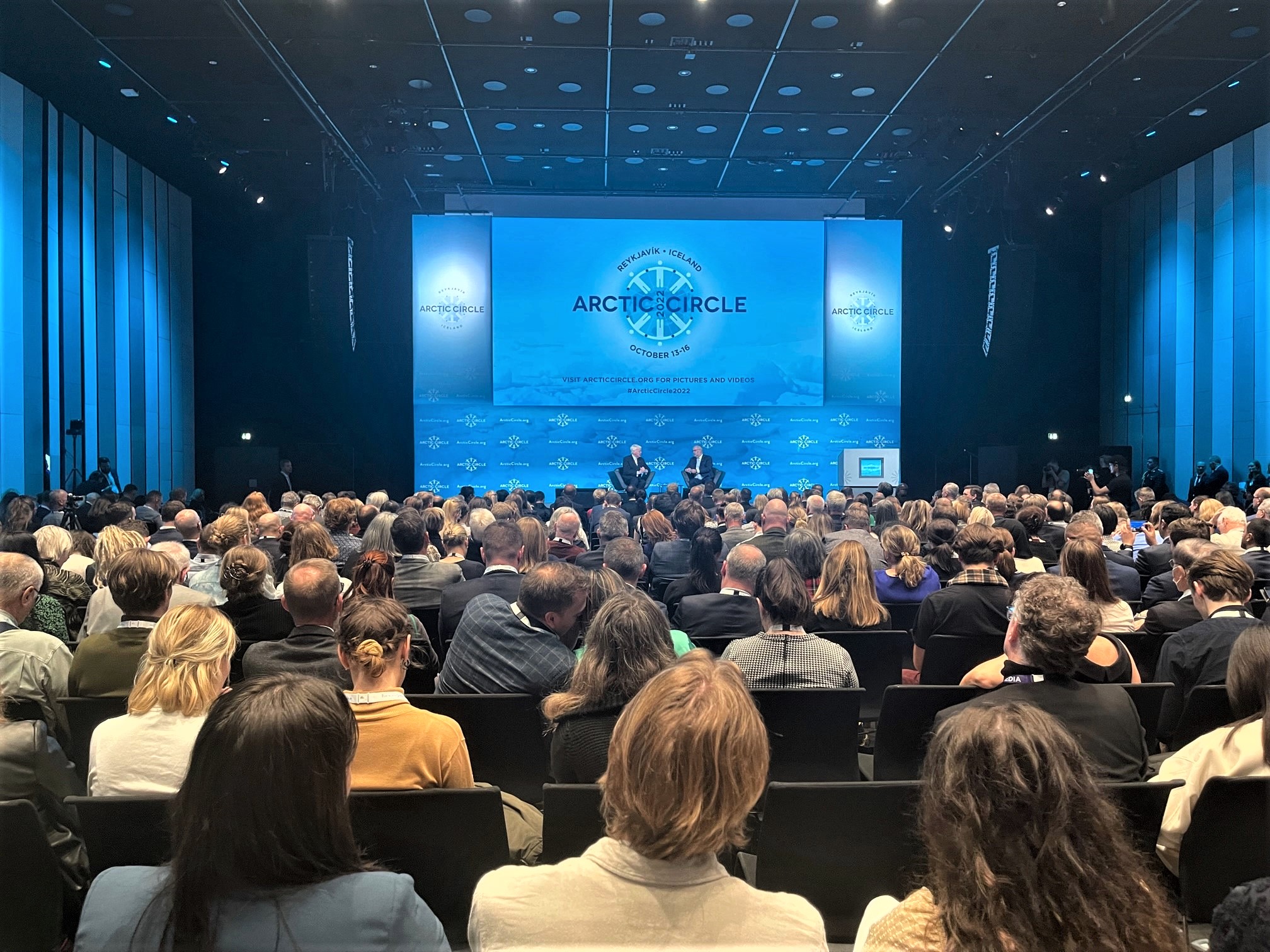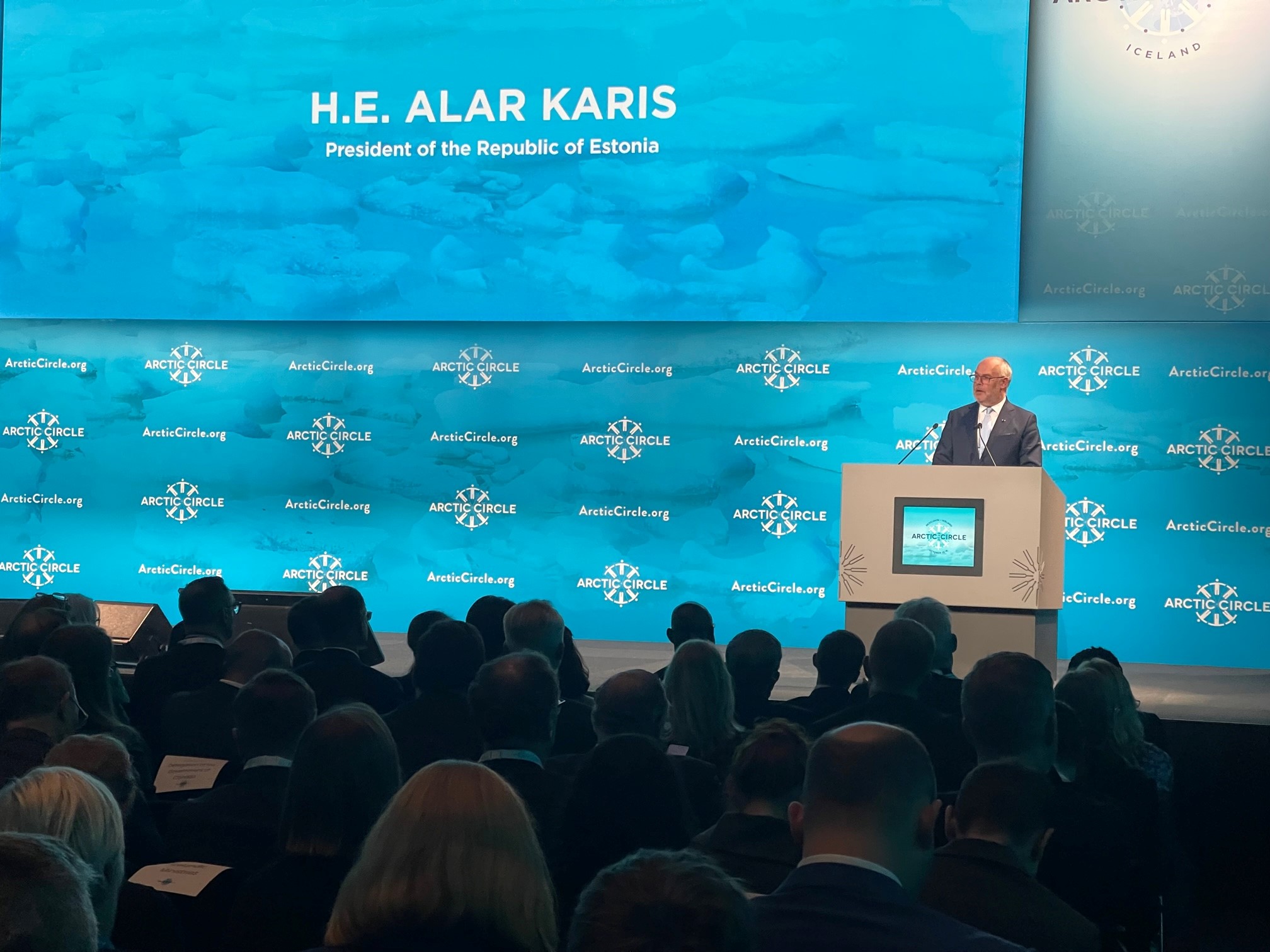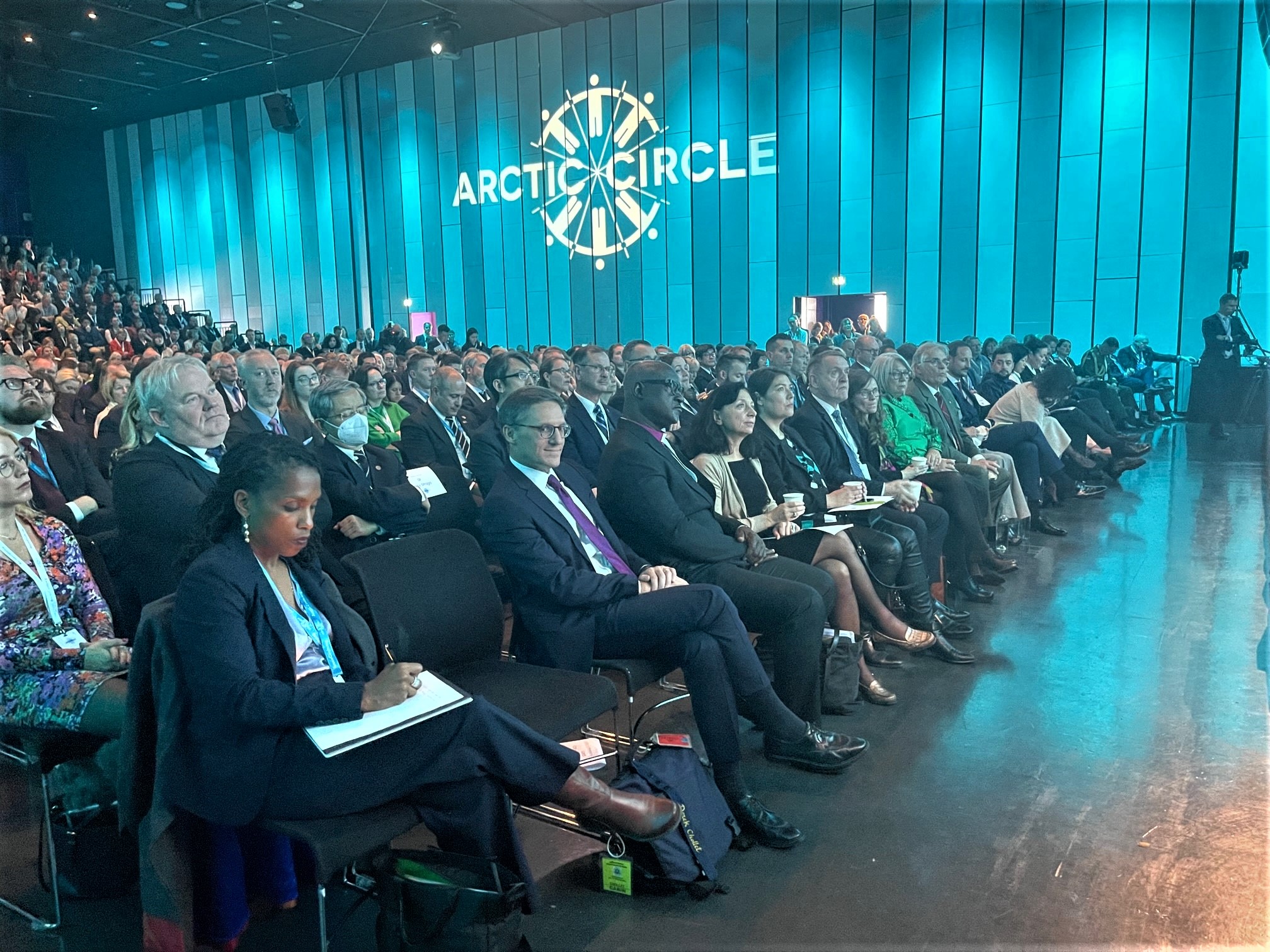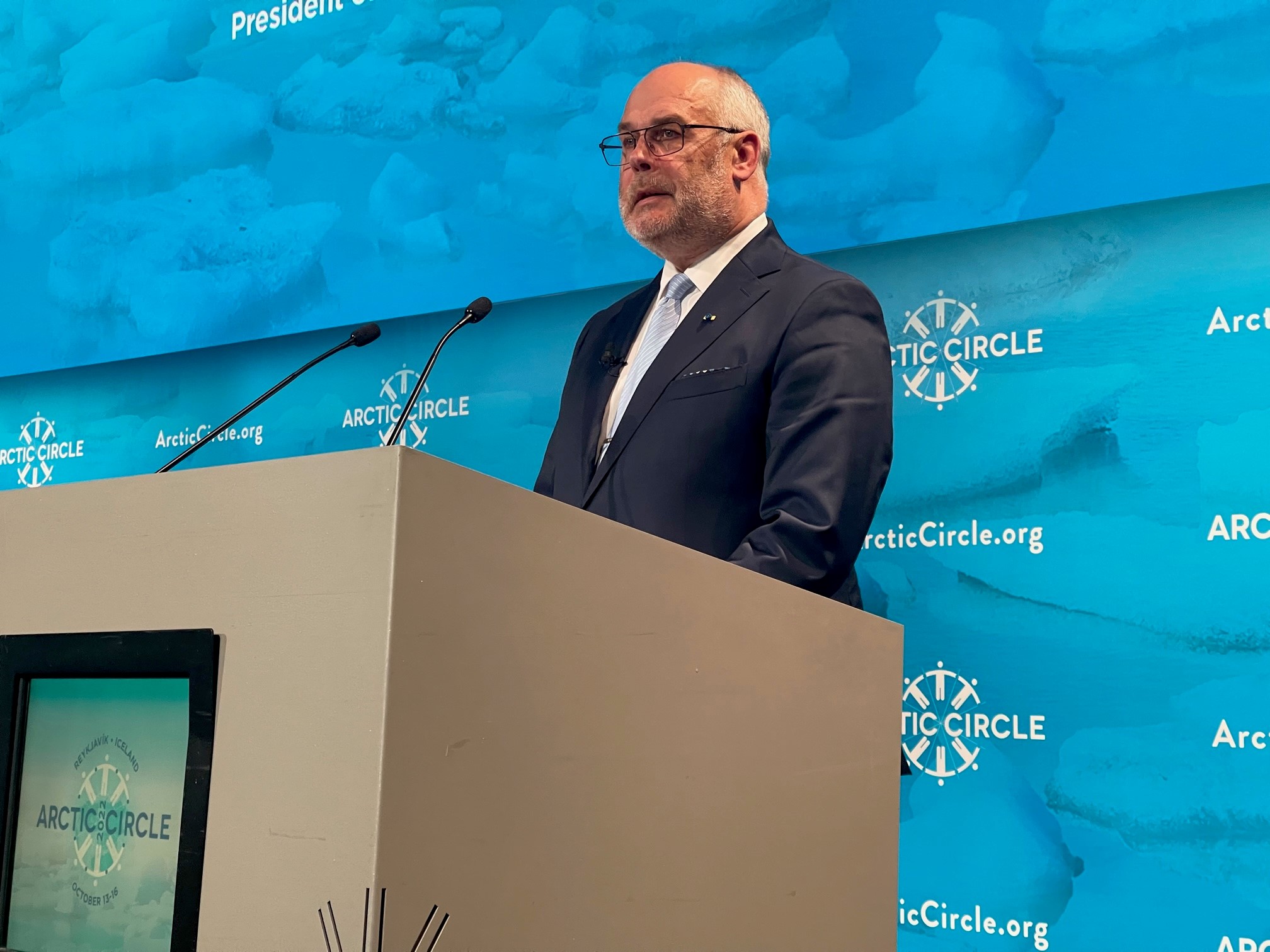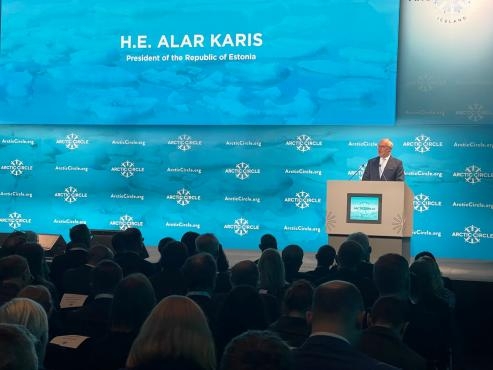
I am deeply honoured to address the Arctic Circle Assembly. The central gathering for Arctic dialogue. It is always a pleasure to be in Iceland. Estonians feel a special bond with Iceland, due to well-known historical reasons that we celebrated here just this August. Iceland clearly punches above its weight and Estonia tries to follow the example.
As an Arctic country with a very special location, Iceland has made the Arctic expertise its national brand. Iceland cares, worries and seeks solutions for the future of this vulnerable region. Second, Iceland understands that fostering dialogue and international cooperation are key in maintaining the Arctic as a peaceful and sustainable polar region. Well done.
I know that it is hard to surprise this crowd with the acknowledgment that climate change is already in full swing and we are witnessing potentially irreversible changes. The environment and ecosystems of the Arctic region are affected more severely than any other region in the world and this is putting an enormous strain on the Arctic communities. What happens here - melting of glaciers, receding sea ice or changing pattern of winds and ocean streams - also amplifies the changes in the rest of the world. Catastrophic drought in East Africa, record low water levels in Europe, apocalyptic floods in Pakistan and rain in Greenland, to name a few, should really bring home the understanding that climate change is escalating rapidly.
I would like to touch upon three important aspects regarding the Arctic and the relevant actors who are involved. First, the human security concerning the future of humankind and why it is important to not question the goals of COP26. Secondly, what Estonia offers to the Arctic region. Last but not least, the hard security – how the Russia’s war of aggression in Ukraine is affecting the Arctic.
Ladies and Gentlemen,
We must save the Arctic as much as we can. It is important to gather more knowledge about the changes undergoing in the Arctic and their impact. Then we can deal with the causes and not the endless consequences that the changes are bringing to the global community.
When we talk about changes, then the local effort is not sufficient to halt the pace of climate change. We all know that and it seems that especially our new generations knows it, that we need a global effort to reduce greenhouse gas emissions, halt biodiversity loss and stop polluting our oceans and rivers.
Therefore, the era of fossil fuels must give way to the era of sustainability within planetary boundaries. Estonian government has decisively bought forward the climate goals of producing electricity 100% of renewables. The whole world needs to step up and increase, not reduce, climate ambition. Only by taking bold steps, the Arctic will benefit and we reduce the effect of endless negative consequences for all of us, starting from the loss of biodiversity ending with the mass migration and hunger.
What Estonia can offer to the Arctic? Building on our rich polar history, dozens of Estonian scientists have done research in the Arctic to study the history, causes and impacts of climate change. The Norwegian archipelago of Svalbard in particular has been a frequent destination for our scientists. While the number of our specialized polar scientists is not comparable to those of key Arctic players, much of our research can be applicable to the Arctic. We will speak about it in more detail tomorrow in a special panel we have organised for this occasion.
Estonia is perfectly suited to contribute to the Arctic sustainable development during a period of profound changes, as we are living example of a country in transition. Arctic countries aside, Estonia is the country with the northernmost capital below the Arctic Circle. We are directly affected by developments in the Arctic. Hence, we want to and need to contribute to the sustainable development of the region. The Arctic is close to us geographically, historically, linguistically, climate-wise and for scientific reasons. We remember proudly famous 19th century Arctic explorers like Krusenstern, Bellingshausen, Middendorf, Wrangell, Kotzebue, von Toll and others who all came from Estonia.
Technological innovation is also a key enabler for scientists in the harsh conditions of the Arctic. A good example is the R&D on ocean monitoring technology taking place in Tallinn Technical University. Together with the Estonian Environmental Agency they have developed and implemented a sea ice monitoring service in Estonia called Ice Chart (Jääkaart). The service is based on Earth Observation data from Sentinel missions and Copernicus programme as well as on citizen science observational data. This service, developed at the national level, is transferrable to other states who deal with seasonal sea and lake ice coverage, and to the member states of the Arctic Council in a global scale.
We firmly believe that all indigenous communities should have a strong voice in discussing the future of the Arctic and we wish to represent that voice. For us this region is not about economic gain or geopolitics, it is in our heart and I guess it is safe to say that the Arctic is in our DNA. Finno-Ugric roots unite Estonia with the indigenous peoples of the Siberian Arctic. We have dedicated ourselves for many decades to extensive research of their language, culture and societies. Not least because their traditional knowledge has great value in finding solutions for the Arctic challenges. We have done extensive research to preserve the roots of Finno-Ugric people. For decades, Estonian ethnographers, linguists and folklorists have studied the indigenous people of the Russian Arctic. The University of Tartu has also been pioneering in the field of genetic studies and personal medicine. The largest genetic database of Siberian peoples is stored in Estonia.
It is also important to keep in touch with one’s relatives. Estonia has been continuously supporting the indigenous peoples of the world through the UN structures and we are a strong supporter of the World Congress of the Finno-Ugric Peoples. Since 1999, we also have a state program to support the languages and cultures of the Finno-Ugric and Samoyed indigenous peoples.
We believe that Estonia’s public and private sector solutions can contribute to addressing the specifics of the Arctic. Reaching out to people who live in remote areas is after all the essence of Estonian digital society. We can engage Arctic communities through specific projects in either online learning, e-health or to enable better participation in decision-making processes through digital means. Digitalisation can have a role to play in preserving indigenous cultures and languages by creating native language solutions and electronic archives – something we have successfully implemented in Estonia.
Excellences, ladies and gentlemen,
My final thoughts will be on the Russia’s war of aggression and how it impacts the Arctic region. We believe that it is in everyone´s interest to maintain the Arctic as a low-tension area where international law is upheld and peaceful scientific interests prevail. Unfortunately, we witness that the situation is changing and we must be prepared for unexpected developments, recent destructive sabotage of the Nord Stream is a proof of that. Geopolitics in the Arctic is changing and we have one clearly aggressive actor in the region. Therefore, we must not only think of climate and environment when we talk about the region but also diplomacy and deterrence.
Russia´s military interest to protect its ability to operate in the North Atlantic and the European Arctic has grown. Russia wants to protect maintaining total control of the transport corridor on its long northern coast and the hydrocarbons that lay in the seabed off the coast. Russia has overwhelming military presence in the region. For this reason alone, NATO needs to pay attention and stay vigilant.
At a time when international cooperation is most needed, international law and norms are under a brutal assault by a country that happens to be the Chair of the Arctic Council. Russia started a war of aggression with a goal to end the sovereignty of its neighbour, overthrow its legitimate government, exterminate Ukrainian nation, and implement its abusive order impregnated of imperialism, self-interest and dominance. It is effectively holding the United Nations’ Security Council hostage, showing that its commitment to international norms and treaties has always been only lip service, nothing more. When the foundations of peaceful co-existence that allow small states to exist without fear of subjugation are being shattered – it is the duty of small states to speak out and resist. There is no other way. Fortunately, this is also the position of the overwhelming majority of the international community.
In this light, the principled decision by the seven Arctic states to suspend cooperation with Russia in the Arctic Council was inevitable. With its senseless war, Russia has struck an unprecedented blow at regional cooperation both at the shores of my homeland as well as up in the North. Can we trust the largest Arctic state to continue respecting the underlying tenets of Arctic governance if it so brutally violates the same principles about 3000 km to the south? Namely, the sovereign rights of Arctic states, their rules-based intergovernmental cooperation and the primacy of international law.
For me, the extensive maritime claims in the Arctic, statements like „the Arctic is ours“ and attempts to monopolize the Northern Sea Route sound a lot like signs of the same ideology we witness in Ukraine. These are the words to claim dominance, expansion, control. These words only show disrespect towards agreed principles.
The current Russian regime does not seem to prioritize the protection of Arctic environment. We rather see overexploiting Arctic territories to advance its economic interests at the expense of the environment and indigenous peoples. Russia is staking everything on fossil fuels even as it is consumed by ever larger forest fires and the large-scale melting of permafrost.
Not surprisingly, in the Arctic the consequences of Russia’s aggression have hit the hardest scientists, activists and indigenous peoples whose work depends on cross-border access. The NGO-s that so need international cooperation are being harassed and threatened with the label of foreign agent or worse, environmental activists are frequently sent to jail.
The democratic community must rethink its relationship with Russia. We cannot go back to the day before the war and continue as if nothing has changed. Everything has changed. And this change must be reflected in our future cooperation with Russia. Russia has alienated itself from international norms and agreed terms. I’m looking forward to the discussions here at the Arctic Circle Assembly especially with the Arctic Seven on how to work for the sustainable development of the Arctic in the conditions where the biggest Arctic state is also the most destructive.
Ladies and Gentlemen,
Respecting the privileged position of Arctic States, Estonia strongly believes that Arctic cooperation is about inclusivity and diversity – only this way can we reach good solutions that resonate globally.
Thank you!