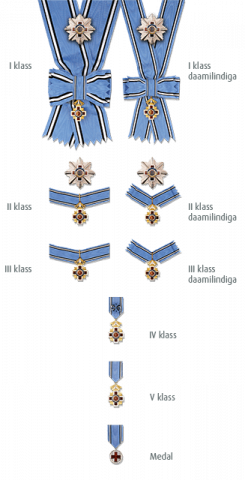
The Order of the Estonian Red Cross
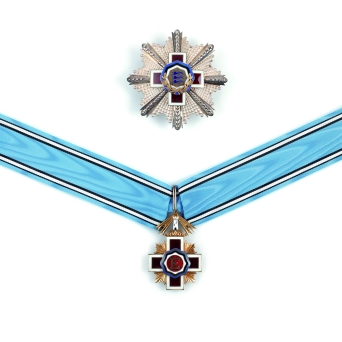
The decoration is awarded once a year. The decision to confer the award is signed by the President of Estonia in early February, and the decorations are traditionally presented on the eve of Estonia's Independence Day.
In exceptional cases, the decoration may also be awarded at another time. It may also be awarded posthumously.
In 1926, the Board of the Estonian Red Cross (ERC) submitted a proposal to the government to grant the commemorative badge the status of a general civil decoration. The proposal was accepted, and in the same year a new statute for the badge was approved, granting it the status of a civil decoration.
The decoration was divided into five classes:
- Class I, Grade 1 (I/1) – a cross worn on a broad sash over the right shoulder, with a star on the left breast;
- Class I, Grade 2 (I/2) – a star worn on the left side of the chest;
- Class II, Grade 1 (II/1) – a cross worn on a ribbon around the neck;
- Class II, Grade 2 (II/2) – a cross worn on a ribbon on the left side of the chest;
- Class III – a medal worn on a ribbon on the left side of the chest.
The original 1921 commemorative badge was considered equivalent to the Class III decoration under the reformed award system.