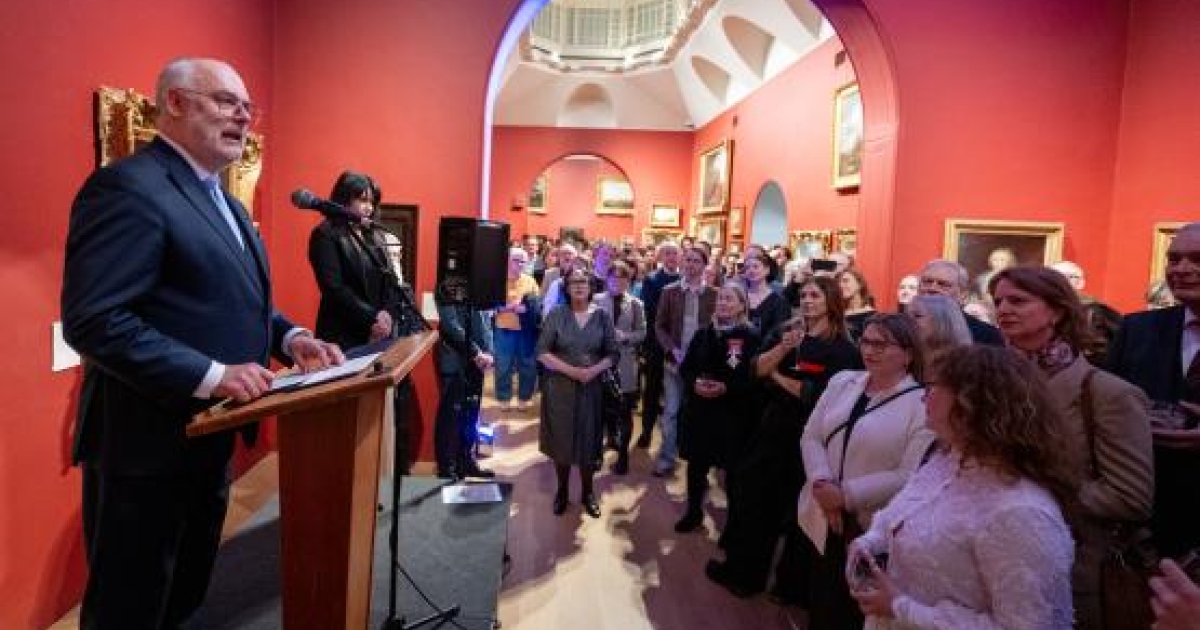
It is a great pleasure to see the work of the outstanding Estonian artist Konrad Mägi reach London, particularly a gallery as distinguished as Dulwich. For art and culture live and develop not just through the sensitive introspection of the creator, but also through encounters with other cultures.
Konrad Mägi is an excellent example of how such encounters shape artistic expression. More than a century ago, Mägi travelled around Europe, remarkably extensively for his time, experiencing impulses that many of his contemporaries did not.
In addition to paintings inspired by specific regions, he engaged with diverse cultures, as well as contemporary art elsewhere in Europe, distilling those experiences into a distinctive and highly personal artistic language.
Today, in music, art and theatre alike, there is an active search for creators who stand to one side of, or in the shadow of, established canon. There is a growing desire to unearth previously unknown works by familiar names, and to discover those who yet remain unrecognised.
Konrad Mägi is certainly among those whose original and unique artistic language, bold use of colour and expressive sensibility are only now beginning to be fully appreciated and discovered – and who have much to add to the established canon of European art.
This exhibition provides the people of London with an excellent introduction to Mägi’s contribution, and the openness of Dulwich Picture Gallery to such discoveries makes it an ideal setting.
Konrad Mägi was always on the move – constantly evolving, reinventing himself, driven by a thirst for the unknown. In many ways, he would fit remarkably well into today’s world: a restless, searching global citizen, rich in feeling, who valued freedom, individuality and the passing-on of skills and knowledge to the next generation.
One might well imagine him as a strong liberal voice, and certainly someone with an opinion on artificial intelligence. Having lived through the First World War, he would no doubt feel deep concern and profound pain over Ukraine and worry for the unity of the free Western world.
We view Konrad Mägi’s work through the eyes of a contemporary audience – with our concerns, our doubts, our own restlessness – but also as free people who have encountered many cultures and seen much of the world.
This perspective is also reflected in the work created for this exhibition by Kristina Õllek: a dialogue between the present and the past. It is particularly symbolic that Mägi himself began his artistic path as a sculptor before,
somewhat by chance – thanks to his friend, the outstanding painter Nikolai Triik – finding his way to painting.
Chance still plays a role today. And the connections between past and present continue to offer us valuable lessons, in the history of art as much as in political history.
I would like to thank the exhibition’s curator, Kathleen Soriano, for her fresh and expansive perspective on Konrad Mägi’s work, as well as all of the partners involved in the exhibition, in both Estonia and the United Kingdom, and of course Dulwich Picture Gallery.
Let us continue to value encounters between cultures and the freedom for all of us to follow our chosen path.
I wish you all an inspiring discovery of Estonian art.