The Estonian state is more than 100 years old. However, since the Second World War Estonia has only been free for around 35 years. Before that, we lived through a period of occupations, experienced oppression and silencing, witnessed political bullying and double standards on freedom, and saw decisions made above our heads. Although times were tough, there are always lessons to be drawn, always something to learn. If not before, then certainly after those years, freedom became for Estonians the dearest thing to hold on to and protect. The UN Charter and its principles, and the multilateral framework deriving from, it has created an environment in which to secure and maintain this freedom.
An Uncertain Future
Geopolitics are back. We are not just hearing that from foreign policy analysts: we are seeing it unfold in the real world. Old conflicts have been unfrozen, new wars have emerged; the air is thick with tension around the world. The international system which was foreseen to handle these kinds of situations is not responding with adequate speed or vigour: the institutional framework is very often not up to the task, and people are watching with concern at what is happening with their lives. At the same time, power, coercion and exceptionalism are making a comeback in world affairs. It seems that a few dominant powers want to impose their might and right on others, while values and the finding of common ground have been put on hold. For small nations, of which Estonia is one, these signs are alarming, especially given our historical experience.
We have always been a keen supporter of multilateralism and seen great value in international institutions and the principles they follow. Commonly agreed and jointly followed rules provide certainty and predictability for our existence, decrease friction in international relations, create stability and reduce insecurity. This set-up should provide us (and all other nations) with the best environment and conditions for development and prosperity, and for the pursuit of happiness, as Thomas Jefferson put it in the Declaration of Independence. It should – but is it?
We have to recognise what is actually at stake: the world order. The order that was created in the aftermath of the world’s greatest bloodshed – the Second World War – with the aim of avoiding a repeat of such carnage and giving peace a better chance in the future. The cornerstones of that order were, and still are, international law and justice, friendly relations among states, respect for the self-determination of peoples, the promotion of human rights and fundamental freedoms, peaceful settlement of disputes, and the sovereign right to self-defence. To be honest, we no longer hear about those principles and such posturing as we used to. Maybe we take them too much for granted; maybe those fundamentals seem too obvious to us to recognize their decline. We have to return those principles to the forefront of our agenda, or we might one day wake up to the knowledge that freedom is gone.
The question is: how can we put the genie back in the bottle? What can we do to emerge from this situation with the shield, not on it? Where might this rolling snowball take us?
First Things First
First, Russia’s aggression in Ukraine must be stopped so that the perpetrator – and anyone else harbouring thoughts of aggression – will never repeat anything like it again. A number of attempts have been made to give Russia a way out of the situation it has put itself in, but it seems that Russia, despite everything it says, is unwilling to step back and alter its geopolitical ambitions. For Ukrainians, their independence is at stake, and they have shown the World that they are willing and able to fight for that. But not only: what is unravelling in Ukraine today is very much connected with European security and the world order. It is also Europe’s future that is at stake here. As such, our response should match the gravity of the challenge we face and keep us in the action for as long as it takes.
True, it is not simple. Russia’s resources are quite extensive, Russians who have been suppressed and brainwashed by their leaders are used to suffering, and other autocrats around the world are willing to support Russia’s war, including by sending their own troops to fight.
In the more than three years since the 24th of February 2022, Estonia and its allies have put together a comprehensive set of measures to force Russia back to within its own borders. The main pillars of those measures are sanctions on the Russian economy, the isolation of Russia diplomatically, and holding its leadership accountable for war crimes, including crimes against humanity and the crime of aggression. We have made a good effort in using Russia’s frozen assets to assist Ukraine, but we should do better in hampering the circumvention of sanctions and constraining Russia’s shadow fleet.
All that, combined with continued political support – and even more importantly continued military support - for Ukraine, will bring us to the only favourable outcome of the war: the defeat of Russian aggression. Our response requires stamina, patience and a concerted effort. Although there is a constant feeling that we are chasing the wind and that results are nowhere to be seen, we should be consistently motivated by considering what is actually at stake in Ukraine.
Estonians know from experience that Russia’s imperialist ambitions will not disappear. All of us in the democratic world have seen that imperialism is still there. It would be wise to keep in mind that it remains there for the foreseeable future. In order to keep Russia within its borders, including after the end of its aggression in Ukraine, we – Europeans – must be fully prepared for a long-term confrontation with Russia. In this regard, the collective and unanimous resolve of NATO at the Hague Summit to set the defence spending of its members at 5% of GDP was timely, needed and strategically prudent. The effect of this decision can be sustained only if member countries take visible steps in strengthening their military set-up, boosting industrial production capacity and enhancing their resilience. Otherwise, the positive impact of the decision will fade and the alliance’s defence and deterrence capacity will be unfit for the challenges we face.
The other pressing issue we face is the presence of US troops in Europe. The American military presence on our continent has served European security and deterrence diligently since the Cold War, and I am sure that its presence can still serve as the best deterrent against Russia in the future. This is why all of the countries in the Baltic Sea region fully support this continued presence politically, materially and militarily. The USA today shifting its attention to other theatres is, on the one hand, understandable, but these decisions should not be taken in a definitive, sudden or hasty manner. In any case, Estonia will continue to work closely with the US so as to jointly be militarily prepared for all contingencies on NATO’s eastern flank.
Nor should we forget Gaza and the decades-long conflict in the region, with all of its complexities and the war and violence that has recently been unleashed. It must be stressed that a chance should still be given for a two-state solution and settlement, while acknowledging that this will not be achievable if disproportionate force continues to be used. This conflict is having an impact on European stability, as well as on conflict resolution in Europe.
What about the United Nations?
The direction for European defence to take seems clear. But what do we do about the question that began this piece? How do we get multilateralism, the United Nations and its Charter back on track? How can it continue to inspire nations to work towards a stable and peaceful world? How do we put values and principles back in the driving seat? Prioritizing one’s own interests ultimately only leads to growing confrontation and a loss of common sense, even if you seem to be among the most powerful in the world. Undermining multilateralism will have the same result. Today’s developments raise concerns and anxiety among small states, which is to say the majority of countries in the world. These developments also weaken democracy and the significance of the rule of law globally.
First and foremost, we have to bring values, virtues and principles back into our political conversations, be it at the national, regional or global level. Without doing so, it will be very difficult for us to find common ground on the serious challenges we face. It should not be taken as lip-service: we must act accordingly, otherwise all our effort will be lost, and the UN will become an empty shell.
The UN reform process launched by the current Secretary General, Mr Guterres, is a right and timely step in that regard. We must listen and support him. The alternative is more power politics, greater injustice and inequality, uncontrolled and lawless technology, more totalitarianism and autocracy, less human dignity, less happiness and progress, less freedom for everyone. Reform is not needed for its own sake, but to boost the UN’s effectiveness, and to restore the faith of member countries that change for the better is possible. Reform efforts so far have included reviewing mandates, streamlining and reducing the organisational structure, and perhaps most importantly, improving output in terms of value for money. In order to secure the future, it is important to ensure that every dollar is well and purposefully spent to achieve the goals set out in the Charter.
It is necessary to review the balance of the resources distributed between the main pillars of engagement. It is understandable that the bulk goes to peace and security, as those expenditures promote stability. Without stability, it is difficult to advance development, human rights and international law and justice. But if those other elements become meaningless due to a lack of attention, then peace and security lose much of their meaning too. In that light, it is unreasonable, indeed pointless, that a mere 5% of the UN’s budget is allocated to the human rights pillar. The UN Charter is a whole; its parts are interconnected. If one suffers, then the others suffer too. An imbalance in the budget leads to a decrease in the efficiency of the entire organisation. I hope the reform efforts will also address this.
Reform of the Security Council – a Never-ending Story
However, the sharpest arrow in the reforms must be aimed at the Security Council. If we continue to walk in circles without true results, as we have grown used to in recent decades, the outcome of wider reforms will be meagre. At the centre of the reforms is the veto power of P5, especially in situations where one of the permanent members is directly part of a conflict. In those circumstances, the veto is paralyzing all efforts towards peace, and indeed dragging the conflict out and making fools of others. No wonder that faith in this kind of arrangement has declined and its credibility is being eroded.
Several ideas on how to reform the Security Council are floating around – ideas which are highly commendable and have the potential for positive change. To be honest, there have been some positive developments over the last 10 years in regard to reforms. However, the core problems – the principle of using vetoes and the composition of the Council – persist due to the opposition of the permanent members. This means that we, the others, have to counter this opposition and pull the P5 out of their self-imposed caves.
I am fully aware that this is easier said than done, but let me make some suggestions on how to proceed from here. Firstly, the General Assembly should assume a greater role in security issues, especially when deliberations in the Security Council are deadlocked by constant vetoing or the blocking of agendas. Although the Assembly does not have legally binding authority, it can keep the process in action, present the views and positions of the global community and send a clear message to the Council members that they are tasked by the Charter and member countries to rid the world of atrocities, not enflame them. In this respect, the Assembly has already become more active and visibly more involved; still, more vigour and determination are needed.
Secondly, small nations should bear in mind that they are in the majority in the UN. They simply have to make themselves more heard and seen, thereby increasing their influence and scaling up the price of their votes. This group includes countries from all regions of the world, whose views, interests and priorities are all too often different. This does not mean that it is impossible to take a common position on issues of great generality, which the principles actually are. To do this, we simply need to communicate and coordinate our activities more closely with one another, and let go of some existing group preferences.
For decades, there has been a group called the Forum of Small States (FOSS) that offers such an opportunity and would enable the voices of small countries to be better heard in the context of the UN. And why not, for example, give small countries a certain quota in the Security Council?
US has reviewed its contributions to the United Nations and policies on development cooperation. Regretfully, that leaves a very big hole in the budget, and with it an enormous impact on the entire operation. Without wishing to analyse the reasons behind this, it is clear that it is a step with a major, and not positive, impact on global development cooperation, and indeed on the entire world order. The European Union, which is still one of the largest financial contributors to the UN, but which itself is currently significantly increasing its defence spending, should find a way to at least partially fill the gap that has arisen in order to maintain its influence. Other democratic countries should also think about this. Otherwise, someone else will fill the gap, and not like that, but with new principles, new views and new rules. Of course, money is not the only thing that matters: greater political attention and constant respectful communication with others are effective and important in themselves, and cost nothing.
Tough times lie ahead. Of course, we have faced such challenges before, and it is encouraging to know that we have always been able to cope with them; we have found a way out. What we need is the wisdom to understand what is happening, and the will and courage to find solutions and take action. We must do all of this together, in cooperation. Then we will still have a hopeful future ahead of us.
Alar Karis
The President of the Republic of Estonia
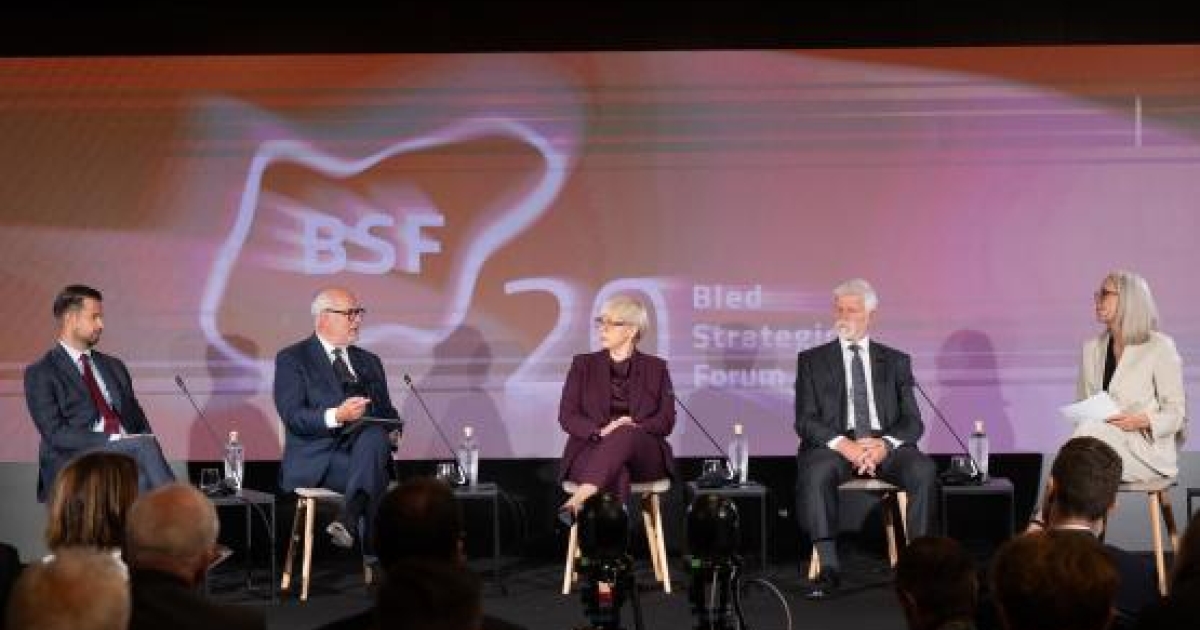
The opinion piece by President Karis was originally published in Bled Strategic Times.