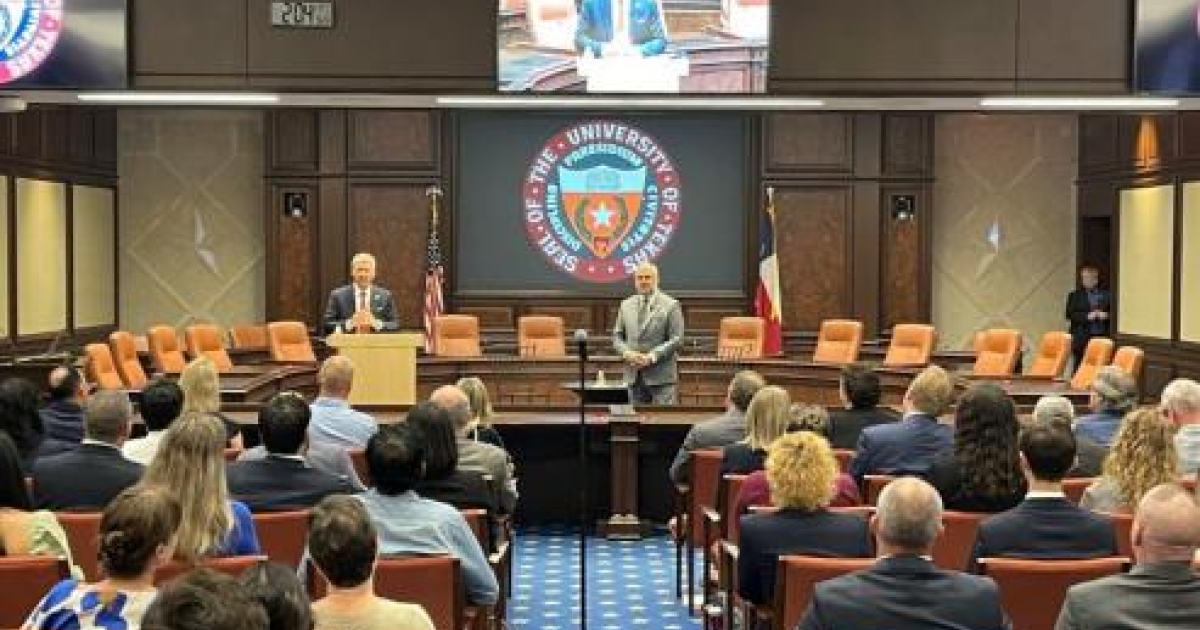
I would like to start by saying that the United States and Estonia are close allies working together to promote democratic values and good governance. Estonia is a small tech-savy nation of startup unicorns and our strength in particular is advancing technology for promoting democracy. I am here today to share with you some lessons from our short road from being the poorest nation to becoming the land of Unicorns.
During current turbulent times it is especially important to work with likeminded partners to advance and promote democracy. Estonians know very well the pain and suffering that authoritarian rule can bring. This is why, we are forever grateful for your unwavering support to our sovereignty even through the darkest years of Soviet occupation. I myself grew up in an authoritarian society.
President Reagan used to tell jokes about the life in the Soviet Union. I believe that many people, who used to live in that evil empire, found these jokes as familiar descriptions of their everyday lives. We are proud that we have come far from that situation.
Let me amuse you with one joke that describes the Soviet economy very well. A man walks into a shop. He asks the clerk, “You don’t have any meat?” The clerk says, “No, here we don’t have any fish. The shop that doesn’t have any meat is across the street.”
So lesson number one: we have learned from our history and experience that the private companies, businesses flourish in democratic countries. Our sufferings from the past have taught us that democracy and freedom are priceless. And this is why we will do all in our power to help Ukraine to fight for its freedom and independence. We call every nation to do the same, it is not only our moral duty, it is also an obligation set in the United Nations Charter.
Today, Estonia is the most advanced digital democracy in the world. We have reached an unprecedented level of transparency in governance and built broad trust in governmental institutions and open, free, transparent digital society. Our simple tax-system, which is acknowledged as the best in the world and this is not so only in our opinion, it is so according to the OECD’s International Tax Competitiveness Index, our e-services and flexible business environment have created a perfect ecosystem for digital companies and startups.
The digital success and almost zero-bureaucracy experience has boosted our economy, but it has also had a broader impact on the society. Besides putting everything online and Estonia on the global map, the expansion of tech sector has transformed Tallinn and many other Estonian cities during the previous ten years.
Estonia has seen a tremendous economic transformation in recent decades. Becoming a member of European Union and Eurozone have created a friendly, predictable business environment. On top of that, we are still the society full of business-minded people, who see opportunities, where others see problems and we are still very eager to succeed.
We are considered the most advanced digital society in the world and continue thriving in the digital space across. In Estonia all public administration services are citizen-centric, digital-first, online based, the only thing you cannot do online is to get married. For this ceremony, you still need to show up in person. Public services use over 100 AI tools to speed up the decision making and automatizes the services.
Estonia has been an innovator in almost every aspect of public life. Estonia was the first country to hold a nationwide election online; implement smart car parking and sharing economy model in mobility and open nationwide electric vehicle fast-charging network. For most Estonians the US electoral system and vote counting compared to our own, seem like a rocket-science.
Estonia is amongst the top 10 innovators in the EU, surpassing all Eastern-European and Mediterranean countries. As a New Nordic we are northern Europe’s hub for digital business.
How did we succeed?
This story starts as most fairy-tales do. Once upon a time, there was a beautiful country on the shore of the Baltic Sea, almost in the end of the world. And this country wanted to break free from the ugly evil empire.
The legend tells that Estonian former Prime Minister Mart Laar had read only one economics book in his life. Luckily, this was not any book, but a book written by Milton Friedman. We put theory in practice and rebuilt our economy.
Estonia is a great example of a country where pro-market reforms and economic freedoms have created prosperity and happiness. It was also decided from a very early on, that we shall only use the most advanced innovative solutions available when we implement reforms. For example, bank checks were never introduced in Estonia, we went directly to online banking already 3 decades ago.
So lesson number two, thrown from our success is, that you need a good leadership, ready to make necessary reforms and hard decision. To illustrate how Estonia has transformed, we must go back to the early nineties, when Estonia had just restored its independence, but the economy was still quite similar to the eighties.
In the first quarter of 1992 the average monthly wage in Estonia was around 16 euros, which is the same in US dollars. This does not seem incredibly little only here in the US, but also for Estonians. It is hard to believe that this was our starting position. Today the average salary is more than hundred times bigger (1754 euros).
Only very few people living in Estonia were not poor then based on our current standards. In fact, if we think about the standard, which we define as a poverty threshold nowadays, then probably 95% of people lived below that standard in the early 1990s.
The economy was still strongly linked to Russia and struggling.
Our problem these days was that although we had relatively modern infrastructure and large industry, the products were not suitable for the market. The technology was outdated and productivity was low. Economic planning from previous decades was based on the need of the Soviet Union not market demand.
It is time for the second anecdote from the Soviet times.
A student wrote in his weekly essay: “My cat just had seven kittens. They’re all communist.”
The following week, the student wrote: “My cat’s kittens are all capitalist.”
The teacher called him up and asked to explain the sudden change. “Last week, you said they were all communists!”
The student nodded. “They were, but this week they all opened their eyes.”
The best way to answer to the demand of the market was to privatize the economy. This was also a way to engage foreign investors and find new export partners. The share of Russia in our exports began to diminish.
The economic importance of Russia for us has declined with every crises. It declined most after they introduced double-taxation to our products soon after the first political crisis we had. Then, after the Asian crises and after Russia annexed Crimea, our economic ties decreased again. Turbulent times have shown that Russia is not a reliable partner and cannot be trusted. Therefore, there are very few business linkages to Russia nowadays, nor to any other great authoritarian country.
Coming back to lesson number one, any authoritarian partner is not a very reliable partner, as they would not hesitate to use economic dependencies from them against you, at any time they feel the need to pressure you. Little side-lesson here is that economic interdependency will not necessarily help to transform an authoritarian country into a democracy.
In addition to the privatization, we reformed the whole economy, increased economic freedoms, developed government integrity and rule of law.
We made it our priority to become a member of the EU and NATO to be a member of the democratic world. We succeeded in this in the early 2000s and since then we have concentrated on building the digital economy, where innovation comes first.
Our history has taught that it is wise not to depend on Russia, therefore we have developed our economy based on the same wisdom. We do not have high dependence on Russian gas, because we acknowledged this problem a long time ago.
We lowered the gas dependence with locally produced biomass, biogas and oil-shale.
We are also trying to set a world record now being the fastest in building a LNG terminal in Paldiski near Tallinn, which will become operational in the fourth quarter this year, so hopefully from idea to its realization it takes us more or less 6 months.
This together with energy interlinkages with other European countries will ensure our energy security. Paldiski is also a good location for investment thanks to its deep harbor, closeness to Tallinn and very good energy linkages.
We have also ambitious green energy plans. Today, one third of our total energy consumption comes from green energy.
The state has estimated that there is room for around 7 gigawatts of off-shore wind farms. This exceeds our electricity consumption by several times, but the private sector is developing even larger amount of off-shore wind farms.
These are long-term projects and will take time, but it is likely that we will have a boom in wind energy in seven to eight years and then we can become energy providers for our neighboring countries.
Our common goal in Europe is to decouple from Russian energy completely and once we have done that, this will be permanent. Russia may brag that they will then sell their energy to China or others but most probably not in a hundred years will anyone pay them nearly the price Europeans were willing to pay.
There are many opportunities in the Estonian energy sector. We are also open to other types of electricity generation, for example nuclear, in the future.
Greening the economy is not only about green energy, it also needs new materials and production. Estonia is one of a few places outside China, which processes rare earth elements.
The factory is located in the North-Eastern part of Estonia in a harbor town Sillamäe and this area has also a lot of potential for future industries.
One of the biggest investment projects in the near term is the Rail Baltic, which will enhance railway connections between Estonia and Germany.
Lesson number three would be that if you need to start from the scratch, you have very limited recourses; you are in crisis, find smart, innovative solutions to move forward.
Estonia is internationally known as an outstanding place for doing innovative business. Our excellent environment for digital start-ups has produced ten unicorns and we do hope to continue on this track. We aim to have 25 unicorns by 2025. Now let me put this into a context. We are the country of 1,3 million people, like the city of Dallas. We have 10 companies worth more than a billion dollars. India, thousand times bigger than us, has 65 Unicorns. In per capita race, no one ever beats us in anything.
Estonia is a small country, but the startup sector is making us bigger. It is nearly impossible to scale a production of physical products in a small country, but scaling a digital company is a different story. This is our opportunity and I believe we have used it well. The reason why I am here is also partly related to Estonian startups. Two companies are opening their offices in Texas and I was asked to join them.
Clevon builds self-driving electric delivery vehicles, which can travel on public roads, reduce costs for companies and on top of that are environmentally benign. I am sure that these solutions are at least part of if not the future of transport of goods and equipment.
That type of solutions will transform transport for a better and more efficient future. This future is very close as they are already transporting goods in Europe and the company is looking for new partners here in the US.
The other company is EyeVi, which uses artificial intelligence to capture high accuracy geo data. Their technology is currently used for more sustainable and cost-effective road management. If the system discovers that part of a road needs more maintenance, then the road-maintenance company can target the problem and use their resources more efficiently.
However, such technology could have many other uses in the mobility sector in the future.
The internationalization of companies like Clevon of EyeVi helps to bring the merits of the digital economy of Estonia closer to the rest of the world.
Estonia is home to an entire galaxy of innovative autonomous-vehicle companies. Estonia is considered a nationwide testbed with a highly innovative and open society and is open to experimenting and testing what companies have to offer.
I believe Estonia might be the first country in a world where some years ago we witnessed the accident between the self-driving robot and a passenger car. The robot was crossing the pedestrian road cross. It turned out, we do not have a laws in place for all the AI tools we use. We established the world’s first nationwide AI/robot law.
As a result, Starship Technologies has operated level 4 autonomous delivery robots in public streets of Estonia for over 4 years and they have now by far taken the lead in that industry. Clevon is close next.
Similar technology is also used by companies that build military equipment. For example drones developed by Threod systems are actively used in combat in Ukraine, as well as autonomous vehicles developed by Milrem Robotics, which are transporting the wounded away from the battlefield.
Without a doubt the start-up and digital sector has been among the fastest growing areas of the economy and I believe that it is now time to bring the innovation that was born in the digital sector to the rest of the economy.
The start-up mindset and digitalisation could benefit many fields of the society, for example in greening the economy or solving the current energy crisis. The fourth lesson to succeed is to be bold… and beautiful and to make decisions fast.
The current high energy prices in Europe reflect the fact that we do not have enough cheap electricity production. However, there are start-ups, which produce construction materials that produce electricity at the same time, when these materials do their main job. For example SolarStone produces roof materials that produce solar electricity so that there is no need for extra solar panels – the roof does the job.
And when we are talking about the future of energy, then we can also think about the future of food. Estonian startup BugBox is developing a method to grow very delicious bugs for food efficiently. I have tried it in Tallinn at a tour organized by Cleantech Estonia.
It is remarkable that fintech technologies and solutions have not stopped with conventional financial sector, but could be used in various areas to create new markets and solve many problems faced by the society. Let me bring some examples of fintech start-ups, which could change the future outside the financial sector and help us on the path of green transition.
Countries have promised to become carbon neutral, but declarations are not enough and we need concrete action. Fintech solutions could be essential for decarbonisation of the economy. Two start-ups eAgronom and Single.
Earth are developing methods for pricing greenhouse gas emissions in order to enhance the market of carbon emissions and neutralise their adverse effect on the climate. They exploit satellite images, artificial intelligence and block-chain to crack the climate issues and boost green transition.
There are start-ups like koos.io and Salto X, which make it easier to issue micro shares in order to facilitate sharing the ownership with wider range of stakeholders and thus creating new incentives for better co-operation and building of community-based services.
Such solutions could be used to get over the so-called Not-In-My-BackYard or “the BANANA” problem bild absolutely nothing anywhere near anything, which has got more binding at the era of wind farms and far away neighbors against them. Ownership will create incentives not to be against innovation.
Technology could transform the future by changing simple things. For example, when I lived in the Netherlands during my academic career, I rode a bike as everybody else. However, several of my bikes got stolen. Estonian start-up Bikeep has developed a public bicycle parking system, which makes it almost impossible to steal the bicycle.
If you are more conservative and would still like to drive a car, but do not like the idea of owning it, then you can rent a car from ELMO rent. The car drives to your location itself so that you do not have to go to any pick-up point, but can just start using it, when it arrives.
The current geopolitical situation has prompted many people, primarily outside of Estonia, to recall that we share a border with Russia. In so saying, it pays to remember that in economic terms we are much closer to the Nordic countries and Western Europe than we are to our neighbor to the east.
Estonian companies’ business ties and exports anchor us firmly in Europe. We are also part in the world´s most powerful security alliance ˗ NATO. In security business you can hardly be better secured than being part of this group. So your business is safe with us.
According to Heritage foundation’s, 2022 Economic Freedom Index our economic institutions are among the Top 10 freest in the world, alongside Ireland and the Netherlands. Our most important export markets are Finland and Sweden, although the United States and Germany are not far behind them. Even our per-capita GDP is closer to that of France than it is to that of Russia.
We are in the same – luckily very sturdy – boat as countries facing similar challenges.
I would like to assure you, that Estonia is an easy place to do business. The economy has transformed in the recent decades. The living standard as measured in GDP per capita in real terms has more than tripled in the last thirty years.
Estonia has a very flexible economy and high economic freedom, which is due to good public governance and strong institutions. Based on the OECD’s Pisa student assessment exams Estonia stands on top of the results in the OECD countries in reading, mathematics and science.
The business friendly environment, government integrity and common rules of the EU make it easy to enter the market in Estonia. According to surveys done among the expat community, there are also other things to appreciate while working in Estonia. The four seasons in the nature, sauna experience and of course Estonian beer.
So I welcome you to do business in Estonia, to invest in our start-ups and other companies, and co-operate with Estonian-born businesses across the world.
Thank You!