“Noticing the wounds that the war has cut into the souls of Ukraine’s children and young people is as important as defending the freedom and land of Ukraine on the front,” said Sirje Karis. “The impact of war trauma is huge. These emotional scars need to be dealt with immediately, there’s a lot of work ahead. If the mental health issues of children, young people, and also adults go unnoticed or are underestimated, the trauma caused by the horrors of the war waged by Russia may cast a lasting dark shadow over the lives of Ukrainians. Let’s not allow the aggressor take the future of Ukraine’s children away from them.”
She also spoke about the help Ukrainian war refugees are given in Estonia, emphasising the cooperation between the state, businesses and NGOs. “Psychologists from Ukraine, who were forced to leave their country and found refuge in Estonia, are also involved in helping them,” she added. “Without them, we wouldn’t be able to provide the help we’re giving now.”
Estonia continues supporting the reconstruction of Ukraine and also focuses on helping children. A nursery school was built in Zhytomyr a couple of months ago. In partnership with the Olena Zelenska Foundation, Estonia is contributing €300,000 to the construction of family-type homes where orphaned children can grow up in conditions similar to those of a normal family.
Sirje Karis spoke about Estonia’s experience in the field of mental health care, the cornerstones of which are cooperation between the state, businesses and civil society, and the creation of a broad support system, which means help available to everyone according to their needs. “We should regard mental well-being and mental health services as a pyramid – at the top is the professional support of psychiatrists and clinical psychologists for the most complex cases,” Sirje Karis said. “Community support and increased awareness are needed to prevent most of the concerns reaching the top of the pyramid. This increases the psychological resilience of people.”
“It also means a change in education, so that children would know how to cope with emotions, recognise problems and support others when needed. This also applies to their parents and teachers.” She emphasised the importance of good relations with loved ones and, more broadly, of creating an environment that supports mental health, including sports facilities, safe environments for young people to spend time or museums.
Sirje Karis highlighted the initiatives used in Estonia such as parenting education programmes, the Bullying-Free School, as well as advice hotlines, mental well-being mobile apps and video counselling platforms.
The First Lady of Estonia visited the memorial to Ukrainian war heroes, the War Museum and the memorial to the Ukrainian children killed as a result of Russia’s aggression. Sirje Karis left there a stuffed version of Poku, a character from Edgar Valter’s children's books, in the memory of the children.
“The memorial to the Ukrainian children who lost their lives as a result of Russian aggression is one of the saddest places I’ve ever visited,” said Sirje Karis. “The blind, evil war waged by Russia has cut short many young lives – as a mother and grandmother, this cruelty breaks my heart. Every broken young life is an unbearable loss for every mother, father, brother, sister, for everyone close to them.”
It is estimated that at least 7.5 million children in Ukraine have been affected by the war in Russia, two thirds of whom have been forced to leave their homes. Over half a thousand children have died as a result of the war, and tens of thousands have been deported to Russia and Belarus.
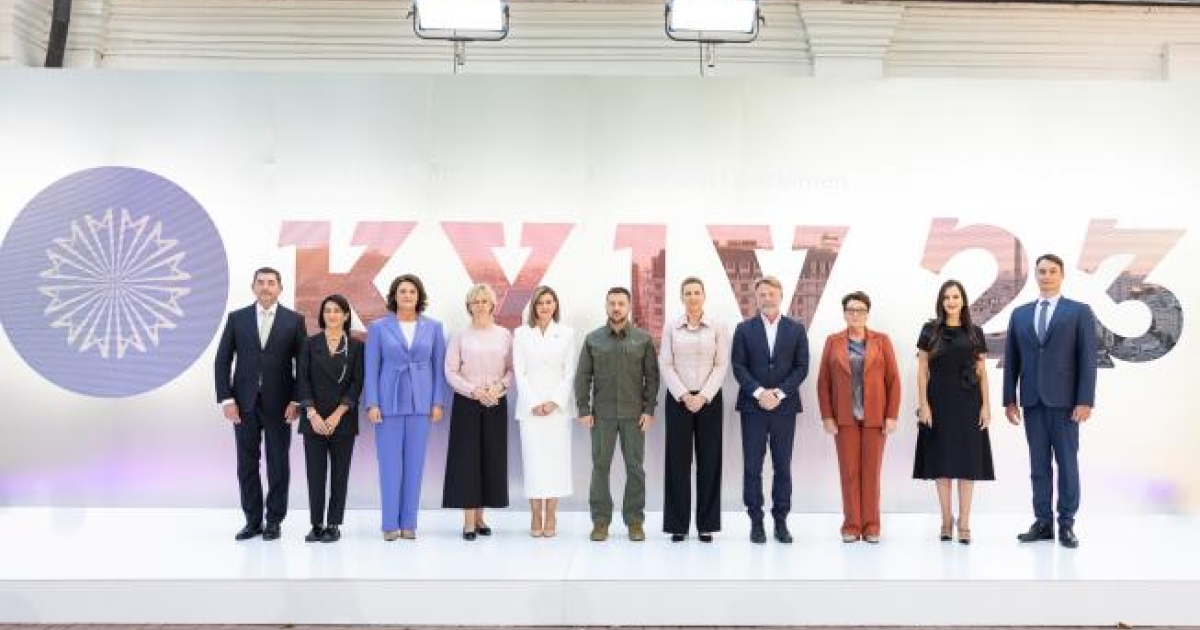
Sirje Karis took part in a discussion of the future of young people and children and how to take better care of young people’s mental health, held at the Summit of First Ladies and Gentlemen. It was also attended by, for example, Juray Rizman, partner of the Slovak President, Anna Hakobyan, wife of the Armenian Prime Minister and virtually by American actor and Ukraine supporter Richard Gere. Diana Nausėdienė, wife of the Lithuanian Head of State, Eva Pavlová, wife of the Czech President, Aleš Musar, wife of the President of Slovenia and Bo Tengberg, husband of the Danish Prime Minister, also attended the Summit.
The Summit of First Ladies was launched by Olena Zelenska in 2021 in order to create a platform for cooperation to exchange experiences and launch new projects in the humanitarian, medical, educational and cultural fields. Similar to President Alar Karis and Sirje Karis, Ukraine’s President Volodymyr Zelensky and his wife Olena Zelenska are also passionate about dealing with the mental health issues of children and young people.
In parallel with the meeting of the First Ladies and Gentlemen, a meeting of health ministers took place in Kyiv, where the main topic was the challenges related to medical professionals and international cooperation to overcome them. The meeting was also attended by Estonian Minister of Health Riina Sikkut.