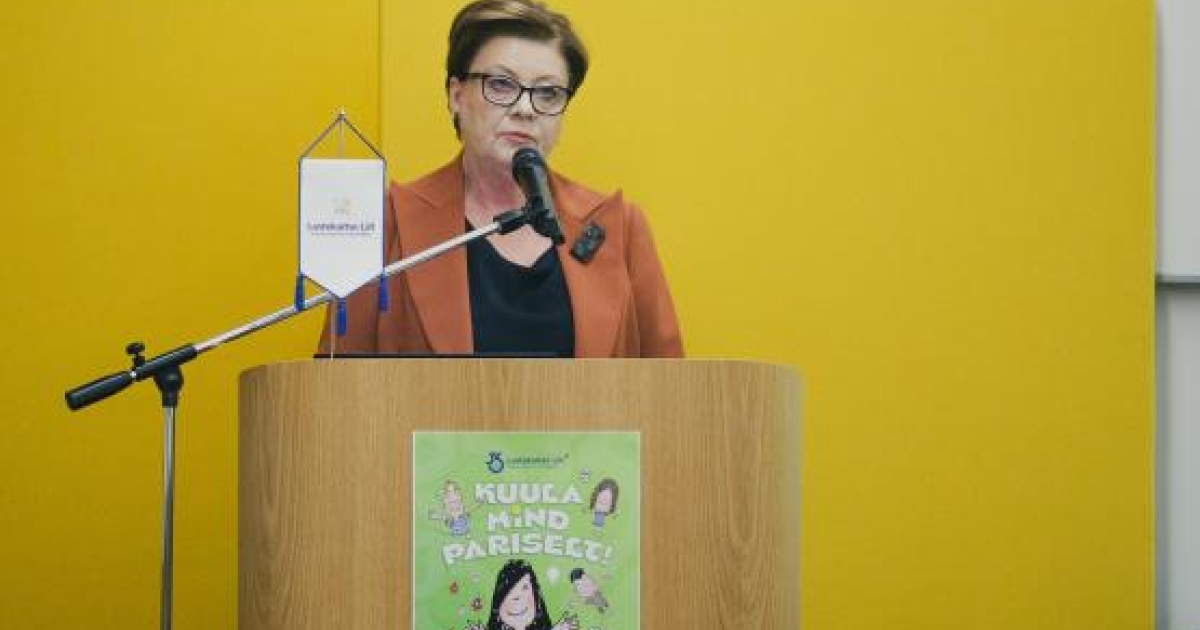
We’re living in the age of noise. Everyday information noise surrounds adults and children alike. In all this, how can you hear the quiet whisper of a child expressing the desire to talk, to share their concerns? Children don’t speak out loud about their concerns. In the Estonian Report of the Child to the UN Committee on the Rights of the Child, which will be covered at this conference today, children themselves insist that we should listen to and believe their concerns. It’s very important that we notice children’s ‘wordless’ talk and concerns.
I experienced the importance of noticing when I have visited the family homes in SOS Children’s Village, orphanages and hospitals all over Estonia. But also, when I’ve met Ukrainian children in Estonia and Ukraine. I’ve heard countless tragic stories about the fate of children whose lives were turned upside down by war and who were robbed of their childhood. Russia’s war of aggression, which has lasted for 1,000 days, has deprived millions of Ukrainian children of their basic rights, including education.
These are stories that shouldn’t exist in the 21st century world, but they do. “Mum, when will the war in Ukraine end? Mum, I’m afraid that war will come here,” should not be the question and fear of a 10-year-old Estonian girl. It’s the same fear that our mothers and grandmothers had in the 1940s, the stories of which we’ve heard in our families. Wounds opened by war or other disasters will cause pain for a long time to come, even after life seems to have recovered and calmed down. Read how Elin Toona and Ilon Wikland, for example, have described the feelings of a child taken far from home. Thousands of children of Ukraine, Syria and other conflict zones are probably feeling the same right now. We cannot allow history to repeat itself. Not here, not anywhere else in the world. The future of Ukrainian children also affects the future of our children. And that’s why I’ve done everything I can to keep the issues of children and their rights in the international spotlight. Be it in relation to children affected by war, their mental health, their education, and especially their informal education.
Why am I talking about this here today? Because what’s happening in the world is reflected in our children – in their thoughts and questions. Our role as adults is to listen, discuss and explain, to listen carefully to the child’s opinion, so that the child feels respected and taken seriously. This is where the mutual trust and respect that are often lacking in our society are born. In the above-mentioned report of Estonian children, a child says: “Many older children and adults don’t respect the opinions of younger children, even though they have good ideas”. When a child feels that his or her thoughts and feelings are genuinely heard and understood, the child’s trust in themselves and others grows.
Dear listeners, if we cannot listen to each other at home, at school, at work or elsewhere, we’ll not have a cohesive, strong and caring society. Therefore, my wish is simple – let’s learn to listen. For real. And in doing so, we’ll set an example for children, even if our own childhood experiences are different.
The characters we know from children’s literature, such as Mary Poppins, Karlsson-on-the-Roof and the Grandma in the Apple Tree, who was born out of the longing of a little boy, have one thing in common – they listened and they made time for children. They took children seriously. As a mother of three and grandmother of five, I’m of the same mind – we must listen to children.
The time dedicated to listening to a child is an investment in their mental health, well-being and sense of security. My wish is that every child has at least one adult with whom they’re not afraid to talk about anything, whatever the subject.
Many thanks to the Estonian Union for Child Welfare for deciding to raise this extremely important issue and to do so on World Children’s Day! Change starts with noticing, listening, speaking. I hope that every participant will pick up from the conference at least 2-3 new ideas and thoughts on how to listen to children in a way that is good for children, ourselves and our society.
Thank you for your attention!