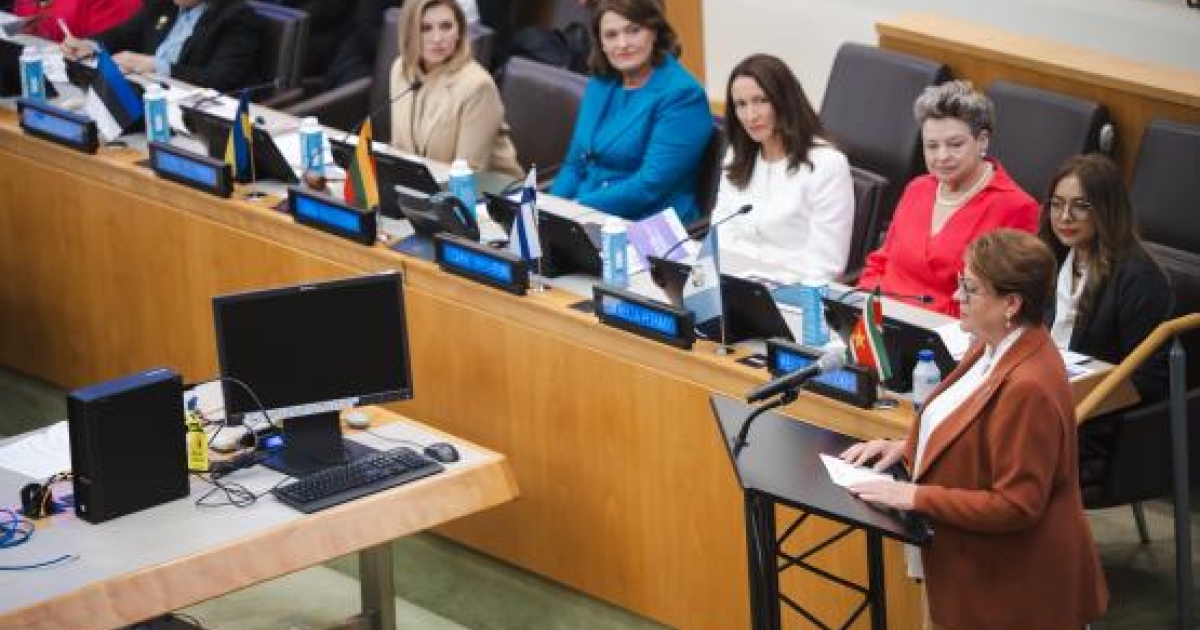
Sirje Karis underscored Estonia’s commitment to promoting children’s rights. “Estonia is continuing to work to defend children’s rights in international organisations and via development and humanitarian aid,” she said. “Each and every child must be able to live in a safe environment, wherever they happen to be. It is children who are most vulnerable in armed conflicts. Recent UN reports have highlighted the suffering of children in countries such as Sudan, Afghanistan and Ukraine, in the Middle East and in other conflict-affected areas.”
Describing the suffering she personally witnessed on a recent visit to Kyiv that Russia’s belligerence is inflicting on Ukrainian children as heart-breaking, Sirje Karis said: “It is depriving them of their basic rights, including access to education and health care. We cannot simply stand by while Russia, a permanent member of the UN Security Council, continues to commit war crimes by bombing playgrounds, schools and hospitals. The aggressor’s systematic deportation of Ukrainian children to Russia is one of the most devastating examples of their atrocities. There can be no peace until these children are returned to their families.”
Sirje Karis also emphasised the importance of education in conflict zones. “Since access to education is being hampered by the war, creative ways must be found to make up for this, such as e-learning and digital tools,” she suggested. “Education isn’t only important from the point of view of sharing knowledge, but also in ensuring that children have a psychological sense of security and develop emotional resilience.”
As part of the event, Sirje Karis provided an overview of Estonia’s activities in tackling mental health problems among school children. “Such problems are on the rise, and we take them very seriously,” she said. “Children must be guaranteed a safe learning environment. We have launched a number of initiatives to reduce bullying and improve access to psychological support, and we consider it very important to share best practice with other countries.”
Among the spouses of heads of state and government from around the world attending the event were Jill Biden (USA), Rossana Briceño (Belize), Suzanne Elizabeth Innes-Stubb (Finland), Lucrecia Peinado (Guatemala), Diana Nausėdienė (Lithuania), Monica Chakwera (Malawi), Mellisa Santokhi-Seenacherry (Suriname), Linda Rama (Albania), Tina Gaber (Slovenia), Anna Hakobyan (Armenia), Isaura Gonçalo Ferrão Nyusi (Mozambique), Filomena Katonivere (Fiji), Lina Ramkalawan (Seychelles), Karsera Christodoulides (Cyprus), Maricel de Mulino (Panama) and Eva Pavlová (Czechia). Other attendees were UK Foreign Secretary David Lammy, Minister of Foreign Affairs of Canada Mélanie Joly, UNICEF Assistant Secretary-General Kitty van der Heijden and representatives from Argentina, South Sudan and Liberia.
Sirje Karis is taking part in the programme for the spouses of the heads of state attending UN General Assembly week. She is scheduled to attend a lunch meeting hosted by US First Lady Jill Biden, a reception being held by the wife of Turkish president Recep Tayyip Erdoğan and a tour of the Fountain House health centre.
Gallery (Raigo Pajula/Office of the President of the Republic): https://flic.kr/s/aHBqjBJCGs