Rakkaat ystävät Alex ja Suzanne.
My dear Estonian and Finnish friends.
It is significant and symbolic that the Finnish president’s first visit to Estonia is a state visit. It nods at the closeness between our two countries and peoples and also evokes the interwoven relationships and geopolitical present we face.
We are geographically so close to each other that in good weather the lights of Helsinki can be seen from Tallinn TV Tower. The Finnair planes that provide air shuttle service between our two capitals barely reach cruising altitude before beginning their descent.
But we are more than just close in terms of the kilometres separating us. Already in May 1917, the Finnish poet Eino Leino presciently noted in his poem “Vapaa Viro” (Free Estonia):
independent statehood is also a common bond
between the two peoples across the Gulf of Finland.
An appreciation for freedom has been a common feature for our nations through the twists and turns of the 20th century, and in our current age, knit us even closely now. In difficult times, we realize the true value of this bond. Finnish volunteers in the Estonian War of Independence, Estonian volunteers in the Finnish Winter War and Continuation War – free citizens came to each other’s assistance in the name of Finnish freedom and Estonian honour, both before we had statehood and when the state was no longer able to do so.
Now we are part of the circulatory system of freedom that unites and sustains us, in addition to our ties as close linguistic and cultural cousins. Our geopolitical position gives our cooperation a special, much broader meaning for all of Europe.
It entwines both of our countries’ national defence and regional security, resting on our common interest. We have a common interest in stability throughout the north of Europe and across the whole continent.
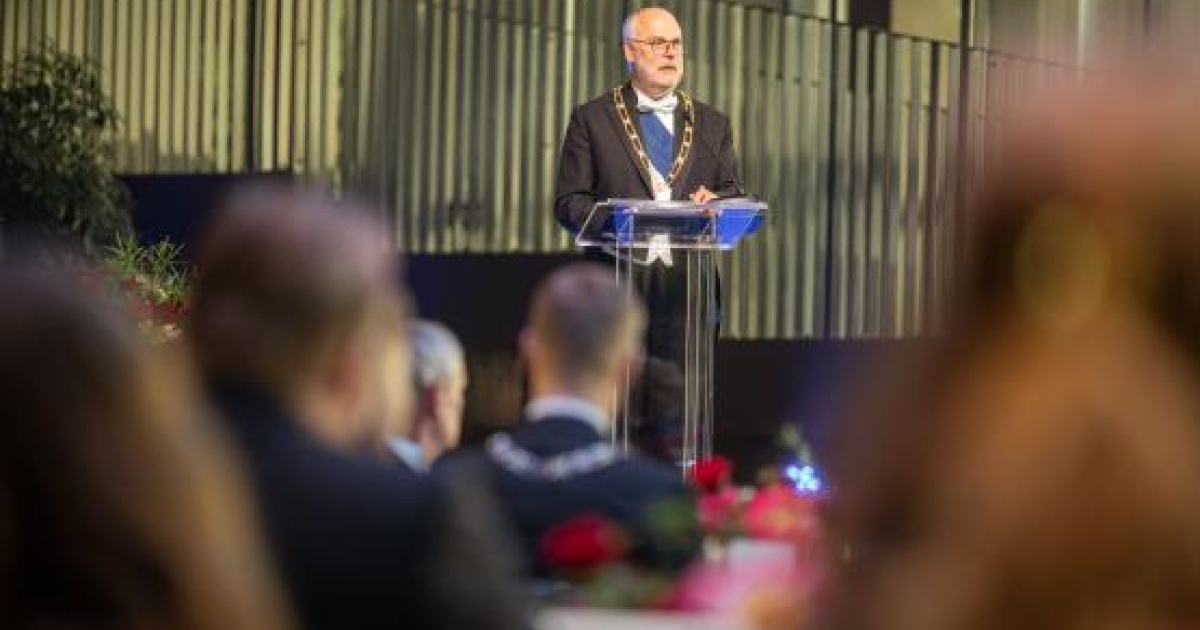
Among us here today at Tallinn cruise terminal on the shores of the Gulf of Finland is Kristi Raik, a scholar who is adept at articulating Estonian foreign policy and security policy and is also well known in Finland.
To quote her: “Small countries depend their international environment more than large ones do. To survive and develop, they must be especially skilled at navigating world politics.”
Estonia and Finland have learned the art of navigating tempestuous world seas. We know well that smaller countries have to rely on their good knowledge of those oceans and broader international cooperation.
We both know what it means to live next door to a bear. That bear has always been nearby, exerting an influence on us. We have tried to understand the bear, consider the bear, hoping that a rules-based security calculus based on international justice will endure. And time and again, we have been deceived.
We have learned that European Union and NATO, a search for allies and joint contributions to collective security are the way out of a geopolitical no man’s land. As an Estonian, I am particularly glad and get a safe and secure feeling when I see the flag with a blue cross on a white field flying in front of NATO headquarters.
We both want a world where the rules agreed in the UN are enshrined and international law is stronger than the desire for war. The path to that world currently traverses Ukrainian trenches and destroyed towns and villages where Ukrainians currently defend their country and freedom against Russia’s colonial war of expansions.
For democracies, helping Ukraine and not setting limits on assistance are the only possible course of action.
For us frontline countries sharing borders with a predator, Russia’s aggression against Ukraine underlines we have known for decades: freedom does not last without the will and opportunity to defend that freedom. Ukrainian freedom is part of European freedom. That is why we do all we can to help the Ukrainian people to defend its land, its people, its sovereignty and freedom.
My dear friends,
When we think of the extensive economic relations between Estonia and Finland, we have to start with the friendly trading that went on for over 700 years between communities on the opposite shores of the Gulf of Finland. Its roots go back to fishing and sealing on small Finnish islands and Estonian coastal villages, later encompassing trading of grain, meat and potatoes.
Of course, we now have a long string of examples of modern business ventures connecting the two neighbours. In 2019, Estonia and Finland became the first two countries to recognize cross-border digital prescriptions with reciprocity.
Starting from that time, Finland has been our primary and best partner in developing cross-border services. You are also right beside us when it comes to championing and implementing the mindset that cross-border public sector digital services and infrastructure should be a success story for all of interconnected Europe.
Europe’s economic growth potential depends greatly on how our business communities succeed in putting our scientific discoveries to work for the whole economy, commercializing new technologies. Finland has been one of the leaders of such innovative initiatives in the Baltic Sea region, and knows inventions born in garages can change the world.
Since I myself have worked in the research community, I am particularly pleased about the collaborations between Estonian and Finnish researchers. Take the FinEst Centre for Smart Cities, an international R&D centre founded in collaboration between Tallinn University of Technology and Aalto University.
It generates novel, clever smart city solutions, not limited only to Tallinn and Helsinki but now many other cities in Europe. It’s a dynamic example of cooperation originating in shared values: innovation and a good living environment.
My dear friends,
Today, 55,000 Estonians live in Finland and about 20,000 people from Estonia travel to Finland for work. About 7,000 Finnish citizens live in Estonia. An even greater number of our compatriots travel back and forth to visit each other, or for creative synergy.
Considering my fellow Estonians, some names come to mind are molecular biologist Mart Saarma, film-maker Veiko Õunpuu, the curator of the Estonian National Museum fairytale exhibition Katrin Sipelgas, jewellery artist Kärt Summatavet, theatre director Ene-Liis Semper, cinema production designer Jaagup Roomet, and many more.
I think in a way it might be a cliché to attribute our vibrant relations only to our special relationship. It’s really the day-to-day relations between two neighbours who are close and share the same attitudes. Your state visit is a significant page in those relations.
My dear Alex and Suzanne, I raise a glass to your health and to the friendship between Finland and Estonia.
Cheers!
Kippis!
Skål