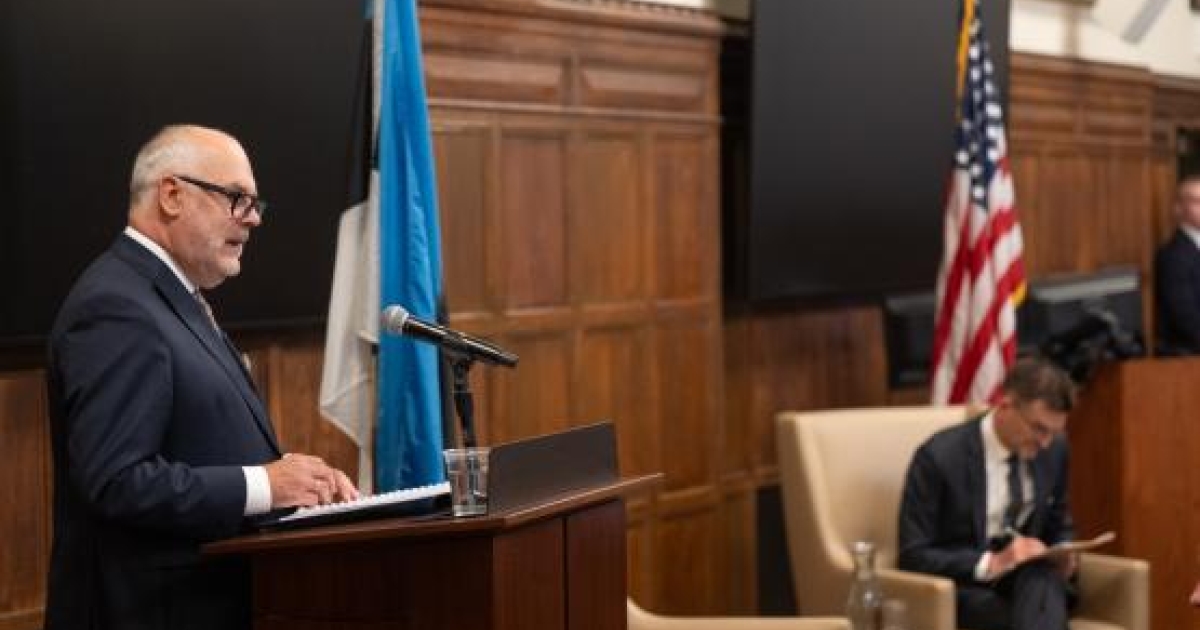
Dear Students,
all the listeners in this magnificent hall,
As a member of Academia and a long-term student of Life, as a retired rector of the University of Tartu or Universitas Tartuensis, I am delighted to be here at Yale, at the University that not only I but the whole world is admiring.
Twenty-five Nobel Prize laureates; this speaks for itself. You have my deep respect.
Besides Aleksis Rannit, who was mentioned by the professor and who has written himself into the annals of this University, particularly this Library, and is the embodiment of Estonianness here, Yale has another small connection to Estonia. You might be surprised, but it is Louis Kahn, the architect who designed, among other monumental buildings, the Yale University Art Gallery and the Yale Center of British Art here in New
Haven and who worked at Yale after the Second World War.
Kahn was born in Estonia and spent the first five years of his life, before his family moved to America, on Saaremaa, the largest Estonian island.
Kahn himself has claimed that the inspiration to become an architect goes back to Kuressaare, the capital of Saaremaa, where a medieval stronghold, which haunted his mind for the rest of his life, stands on the seashore.
To be honest, anyone who has seen this Castle in Saaremaa and Kahn’s most famous works will clearly understand this emotion and the connection.
Kahn played with light and heavy structures, with light turning heaviness into airiness. This phenomenon is valid even today, where solid structures of democracy need more room to breathe, need air to avoid suffocation, where there is a need to show people what is right and what is wrong, to give them perspective on how to move on with their life, how to find peace and balance in their existence.
Several times in history, Estonians have been in situations where things looked sour.
We are a Nation that has been living in the same place for more than 8000 years.
Coming from the North, we are accustomed to cool summers, where the sun sets for just two or three hours, and cold winters with long, dark nights. Throughout our history, we have been living under a foreign yoke. Only in the last 100 years have we had, backed by the Wilsonian self-determination clause, our own sovereign state.
And even those 100 years or so have brought four occupations to our territory, the Soviet one being the longest, lasting almost 50 years. This is why independence, the freedom to choose our own path and future, is so important to us.
There are just over a million Estonians living in the world. We are a Nation that has always valued right over might. This statement may not seem correct because we have won the most Olympic medals in wrestling, but it is backed by the fact that at the end of the 19 th century, almost all Estonians, actually 93%, were literate.
One of the fathers of the Estonian awakening – Jakob Hurt – created motivation among Estonians to be a nation with the slogan: if we cannot become great in numbers, then we must become great in mind.
Through the last 100 years, we have tried to justify this slogan. Estonians are claimed to be the most book-loving nation in Europe, maybe even in the world. Some years ago, the journal Social Science Research published a study by the Australian National University that claimed the biggest average number of books is in Estonian homes. 218!
We are followed by fellow Nordic countries – Norway and Sweden – 212 and 210, respectively. We really love reading. I took it up because in Estonia, we celebrate the Fifth Centennial of the book in the Estonian language. This is evidence of our pursuit towards literacy and knowledge through the centuries.
Ladies and Gentlemen
At the beginning of the 1990s, we used the window of opportunity and regained our independence. Among other factors, the fact that the United States did not recognise Estonia as a part of the Soviet Union and considered it as occupied territory played an extremely important role. Knowing this gave us hope that one day we would be free
again.
And in 1991, free we became. The next 30 years have been sort of a miracle. From the country whose defence budget was USD 3 million, whose GDP was about USD 3000 per capita, where occupation troops were still in the country, where state services were characterised by typical Soviet disorder and ideological repression in 1992, we have, in thirty years, grown into the Nation who will spend 5% of its GDP, approximately USD 2.2 billion, on its defence and whose GDP per capita is USD 41,500.
This country is now a member of NATO, and it has built up one of the best serving egovernments in the world. And those are only some facts for proof.
How come? Our castle on the island, our vision for the future, was based on strong dedication to freedom and liberty, to democracy, market economy and the rule of law. This dedication, backed by the integration process into the European Union and NATO, facilitated the quick change. We could not stand of Soviet repression and the silencing of society; we were not satisfied with the ordinary Soviet inefficiency and low productivity.
We were ready for change, for reform, for a quest towards a better and stable life. Democratic institutions were established, the division of powers enforced, civil and human rights and the rule of law restored.
And on top of that, we got inspired by the internet and computing, which resulted in an e-government, where all government services are available to citizens online.
This was only possible thanks to our respect for freedom and democracy, for the freedom that was taken away from us for decades and the democracy that we dreamed about while being occupied.
Today, Estonia ranks 2nd in the World Press Freedom Index,
2nd in the Freedom House World Internet Freedom Index,
8th in the World Economic Freedom Index,
16th in the Global Innovation Index, and
1st in the World Environmental Performance Index.
We place 22 nd in the Economist Democracy Index and so on and so on. Of course, indexes can be presented in a cherry-picking way, but in combination, they still say something, and we can say that we in Estonia have done something right. It is almost a Paradise where we live.
Dear audience,
Life is not easy; there are always some surprises or unexpected cards to be drawn. Geopolitics is back. Ideological strife and competition are forcefully visible. Autocrats and Democrats around the world are crossing swords.
Dependence, migration, energy supply, food, and things beyond imagination are used as weapons. It is becoming increasingly clear that instead of a castle on an island, we need a stronghold.
Who could have believed 30 years ago that there would be a full-fledged war in Europe, or that it would be fought by kin-nations – Russians and Ukrainians. This kinship is now gone forever, has been replaced by hatred and anger, by violent death and human suffering.
Russians have used the same modus operandi as they did in the 1940s in the Baltic states, with the same brutality and carelessness. For Estonians, as for other Balts, Latvians and Lithuanians, it was like a reminder of history. Russians had not changed, no matter what was hoped or thought in the aftermath of the Cold War.
It is not only a struggle between two nations that has been unleashed by this aggression. There is much more at stake. It is the present world order and its principles. It is the Western value system that has inspired so many nations so far. It is our way of life and worldview that might be scrambled.
Russia’s big picture aim is to weaken the West and change the world in accordance with its interests – a world where might triumphs over right, where freedoms are only for the chosen ones, where the state always comes before the person. We cannot let it happen.
What could, or even should, be done to prevent it?
First, Russia must be pushed back. This requires ensuring that Ukraine is able to resist Russia in the long term and sustainably, and by weakening Russia to the point where war would no longer make sense.
This needs a long-term strategy, not only from Ukraine but also from the West. I think we actually have it.
It stands on four pillars – isolation, sanctioning, making Russia accountable for the war crimes and crimes against humanity, and last but not least, helping and supporting Ukraine politically, financially and economically as long as they are willing to fight for their liberty and freedom.
We, in the West, should simply be consistent and strategically patient in our response. We cannot rule out that Russia will come to the peace table, but so far, it has been nothing more than cheap talk.
One additional thing: Peace in Ukraine will not automatically mean that Russia has changed, that Russia is eligible to be readmitted to the international framework from which it has been excluded.
It is more certain that Russia will stay aggressive, retaliatory and stick to its goals of weakening the West. To contain Russia, we should formulate a common strategy to keep Russia engaged in introspection within its borders. Their lust for others’ land should be kept at bay.
The last few years have shown Europe that its military posture is not up to the task. We have relied too much on our friends, especially on American troops and capabilities. Most of us took out peace dividends when the Cold War ended.
Turbulent times need better preparedness and a stronger, more up-to-date military. Achieving that requires many times more resources and a dramatic increase in the capacity of the defence industry.
The NATO Summit in The Hague last spring witnessed important decisions in this respect. Almost all the member states agreed to raise their defence budgets to 3.5%, adding up to 1.5% to improve resilience.
Because of the tense security situation, but also because of the aggressive neighbourhood, Estonia has already been spending 3.5% of its GDP on defence and will reach the 5% target next year. The same goes for Latvia and Lithuania, the two other Baltic states.
It is clear that Europe’s boosted attention on defence and capabilities is justified and should have appeared much earlier, but this should not be taken as the replacement of American presence in Europe.
It is philosophically the wrong approach. Considering Russia as a threat only to Europe is a dangerous simplification. Russia is a threat to the democratic world in its entirety, not only to Europe or some bordering nations.
This is a principled confrontation where losing could inspire others who are looking for opportunities to undermine and ridicule the democratic world. We are in this tense, conflict-filled situation together. What is at stake for Europe is at stake for America.
Those are the ideals and principles written into the Declaration of Independence, the US Constitution and the Bill of Rights that inspired the European people and guided the development of democracy. Our core is the same; if one crumbles, the other will follow. This ties us together, this keeps us together, this is natural. Therefore, US presence, including military presence in Europe, is not only symbolic but essential.
The application of threat is under transformation. It is not only military anymore; it is more complex and complicated. Destabilising effects could be imposed on states and people through very diverse and different means and domains.
Many things can be weaponised – targeted migration, manipulation of energy and food supplies, rigging elections, bending truth and information, flying unidentified drones around critical infrastructure, and constant and never-ending cyberattacks. This is a new reality.
As single events, they do not look as dangerous, but if applied at the same time or in a constant flow, the effect will be different, sowing instability and fear. During the last few years, we have witnessed the intensification of so-called hybrid events. In Estonia, the Russian shadow fleet has broken underwater cables and tubes a
number of times.
Our neighbours, the Finns, had to close their border with Russia to stop organised migration from the other side. In Romania, the elections were rigged and the results were therefore annulled. In Denmark, drones flown in from the blue disturbed the operation of airports.
Those are only some examples. The result is hesitation – a society-wide uncertainty that is not far from fear.
The answer to this is better awareness, new technology, more effective countermeasures and a higher level of preparedness. We have to raise our resilience, and this has to be done in a concerted way by the nations, as the effects very often cross borders.
But the most essential countermeasure is a confident and aware society that understands what is happening, knows how to react, and does not let itself become unduly disturbed by it. A frugal and cohesive society can do this best.
Dear Academia, dear students,
The next technological revolution is here and present. Its speed is quicker than that of the previous revolutions; it needs agile and focused action. Estonia is known to be technologically savvy and open to new, promising ideas.
During the last technological leap, in times of digitalisation, we were the ones who grabbed the moment and made the new opportunities work for our sake. We made the computer and the internet our friend and accelerator. This coincided with the early 90s, when Estonia became independent again, and quick changes and reforms were needed.
At the core of that change was a programme calledTiger Leap. By its nature, it was an educational programme with the aim of quickly gaining society-wide digital literacy.
In one year, all the schools in Estonia got a computer class, and programming and work with computers became part of the curriculum in every school. Children from an early age became accustomed to the computer and, instead of scrolling alone on the internet, they were mentored at school about how to make the best use of it.
As a result of Tiger Leap, we have the widely recognised and admired e-State with its more than 2000 services on the net, but also a vibrant and agile start-up ecosystem.
This ecosystem has given birth to 10 unicorns, which makes Estonia the country with the most unicorns per capita in the world. A fact that speaks for itself.
Today, we are facing new technologies, such as nanocomputing, biotechnology and artificial intelligence, which are coming on strong and affecting our lives. Our task is to adjust ourselves to this wave and take everything positive from it, while also protecting ourselves from the possible negative manifestations.
Estonia’s focus is on AI. Our approach is almost the same as thirty years ago – start with education. Learning to ride a bike is much easier and more effective at the age of five than it is at the age of fifty.
As such, I launched a new programme calledAI Leap. In short, it means that all secondary schools, every student and teacher, are provided with free access to AI tools that have been deliberately modified for teaching and learning and designed by worldleading AI companies.
This is being done with the aim of bringing AI into the learning process in a streamlined way so that users can create a common culture, a common ecosystem, around this topic.
Our grand aim is to transform how young people learn, to ensure that they are equipped for any kind of future that awaits them. Only in this way can we have control over the machine, learn from it, and develop with it.
AI literacy must become a core part of lifelong learning. This is about empowering citizens to shape how AI is used, to think critically, to act creatively, and to remain curious. If we succeed, we will not fear AI as an enemy, but trust it as a partner – one that helps us build a smarter, fairer, and more human-centred society.
Ladies and Gentlemen,
It has been a long speech. Now it is time to draw the line. Times are turbulent, but this is not the first time we have been troubled by the present and worried about the times to come. So far, we have always found the way out. Sometimes, the price has been too high and devastating.
We have to be smarter so as not to let those scenarios evolve in this direction. I think it is time to bring values, virtues and principles back to the fore, back into our political conversations, be it at the national, regional or global level.
International law and justice, friendly relations among states, respect for the selfdetermination of people, promotion of human rights and fundamental freedoms, peaceful settlement of disputes, and the sovereign right to self-defence – all are much too important to put aside.
Commonly agreed and jointly followed rules provide certainty and predictability in our existence, reduce friction in international relations, create stability and reduce insecurity. This setup should provide us, but also all nations, with the best environment and conditions for development and prosperity, for the pursuit of happiness, as it was put by Thomas Jefferson in the Declaration of Independence.
In New York City, on Roosevelt Island, directly across the East River from the United Nations Headquarters, stands a monument designed by Louis Kahn. In fact, it is his last work, built posthumously, his last castle on the island.
It is a monument to Franklin Delano Roosevelt, a man who played a significant role in ending the greatest human bloodshed ever – World War II – and was one of the architects of the current world order, even coining the term ‘United Nations’. As is typical of Kahn, the structure is somewhat heavy, but there is a lot of light around in the air. This is the same light seen in Saaremaa, where the original castle on the island lies.
Let us remind ourselves that this light, this airiness, that links two castles, also links two nations and two continents. It is needed for us to get inspired and move forward together.
Thank you!