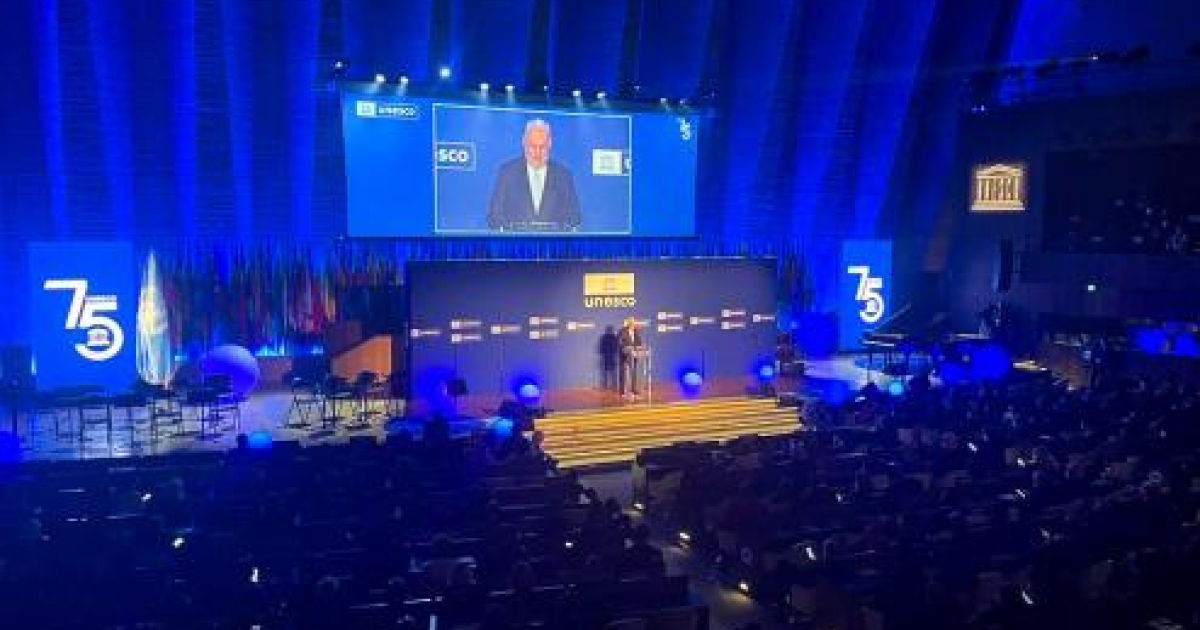
Mr Special Envoy for Peace and Reconciliation,
Excellencies,
Ladies and Gentlemen,
Back in 1946, when UNESCO held its very first General Conference in Sorbonne University, my country was not at the table. The twists and turns of our history prevented that. Estonia became the proud member of UN and its bodies, including UNESCO, only in 1991 after restoring its independence. Estonia is today a strong believer in multilateralism. It has to be protected, it is the most valuable tool to provide solutions to global issues.
Estonia has built strong partnership with UNESCO over the years, valuing UNESCO’s commitment to the promotion and protection of human rights for all, to mainstreaming gender equality and the empowerment of women and girls because there can be no democracy, no security and no development without one half of the humankind.
That is why Estonia continues to work with UNESCO to support the rights of women and girls around the world. This is why we expressed our grave concern on the situation in Afghanistan and emphasized the importance of education and information for Afghan citizens, in particular the right of Afghan girls and women to be an integral and active part of Afghan society and exercise fully their right to education and work. This is why we continue to call upon all stakeholders for the protection and development of educational and cultural institutions and upholding the rights of girls and women to education, work and social participation.
UNESCO has been a success story by providing possibilities for countries of different sizes to engage in international dialogue and to find partners. You might be small in size, but big in commitment. One such example from Estonia is cooperation with eSwatini via UNESCO National Commissions and Associated Schools Networks that contributes to global priority Africa, supports youth engagement, cultural exchange and teacher training.
A new approach to teacher training is also what we need in the light of the global COVID-19 pandemic. According to UNICEF, we have lost 1,8 trillion hours of learning due to the pandemic. We need to compensate for this gap with global arrangements looking beyond conventional solutions. Better access to quality education might mean that we invite professionals with various backgrounds to complete teacher training and become educators. But it also entails thinking about what skills we are giving to the learners and the educators.
In our increasingly globalized, technological and environmentally-aware world we need to provide relevant skills to achieve required transformations. I have personally witnessed education as the most impactful tool for transformation. Estonia is a committed partner to UNESCO´s visionary initiative on Futures of Education that addresses education and learning 2050 and beyond.
Ladies and gentlemen, world cultural heritage is like a bridge between past and future that provides the opportunity to look back to the history of mankind and to learn from the experiences in order to create better life and happy memories. As the only UN agency with a mandate in culture, UNESCO has been strong and visible in its efforts to promote creativity and to safeguard the diverse cultural heritage of humanity. We commend UNESCO for revisiting the strategic approaches of the cultural conventions in the light of the 2030 Agenda.
Estonia’s current membership of the Committee for the Protection of Cultural Property in the Event of Armed Conflict has enabled us to get a full picture of UNESCO’s work as a global leader in safeguarding heritage. At a time when the protection of cultural property in conflict zones is at the fore and natural disasters have had a devastating impact on cultural heritage, this important work needs increasingly more resources.
Culture is always very closely connected also with language as languages play a crucial part in keeping cultures alive - passing on knowledge, cultural and social values and collective memory. Estonia is ready to work with UNESCO and other UN agencies to protect multilingualism in general and indigenous languages in particular through contributing to the International Decade of Indigenous Languages (2022-2032).
Cultural pluralism, willingness to cooperate in pursuit of shared values and ideals and free speech is the springboard for cultural and social development. Unfortunately, we cannot take today the freedom of expression as a core human right as well as safety of journalists` and media worker´s for granted.
For that reason protection of journalists’ and media workers’ safety, safeguarding a free and independent media and ensuring unhindered access to information, both online and offline is a priority for Estonia. In order to contribute to the global debate following the 30th anniversary of the Windhoek Declaration for the Development of a Free, Independent and Pluralistic Press, Estonia is hosting the third Global Conference for Media Freedom that will take place in Tallinn from 9 to 10 February next year.
Ladies and gentlemen, a few days ago UNESCO announced 49 new cities designated as members of the UNESCO Creative Cities Network. Among them is Tallinn, which will bear the title of UNESCO City of Music from 2022. This is another reason to visit Tallinn. In this endlessly rich world of music we offer something for everyone from jazz concerts to opera festivals. It has been proven that music and culture make cities alive and thrive, and thrive is what we particularly need in order to recover from the COVID-19 pandemic.
Before I end, I would also like to emphasise that in order to keep our globally connected world open we all need to act to fight the pandemic. Without solidarity, the goal of effective delivery of vaccines to all countries of the world will not be achieved. Estonia is contributing at least 900 000 vaccine doses – almost each grown-up in Estonia who takes a shot donates one to someone else globally. We are all responsible for the future, and we all have to do our bit.
And last but not least, let me congratulate the Director general Audrey Azoulay for her second term (valiti 09.11 suure häälteenamusega - 155 poolt) and we thank her for her invaluable contribution to the advancement of the objectives of this organization.
Thank you very much for your attention and best greetings to UNESCO staff all over the world!