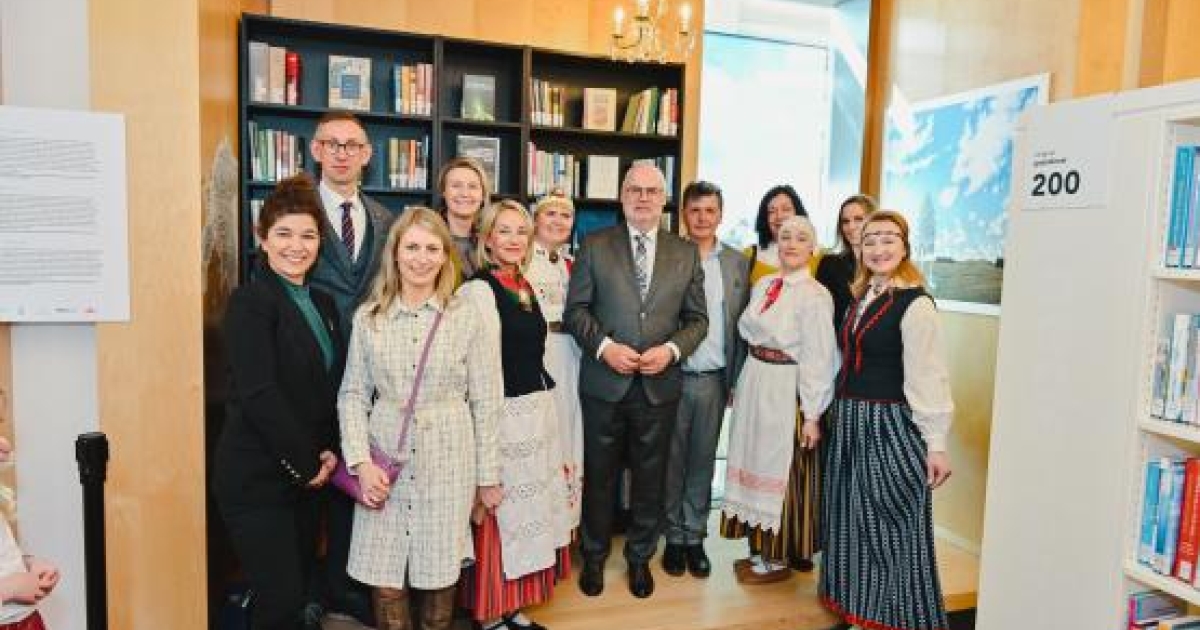
“Here in the Amsterdam Public Library you can now discover the colours of Estonian culture,” the head of state remarked. “You can find out about the nation which the writer Ain Kaalep once described – not altogether seriously, more to arouse interest – as the indigenous tribe of Europe. And indeed there is a kernel of truth to his statement.”
President Karis said that when he turned his thoughts to the collection, the words of one of his predecessors came to mind. “Former Estonian head of state Lennart Meri, himself a writer, once said: ‘Europe is not a hodgepodge, but a mosaic in which every piece, every fragment, has its own particular colour’,” he quoted. “Centres such as these help us to see the colours of those diverse cultures, be they here in Europe or elsewhere; to more clearly navigate our way through the wealth of culture the world has to offer, and to prevent what makes those cultures unique being blended together and watered down into the thinnest of gruels.”
President Karis said that familiarity with, appreciation for and attempts to understand different cultures make it easier for people to live together and prevent conflict. “Conversely, ignorance and intolerance breed hate and destruction, as we are seeing in Russia’s war against Ukraine,” he cautioned. “But here in this library we should remind ourselves that neither Gutenberg’s printing press nor the Internet alone make us smarter people or the world a significantly better place. These inventions have granted us opportunities, and we have to learn how to make smart use of those opportunities for the good of all. In an era in which we are bombarded by information from all sides we must look at things with a critical eye and be able to distinguish the important from the unimportant. This is where libraries can be of help, since they promote the wisdom to remain willing and able to learn in any situation.”
The Estonian head of state personally gifted five books to the collection: Kristiina Ehin’s Janu on kõikidel kaks, Piret Raud’s Järve kiri, Viivi Luik’s Kuldne kroon, Fred Jüssi’s Olemise mõnu and Tõnu Õnnepalu’s Eesti loodus. Other authors represented in the collection include Jaan Kross, A. H. Tammsaare, Karl Ristikivi, Andrus Kivirähk, Sofi Oksanen, Valdur Mikita, Eno Raud and Aino Pervik. Everything – from the most colourful fiction to the most exhaustive facts – adds to the overall picture of how Estonia has become the country and nation it is today. The collection also includes books written by Estonian refugees between the 1950s and the 1970s, which form an important part of the Estonian story. Fiction, historical texts, reference books on Estonian culture and traditions and the best contemporary writing are represented in the collection in Estonian, Dutch and English.
The collection and book corner were assembled in cooperation with the Estonian embassy and Estonia House in the Netherlands and the National Library of Estonia.
President Karis also visited Erasmus University Rotterdam yesterday, at which he himself previously worked as a scientist. There he gave a speech to students and researchers about the challenges of achieving peace in Europe. He also met with honorary consuls and Estonian entrepreneurs and their partners active in the Netherlands.