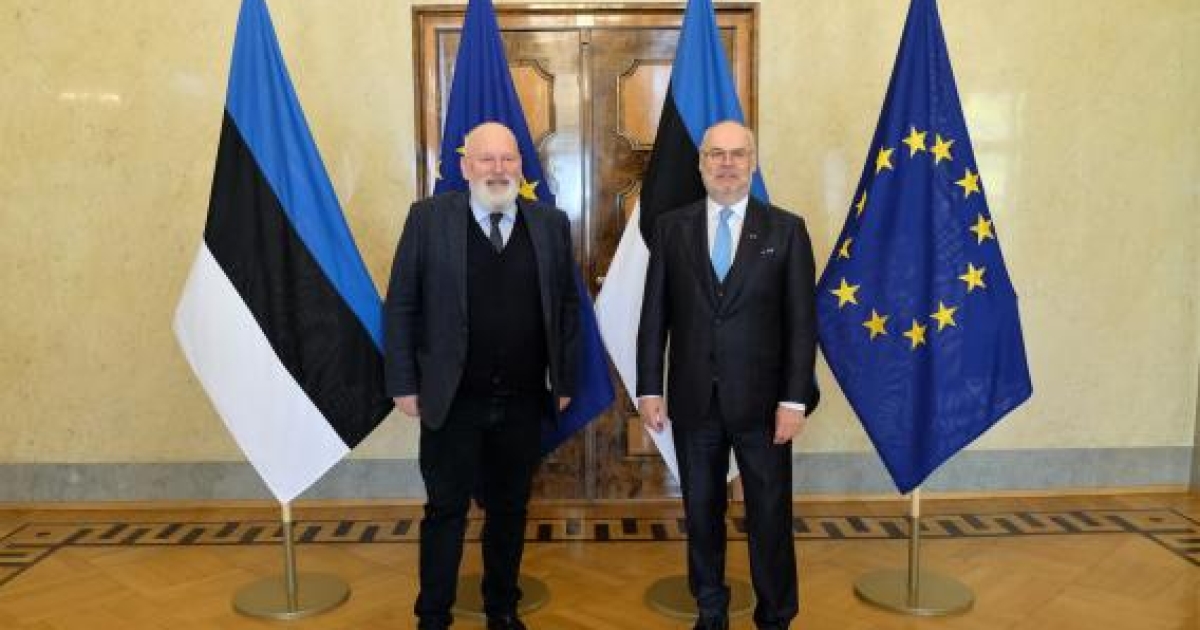
“The terrible aggression against Ukraine has forced European countries to act in their shared interests,” President Karis said. “Together they have helped Ukraine at every possible level, and they have also done much to reinforce their own security. Estonia has just passed a supplementary budget that will enable it to rapidly shore up its military defence, internal security and energy security.”
Other topics covered during the meeting were the energy economy and environmental protection. President Karis explained that a broad-ranging approach needs to be taken to the energy crisis in Estonia, including by developing solar farms and offshore wind farms, and thinking about how to make the most environmentally friendly use of oil shale, which at present unavoidably remains one element in ensuring the country’s energy security. “Ukraine too can be assisted in modernising its energy economy and agriculture before it joins the European Union,” he advised. “That way we will give a major push to its accession efforts. Joining cannot take place overnight, of course, as it is a long process for which there is no fast lane.”
During the meeting, President Karis noted that a substantial number of the Ukrainian refugees in Estonia and elsewhere in Europe have already adapted well to their new situation. “Ukrainians are very hard-working, and the school-age Ukrainians here in Estonia are taking to the national language very enthusiastically,” he said. “People’s kind-heartedness and open-mindedness have helped enormously, both here and elsewhere.”
The head of state remarked that the events in Ukraine have shifted the European Union’s centre of gravity eastwards. “‘Eastern Europe’ has long been a politically loaded term, and we have to stop distinguishing between East and West,” he advised. “The Member States in the western part of the union also need to clarify their positions in regard to a number of matters, for the sake of European unity.”