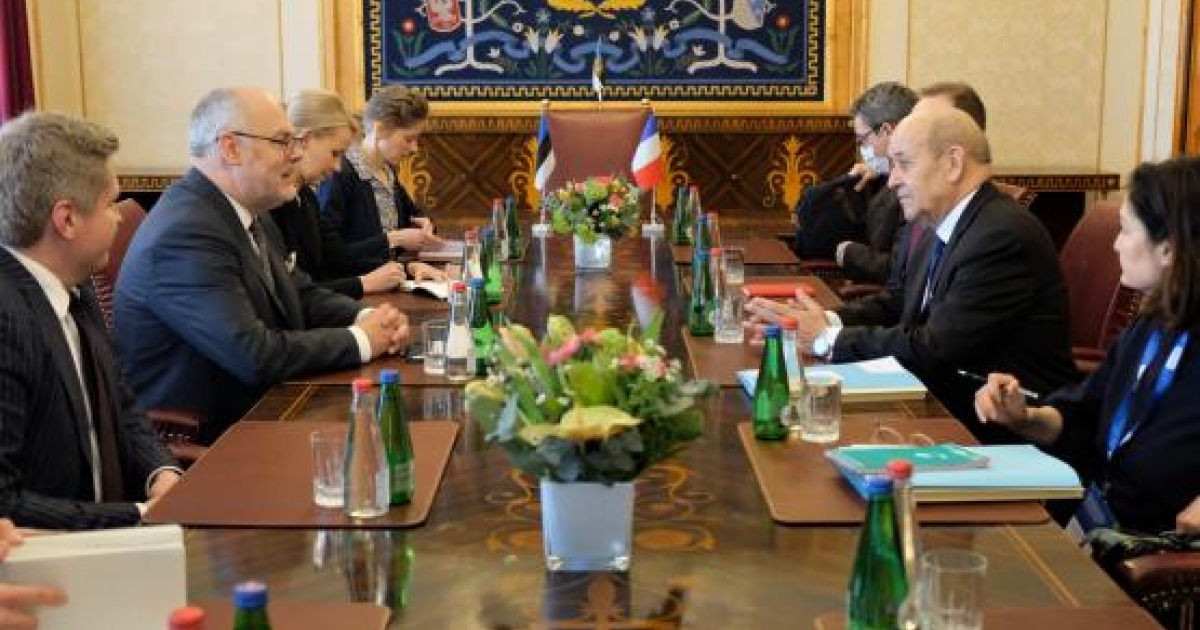
The discussion between President Karis and Minister Drian focussed on Russia’s war against Ukraine and on defence cooperation between Estonia and France.
“We support every effort to end the war in Ukraine, but the only peace we will accept is the peace that is accepted by the people of Ukraine,” said the Estonian head of state. “We have lived under Russian rule and seen their ‘peace’, and believe me, it can be every bit as horrific as war.”
President Karis says that all EU Member States and NATO allies must support Ukraine militarily and politically while also providing humanitarian aid. “Ukraine today is fighting for European values, which is to say they are fighting for all of us,” he remarked. “Russia will lose this war, but to ensure that it does, the like-minded among us must stand firm and sanctions must raise the price of aggression as high as it can go. That is why we must continue efforts to prepare the next package of sanctions.”
President Karis described France as a valued and very important partner to Estonia in NATO, expressing his thanks for the increased presence of French armed forces in the country and for France’s contribution to the defence of Baltic airspace and ensuring security in the region generally.
The head of state also mentioned the excellent cooperation enjoyed by France and Estonia when both countries served as peacekeepers in Mali, but cautioned that due to the worsening security situation in the Sahel countries, all those involved therein needed to carefully weigh up their future action in the fight against terrorism in the complex region.
During the meeting, President Karis also highlighted Estonian-French cooperation in the EU and the progress made on the Digital Markets Act, which is important to both countries, in the course of France’s presidency of the Council of the European Union. Speaking of further cooperation between Estonia and France, the head of state expressed his hope that at his next meeting with Minister Drian they would be able to discuss in greater depth ways of boosting cultural, economic and digital cooperation, which have been somewhat overlooked in the ongoing security situation.