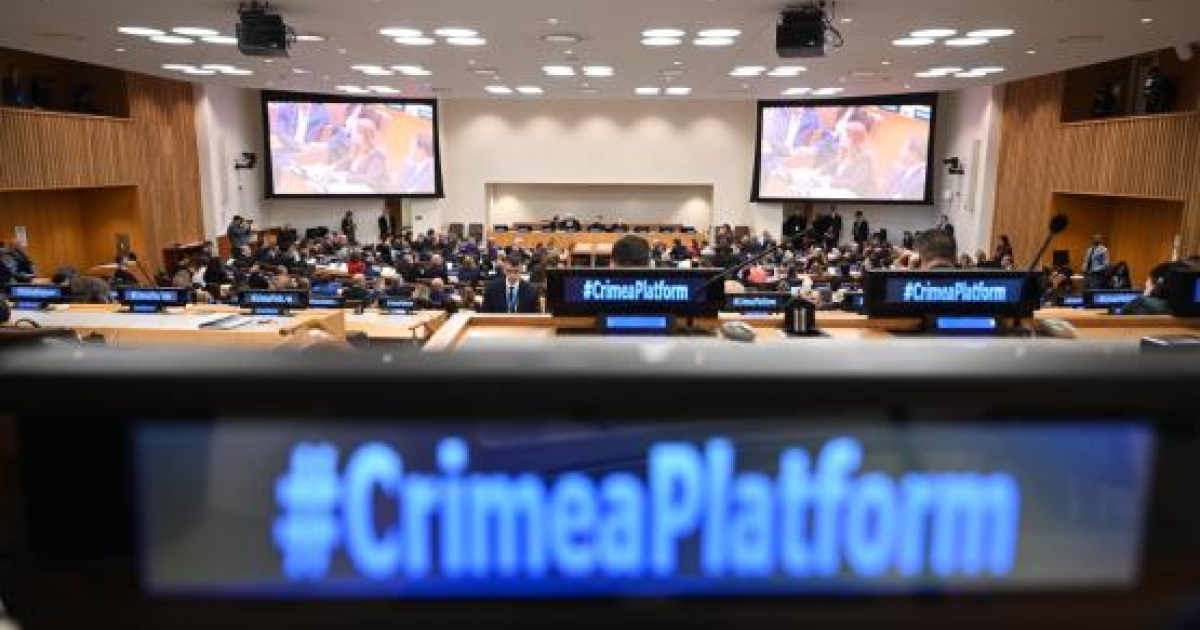
“Crimea is Ukraine,” the head of state said. “This is not merely a question of borders on a map: it is one of international law, of the right of peoples to be independent and to freely determine their own future, and of whether aggression, illegal occupation and annexation can be justified simply because the occupying power has held the territory for a sufficiently long time.”
President Karis added that for Estonia and the other Baltic States, this concept is by no means an abstract one. “For 50 years, our countries were subjected to Soviet occupation and rule,” he noted. “Our sovereignty was denied. Our people were deported. Our institutions were dismantled. Our national identity was subjected to systematic pressure. And yet, despite all of that, the occupation did not mean we disappeared.”
According to the head of state, the history of Estonia, Latvia and Lithuania confirms that time does not legitimise aggression or occupation, and that national borders cannot be altered by force. “It is for this reason that Russia’s illegal annexation of Crimea cannot and must not be regarded as a new political reality,” he said.
President Karis reaffirmed Estonia’s support for the people of Crimea, including the Crimean Tatars, who are suffering under both occupation and repression. He said that Crimea must remain at the core of international diplomacy, that Ukraine must continue to be supported for as long as necessary, that violations of human rights and international law must be documented, that the normalisation of the occupation must be opposed and that preparations must be made for the restoration and reconstruction of a free Crimea as part of Ukraine.
“Peace is essential, but a just and lasting peace cannot be contingent on making concessions to the aggressor,” he cautioned. “A solution that leaves millions of Ukrainians under occupation and repression does not constitute peace.” The head of state stressed that peace must restore the rights that the war has sought to destroy and ensure that Russia is held accountable for the crimes of aggression, the war crimes and the crimes against humanity it has committed in Ukraine.
Preside Karis described the situation as one in which more than just the future of Crimea or even Ukraine is at stake: it is a question is whether national borders can be changed by force, and whether an aggressor can simply wait for the rest of the world to grow weary. “Our answer to that must be a clear ‘no’,” he insisted. “Let us stand by Ukraine until its territorial integrity has been restored and its people are once again free to determine their own future. Let us work towards the day when the Ukrainian flag flies freely over Crimea once more. Crimea is Ukraine. Ukraine will be free.”
Gallery (Office of the President/Raigo Pajula): https://flic.kr/s/aHBqjD5q7a