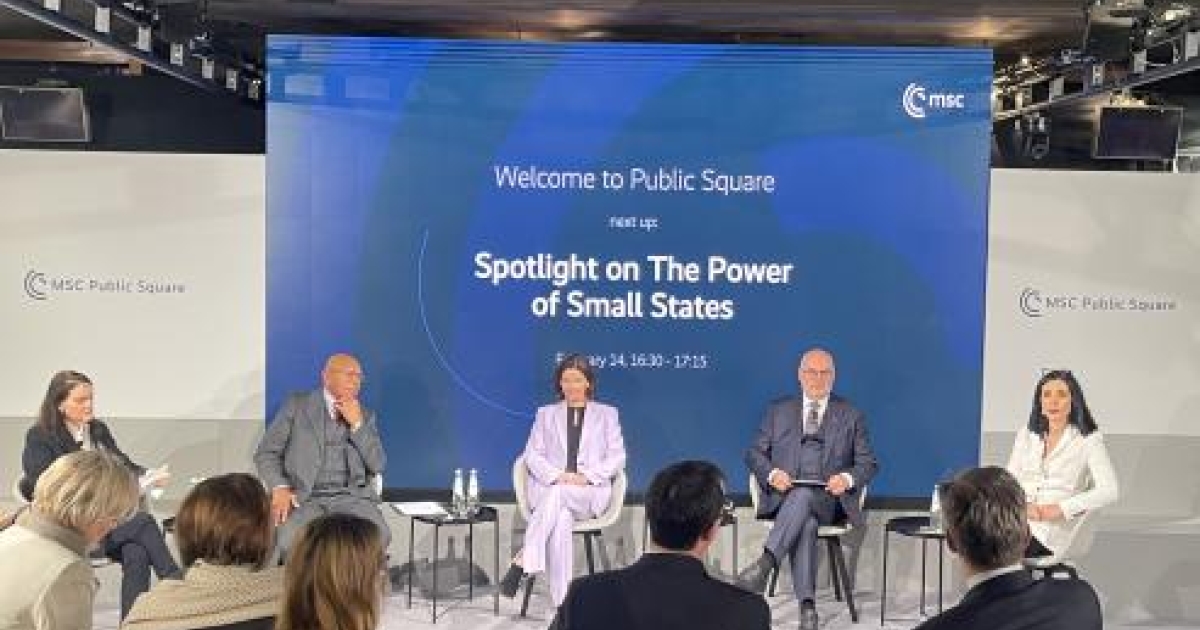
The President of the Republic emphasised that small countries are united by the experience that big countries often influence their security and political decisions. He referred to historical agreements such as the Yalta Conference and the Molotov-Ribbentrop Pact as examples. “The lessons of history must not be forgotten – they must remain in the past as warning examples,” said President Karis.
He emphasised the need to work for the preservation of international law, to reform the UN so that the organisation can play its role in ensuring peace and security and preventing conflict more effectively. “The Security Council, which is supposed to protect peace and security, has become powerless – we see this in Ukraine, Gaza, Lebanon and elsewhere,” said the Estonian Head of State. “The UN must be more than an onlooker.” “Abuse of the veto by permanent members must stop,” President Karis added. “That is why we, together with other small countries, support all initiatives to stop this abuse.”
Alliances are also more important to small countries in today’s world than ever before. President Karis recalled that Estonia, after regaining independence, considered it important to become a member of the European Union and NATO in order to strengthen its security. He drew parallels with the current debate on Ukraine’s application for NATO membership, recalling that negotiations about the accession of Estonia were also held while Russian troops were still in Estonia. “All of our alliances are based on joint work and solidarity – a principle that was true for Estonia then and is still true for Ukraine,” he emphasised. “Alliances increase the power of small countries, we can be the spokespersons for new initiatives and, by example, invite others to join in. This is what Estonia is focusing on.”
The Estonian Head of State also noted that membership of the Alliance means responsibility, and Estonia also contributes to the security of other Allies by participating in international missions, for example in the Middle East and Africa.
Prime Minister of Fiji Sitiveni Ligamamada Rabuka, Deputy Prime Minister of Slovenia Tanja Fajon and Foreign Minister of Liechtenstein Dominique Hasler also participated in the discussion. The discussion was moderated by Bronwen Maddox, Director and CEO of Chatham House.
Gallery: https://flic.kr/s/aHBqjC2vPN