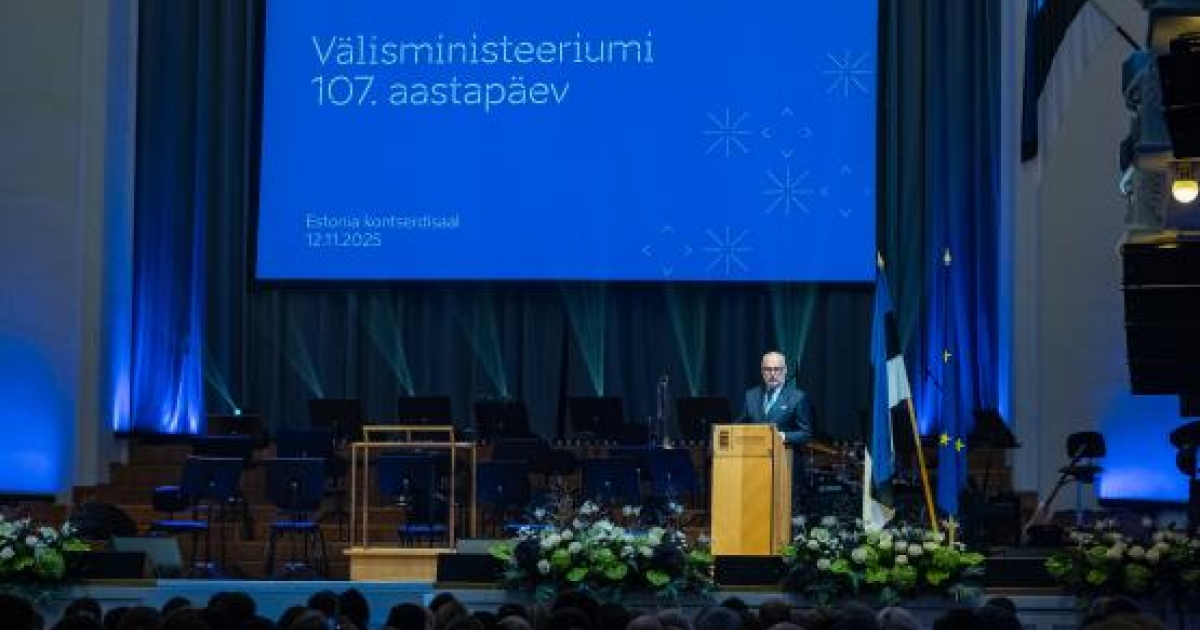
“Talking, communicating, explaining, understanding and empathising must be foregrounded,” he said. “International law, institutional order and cooperation are our frontline weapons. This is what we must fight with to preserve democracy, to defend the right of small nations to life and to bring an end to war and violence. That battle is by no means easy: it requires mental effort and resolve, but most importantly care and commitment – and, of course, resources.”
The head of state added that principles must be brought to the fore once again in international relations. “A stand must be taken to defend those principles,” he urged. “We must talk about them incessantly and remind people of their existence. Without those rules and principles we would be even more at the mercy of the winds buffeting the world. Entropy would reign.”
At the same time, President Karis cautioned, we must refrain from overturning the current order and withdrawing from existing agreements out of hand. “Especially those that pertain to the humanitarian field, even if they do not seem to suit us at the time,” he said. “We cannot and must not dismantle, piece by piece, the world order which feeds our own freedom and serves as a basis for our future. While we work every day to deter aggression and back Ukraine, we must not lose sight of the longer-term, more multifaceted view of the future.”
The head of state noted that the old-school triple maxim we frequently use which repeats a single word does not work in this context. “It is restrictive, narrowing our field of vision,” he stated. “It is too much of a simplification. Estonia’s future is more complex. Our playing field is much wider – security is utmost, but alongside it, equal attention ought to be given to individual freedoms and human rights, as well as to soft power.”
President Karis also spoke about Estonia’s place on the UN’s Human Rights Council in 2026. “It will provide us with the opportunity to act more forcefully and to raise our profile,” he said. “We will be able to make an even more forceful stand for deported Ukrainian children and bring the protection of civilians and the press in conflicts to the fore. Moreover, our innovation model should not just be our own, a thing in and of itself, but form part of the wider international environment.” He added that Estonian culture, science and education have a lot to offer the world, as recently seen in London, New York and Chicago.
Full text of address in Estonian
Full text of speech in English
Gallery: Aron Urb, Ministry of Foreign Affairs