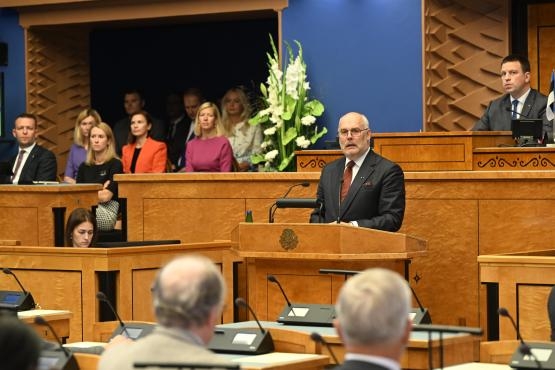
Distinguished guests!
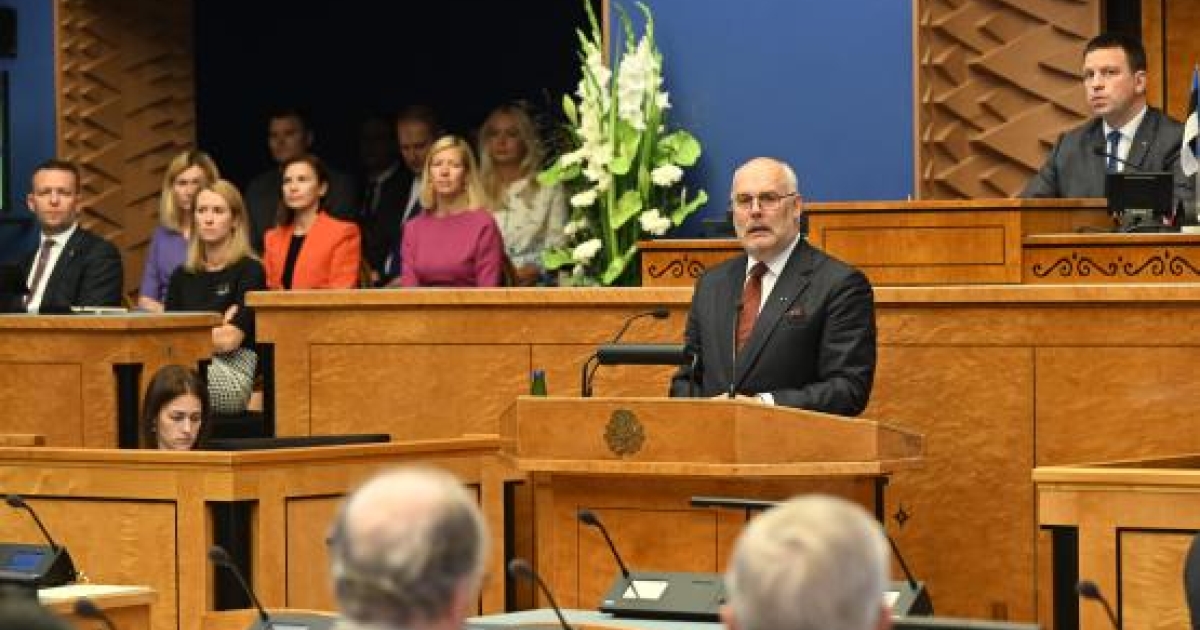
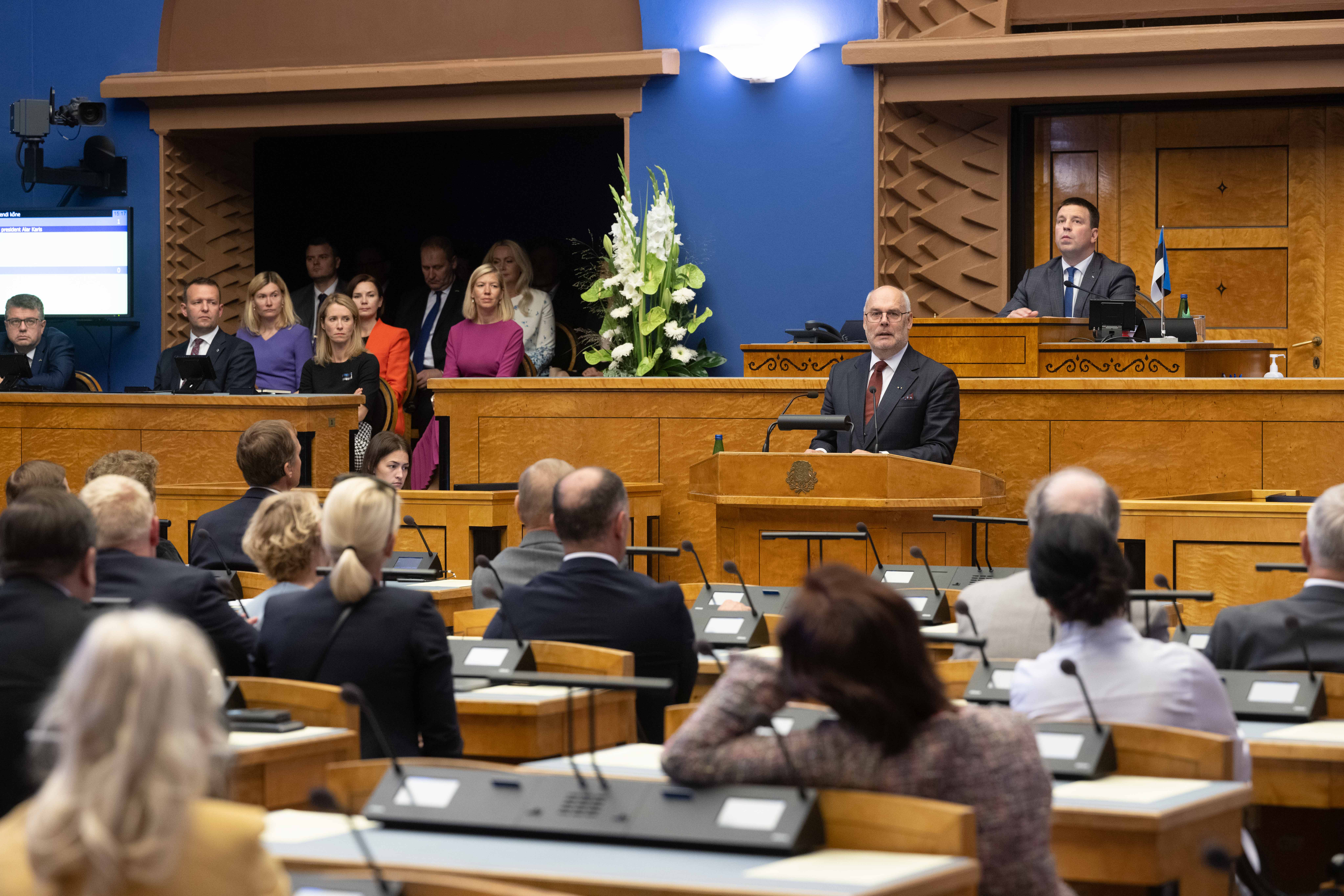
The honour again befalls me to stand in the most important chamber of parliamentary Estonia: the Riigikogu. It is precisely here that you, the legislators elected by the people, must decide where Estonia is heading and how it will take its next steps.
Will our progress be hesitant and unsure, or self-confident? Will look only in front of where we plant our feet or will we also take notice of our companions on the road? Will our eyes be fixed on the first curve or trained on the distant horizon? Will we have mainly the March 2023 elections in mind, or do we have the wisdom to ask what our current decisions will mean for our children and grandchildren’s Estonia?
My wish is to continue to be a good partner for the Riigikogu in all of this, someone who can sometimes give unsolicited advice when it feels like my knowledge and experiences fit the task, perhaps even give a bit of a prod in the back when there is reason to do so.
The field that requires the quickest solution, and which you have been dealing with in recent weeks, is energy prices. Although time is of the essence, I would counsel you to discuss all the possibilities and compare notes with your colleagues from elsewhere in the world to find the best possible solution; the one that is best for both home consumers and businesses. And, of course, a request: when you pass legislation, do not leave too much room for interpretation that can raise questions about unconstitutionality and slow down the entry into force.
At the same time, we must understand that we cannot continue indefinitely to pay heating bills with government loans. High energy prices may be with us for years. We badly need new energy-generating capacities that are not subject to the whims of warlike or undemocratic countries. Over the last several decades, Estonia has developed many visions and strategies for environmentally clean energy solutions. The capacity of the offshore wind farms planned in our waters exceeds Estonia’s demand severalfold, but the problem is that to this point these remain merely ambitious plans. I now ask you to work consistently to ensure that three or four years from now, we would not still be talking in this assembly hall about the need to help households and companies pay ballooning heat and power bills, but instead that we could speak proudly about Estonia’s new energy generation facilities.
We have many technology companies that are developing energy solutions and materials of the future or optimizing energy use. As we resolve the current crisis, let us refrain from solutions that robs innovation of its vitality.
It has recently become popular to increase various expenditures in the state budget, without talking about hiking taxes. Using borrowed money to cover crisis-related spending and to invest in increasing defensive capability is a reasonable idea, but covering long-term spending with temporary loan money is not. Our past attempts to bring the budget back into balance did ensure budget sustainability and it also helped rein in politicians who wanted to play Father Christmas with budgetary funds. In a situation where everyone demanded that the balanced budget requirement be followed, any politician making promises had to show how spending would be cut or which taxes would be used to bring in more revenue. The current situation has fostered the illusion that spending can be increased without raising taxes or without giving anything else up.
That is self-deception and it also deceives the electorate. The budget is not a golden goose or a perpetuum mobile. Let us be responsible when increasing spending so that we can leave future generations something other than debts, which hopefully they are able to repay. And let us remember that increasing spending without finding a long-term source of funding means that responsibility for the current choices has been shifted to the next Riigikogu and the next cabinets of ministers.
Forgetting this would be an indifferent and irresponsible attitude toward future generations.
Distinguished legislators,
Let us talk about security. But not about steel, munitions, firing ranges and allies – not quite yet.
Instead, let us talk about how education and culture are Estonia’s broad-based national defence, our intellectual indirect fire and medium-range anti-aircraft system against ignorance and darkness. Education and culture are Estonia’s strong defence for maintaining foreign and domestic peace.
I call on all Members of Parliament, regardless of what their party they belong to or committee they serve on, to remember this every day. True, this means more funding for education and intellectual pursuits, and greater value placed on the teaching profession. But what is the alternative? Lack of education and ignorance, including when it comes to steering the ship of state. That, my friends, is a greater danger to Estonia than a possible airborne landing or tank assault on Estonia.
But now let us turn to hard security, without which none of the rest – Estonian education, Estonian culture, Estonian nature, the Estonian state, Estonia itself – could exist.
President Putin’s decision to pull Russia into a war with Ukraine – this brutal aggression in the heart of Europe – destroyed the previous security picture. The Parliament and Cabinet have responded uniformly and in no uncertain terms to the Kremlin’s war, making decisions that increase Estonia’s defensive capability and security. But we are only halfway there.
Plans pertaining to national defence must be implemented regardless of who is the prime minister or what parties form the Cabinet. Defence spending may seem very high at a time when general well-being is going downhill, but with a war raging in Europe, where Europe is defending itself against an aggressor, and where Estonia is under major cyber attacks,
this is one line item we cannot skimp on.
Additional capabilities like short-range anti-aircraft, anti-tank capability, indirect fire, situation awareness, allied infrastructure, cyber security and voluntary defence via the Defence League are of critical importance for us. So is medium-range anti-aircraft capability, which is still being discussed.
It is not important merely to develop military capabilities. The parts of the broad-based national defence system that relate to domestic security and ensuring operational continuity of the state are just as critical. I would also make separate mention of ensuring protection of the population, which to this point has received less attention than military defence. The lessons learnt from Russia’s invasion of Ukraine show clearly that if we want to save civilian lives, we have to be better prepared. Inhabitants of Estonia must know what to do in a crisis or threat of war, we have to continue work on our alert system, shelters and evacuation contingency plans. I hope the Riigikogu will tackle the development of these systems for keeping the population safe, just as rigorously as it has approached military national defence issues.
The European Union’s response to Russia’s war of aggression has been resolute and more united than the adversary thought it would be. Our greatest strength lies in unity, and all of us must always strive to achieve and maintain that unity. To win, Ukraine needs our political support and our military, humanitarian and economic aid. The Estonian state and people have done a great deal to support war refugees. Humanity is not a burden, and we must not weary of lending a helping hand. We can also undoubtedly help and support Ukrainians on their road to joining the European Union. This will remain our priority for many long years.
As to relations with our allies, active bilateral meetings and mutual respect are of determining importance. Our security depends on their security. That means that our concerns and joys must be shared. And we always have to be ready to contribute to missions that are important for our allies.
Estonia is a member of the world’s strongest military alliance – NATO – in order to guarantee our security and peace. We are now glad that two of Estonia’s closest neighbours, Finland and Sweden will join the same alliance. They can count on our full support.
I am glad that the diplomatic corps is represented at today’s session. As I look out upon you, I recall that small countries respond to impending storms faster, much as a light craft might respond to even a small swell and does not need a full gale to sense the danger. Because of that, it is always wise to listen to smaller nations more, especially when we sound the alarm.
Honourable members of the Riigikogu,
I would like to also speak about what sort of a role the president has as a defender of the Constitution. There has been debate about whether a president can veto legislation only if it is unconstitutional. In fact, the Constitution does not impose so narrow a criterion, and the framers of our Constitution have also confirmed that the president has a broader powers in as a check and a balance on laws.
In 1991, it was proposed that the president’s function might include performing quality control of legislation. Back then, when the Riigikogu of the newly restored Republic of Estonia just started work, that sort of control was indeed probably quite necessary. I am however quite sure that the quality of Estonia’s laws today is solid. Legislative drafting has certainly become more expert over the years.
But that does mean that every single law is carefully considered. This is perhaps inevitable; after all, today many pieces of legislation have to be drafted very quickly, to respond to some or other problem that has suddenly been discovered. If a matter seems urgent, the president comes under pressure, too, because a decision to veto always means a delay. Yet I would recall one idea that perhaps best summarizes the president’s broader function in exercising oversight of legislation: according to this idea, the president acts as a brake. After all, speed is not the only virtue in governance.
The idea behind the presidential “brake” is to tell the Riigikogu: think about this some more and provide a rationale for your chosen solution. Have I done that? Not to this point. Would I be prepared to do it? Being one year in office wiser – yes, I would, if excessive haste and dealing with an individual problem meant that the legal order as a whole had been given short shrift.
In a state governed by the rule of law, everyone reading a piece of legislation must be able to understand under what circumstances their actions would be punishable. That is why, going forward, I intend to make sure that in particular laws that provide for sanctions would not contain too much room for interpretation.
This is a broader problem that ties in with attempts to resolve particular matters with general legislation whose impact is often unforeseeable. It is understandable that legislators do not want to appear idle – especially if society has an expectation that something should be done quickly. In such a situation, the president may have to shoulder the difficult task of stepping on the brake even if the new law is very urgently required to enter into force.
My overarching belief is that even in a crisis, the rule of law must never be bent out of shape. For example, it is hard for me to support calls to strip non-citizens of the right to vote at local elections. I also consider it wrong to incite collective mistrust in entire classes of people.
It is a widespread opinion that fundamental rights may be restricted in a crisis. And that is indeed so. Our Constitution provides for such a possibility as well. Yet it is a separate matter whether we accept as a general guide the idea that the Constitution cannot be followed to the letter in a crisis.
I cannot accept such an idea.
Such a position would display a lack of respect toward our framers, who had foresight and left enough flexibility to our leaders even within the existing frameworks. The Constitution gives us sufficient opportunity to defend our security without us crossing a red line where we start trying to monitor Estonian inhabitants’ ideological mindset.
However, what we have to remember here – and that goes for all of us, no matter what our views – is that words are deeds and deeds always entail responsibility.
And one message, in closing. When I stood before you last year, I noted that we would have to discuss the most reasonable way to elect a president in modern Estonia. Many discussions, including with chairmen of parties and Riigikogu factions, have convinced me that there is currently a lack of political will to amend the Constitution.
Still, I think it would not go against the spirit of the Constitution to arrange things so that, in a case where the Riigikogu was unable to elect the president, the electoral body would have to deliver a president in any case. It would take just a single amendment to ensure that elections could not reach a stalemate in the electoral body, i.e., a solution where blank or spoiled ballots would not be counted in the electoral body.
And now, my dear members of the Riigikogu, it is up to you whether we will fix this provision and thus avoid risking the public’s perplexity and perhaps disillusionment at the next presidential elections.
Distinguished members of the Riigikogu!
In complicated times, there is nothing more important than a political role model. That role model may be a conflicted; petty and two-faced one. Or the role model may be honest, full of hope and uniting. That role model may guide us through crises without dividing society or it may end up increasing discord, making the difficulties even more oppressive.
There is no doubt that security concerns, inflation and problems making ends meet will get thornier in the autumn and winter ahead. And so I will hope that the political role model for every member of the Riigikogu will be one who unites us all, supports us, and looks reality straight in the face.
I wish all of us fortitude and wisdom!