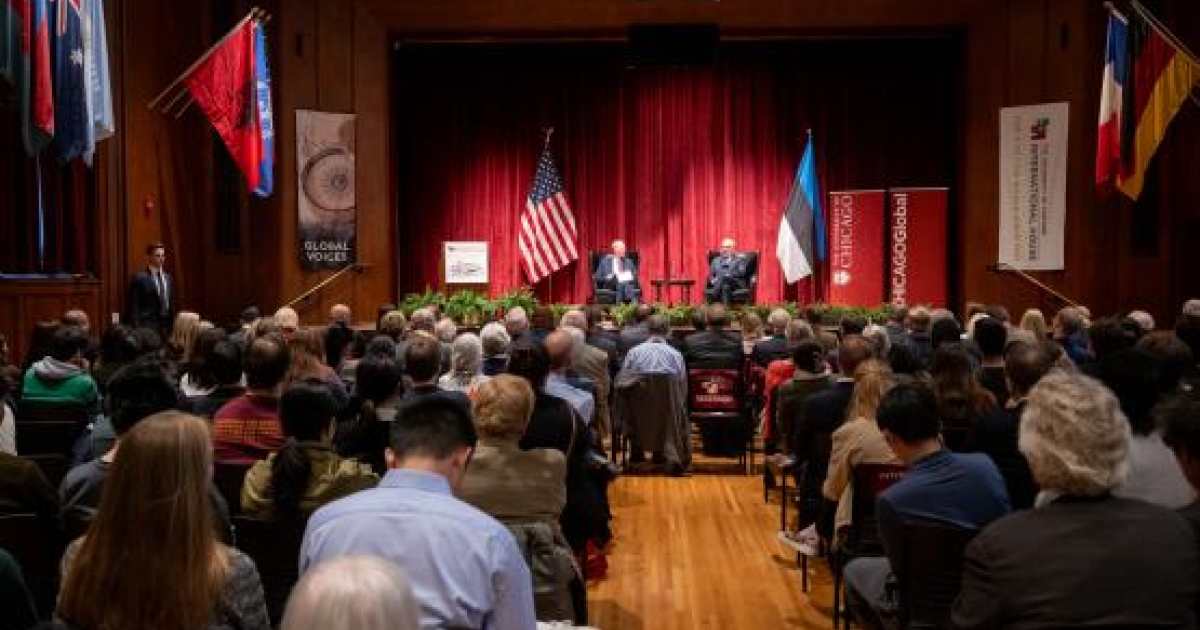
The head of state noted that Estonia’s success had largely been based on values originating from the University of Chicago and its school of economics. “The intellectual foundation that guided us came, to a surprising extent, from here,” he said. “The ideas born in this university – rooted in classical liberalism and belief in individual freedom, private property and open markets – became a compass for the transformation of our nation.”
President Karis explained that Estonia’s reforms in the 1990s were based on pro-market logic, which led to extensive liberalisation and straightforward taxation. “We introduced a simple and transparent system, which is still ranked by the Tax Foundation as the most competitive in the world,” he added. “Not because of low tax rates, but because of its clarity and simplicity.”
The head of state gave conservative macroeconomic policies and fiscal discipline as further factors behind Estonia’s economic success, as they have allowed the country to maintain low levels of public debt and provided a solid basis for current increases in defence spending. “These policies laid the foundations for long-term trust and resilience in the Estonian economy,” he said.
President Karis noted that Estonia has reached the global forefront through its implementation of economic freedom and democratic principles. “Today, according to the Heritage Foundation’s Index of Economic Freedom, Estonia ranks 8th in the world,” he pointed out. “In Freedom House’s overall index, we are 12th. That is a testament to how freely we have been able to apply and adapt liberal principles – without the institutional and political constraints that more established democracies sometimes face. But freedom is never finished: it requires continuous care, debate and defence.”
The head of state also linked Estonia’s economic reforms to digital development and innovation. “The market reforms of the 1990s paved the way for what came next: Estonia’s digital revolution,” he explained. “At the turn of the millennium, we invested heavily in digital identity, electronic registries and public information systems. At first, these were simply digital versions of paper processes. But soon, digitalisation began to change the very nature of public services, some of which could never have existed in paper form. Digitalisation has done more than make bureaucracy efficient – it has reduced corruption, increased transparency and supported democratic development.”
Looking to the future, President Karis touched on the growing role that AI is playing in society. “We should not be paralysed by fears that AI will take away jobs,” he urged. “Instead, we must learn to use it to increase productivity, to enhance human work and to deepen the meaning of what we do.”
The head of state gave the example of Estonia’s secondary-school AI education programme. “Children are already using AI,” he noted. “Our responsibility is to make sure they can use it wisely and to their long-term benefit. We aim to nurture a generation that can use AI for empowerment, not dependence.”
Full text of speech translated into Estonian
Full text of speech in English
Gallery (Raigo Pajula/Office of the President): https://flic.kr/s/aHBqjCyf6p