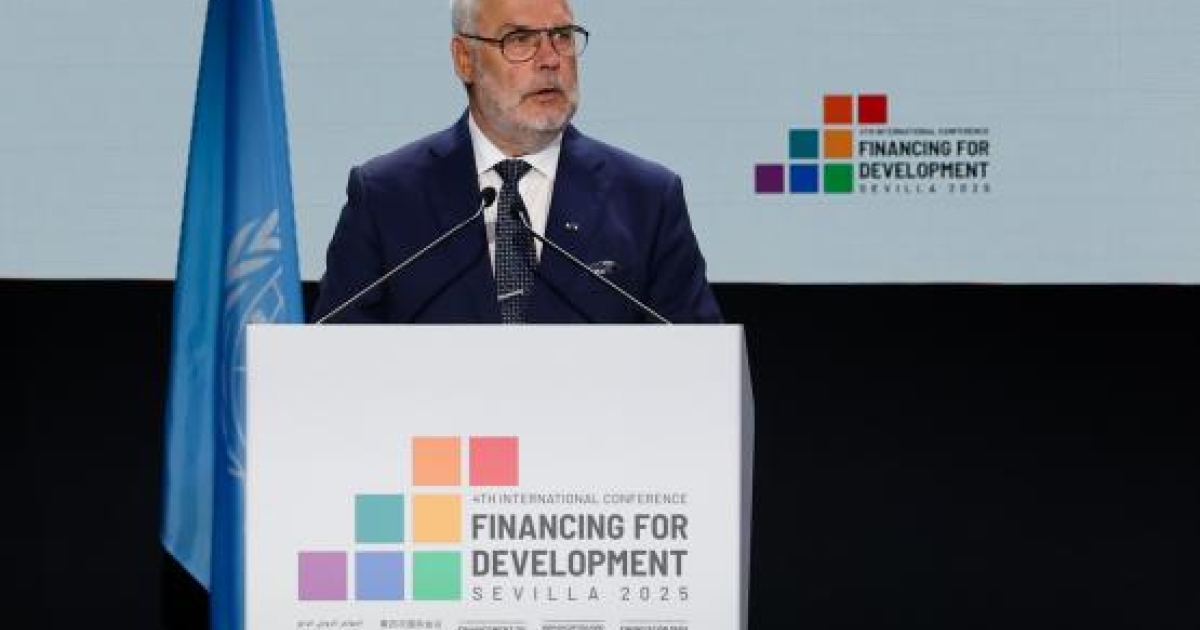
“The way development is funded needs to change,” he said. “It needs transparency, simplicity and clearer accountability. In that regard, developing countries can assume greater responsibility for their own future. This requires clear objectives, solid policies and reforms that create the conditions needed for development. Digitalisation and the adoption of new technologies help with this.”
The head of state acknowledged that the world is facing difficulties which hinder the financing of development. “Climate catastrophes, conflicts, geopolitical tension and rising levels of debt have complicated financing conditions and slowed progress towards achieving the Sustainable Development Goals,” he noted. “Those difficulties can be overcome if the countries themselves take on responsibility and if all of us work together as an international community.”
President Karis added that digitalisation helps developing countries accelerate reforms and strengthen governance. “Digitalisation and AI are opportunities that do their part in promoting development, improving access to financial services and boosting the role of women in the economy,” he explained. “Making public services digital accelerates reforms and streamlines governance. Public-private partnerships play an important role in that.”
The head of state said that Estonia’s experience is a perfect example of how strategic leadership, digitalisation and innovation can help in creating the conditions needed for development. “Digital tax services and an efficient taxation system increase transparency and reduce waste,” he noted.
Estonia is assisting developing countries in making the digital transition via open-source solutions. “We are contributing as part of the GovStack initiative, which helps countries establish open, modular and adaptable digital services so as to provide people with better public services and bolster their administrative capacity,” President Karis explained. This initiative was set up by the Ministry of Foreign Affairs in cooperation with the German Agency for International Cooperation (GIZ), the International Telecommunication Union (ITU) and the Digital Impact Alliance (DIAL).
At the conference, alongside his Sierra Leonean counterpart Julius Maada Bio, the Estonian head of state co-chaired a debate on how to better mobilise local resources and thereby support developing countries via digitalisation and new solutions. The opening address at the discussion was given by Prime Minister Denys Shmyhal of Ukraine.
President Karis highlighted AI as one way of speeding up development and making public services more efficient. He noted that Estonia has already utilised AI to evolve its tax and financial services, making them smarter and more data-driven.
“Technology alone changes nothing if people don’t know how to make effective use of it,” he said. “That is why I feel that AI literacy should be part of lifelong learning for everyone.” The head of state also showcased Estonia’s AI Leap initiative, which is designed to help schoolchildren gain skills and knowledge in this rapidly developing field.
World leaders are joining representatives of businesses, civil society, development banks and international organisations at FfD4 to discuss and bolster cooperation in support of developing countries. The aim of the Seville conference is to agree on new approaches to supporting global development cooperation and developing countries more effectively by adopting an outcome document entitled Compromiso de Sevilla. Heads of state and government from almost 50 countries are attending the event.
Gallery: https://flic.kr/s/aHBqjCjPLx