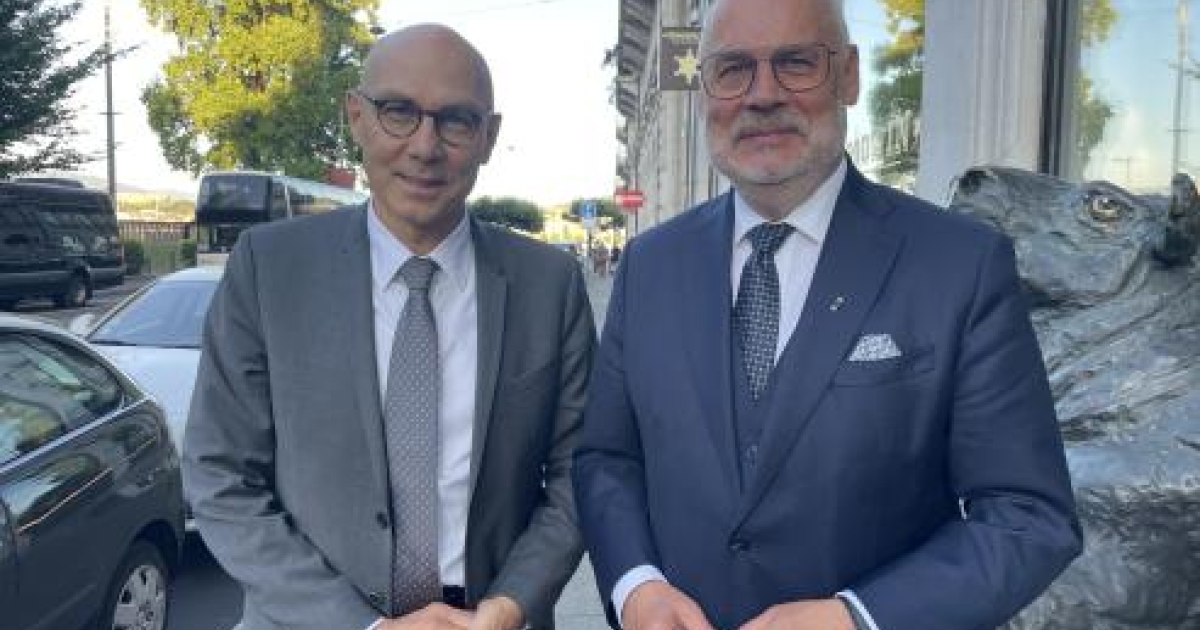
“Pressure on democracy, human rights and the rule of law is growing all over the world, and the tense geopolitical situation underscores the need to bolster international cooperation and increase support for the protection of human rights, which is one of the pillars of the United Nations,” President Karis remarked. “Regardless of budget cuts, Estonia has managed to boost its voluntary support for the protection of human rights.” The head of state also expressed Estonia’s support for an observation mission in Ukraine during the meeting.
Also discussed was Estonia’s candidature for a seat on the UN Human Rights Council from 2026-2028, and reforms to the UN in order to modernise it, meet the expectations of its member countries in a changed world and make it more cost-effective – while still maintaining its core objectives.
In his meeting with ITU Secretary General Doreen Bogdan-Martin, President Karis talked about the security of critical infrastructure in the Baltic Sea region, including how to ensure the security of undersea communication cables and more effectively prevent the growing number of incidents of intentional interference in radio communication. “Increased Russian interference with radio and satellite communications is having a harmful effect on both air and sea traffic,” he said. “We are faced with real and immediate threats, in response to which we must act decisively with our neighbours and other European partners in what is a complex security situation.”
The head of state says that incidents involving underwater infrastructure in the Baltic Sea prove that more attention needs to be turned at the international level to guaranteeing the security of communication cables.
At his meeting with Secretary-General of the United Nations Conference on Trade and Development (UNCTAD) Rebeca Grynspan, President Karis spoke about how Estonia is able to help developing nations boost their self-reliance and independence from foreign aid by sharing its digital state experience with them. “Estonia’s e-governance solutions help to open up new markets for other companies in developing countries, which in turn helps to reduce inequalities,” he explained, acknowledging UNCTAD for its actions in support of the fairer integration of developing countries into the international trading system.
While showcasing Estonia’s candidature for a seat on the UN Human Rights Council, the head of state also met in Geneva with envoys from Botswana, El Salvador, the Gambia, India, Mexico, New Zealand, Qatar, Singapore, South Africa and Sri Lanka. If selected, Estonia’s focal points will be children’s rights, media freedom and the protection of human rights in digital space.
Gallery: https://flic.kr/s/aHBqjCm1E5