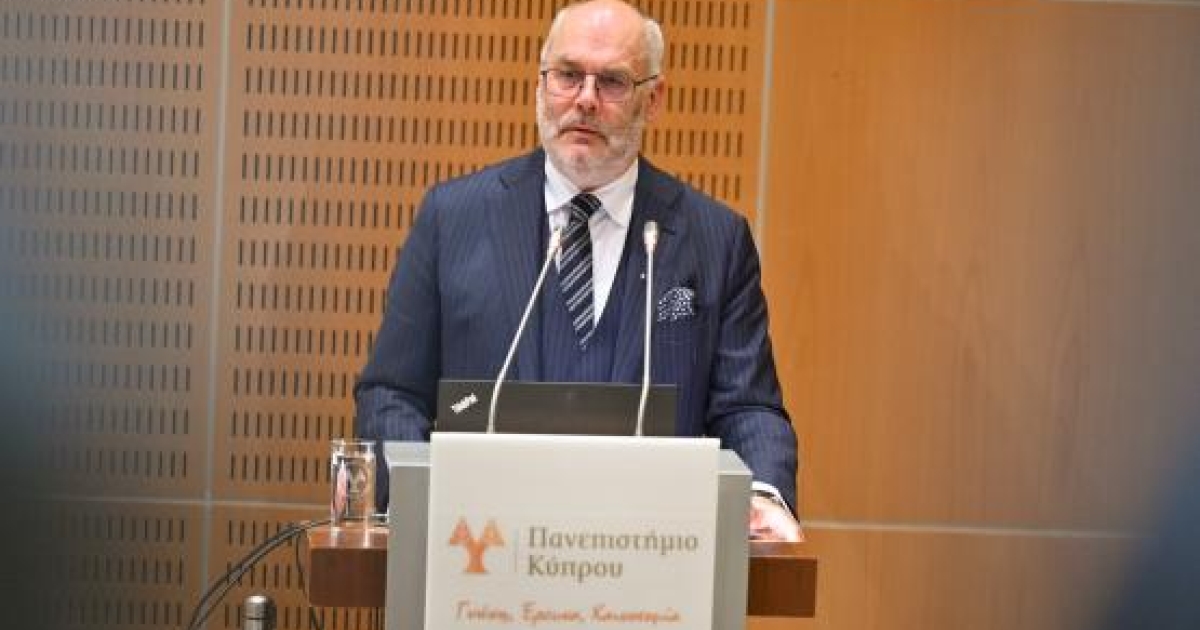
The head of state remarked that as countries at the crossroads of cultures and civilisations, Estonia and Cyprus know that a rules-based international order serves as an insurance policy for small nations. “In that regard, Estonia’s cooperation with Cyprus to promote peace and stability in Europe and beyond will continue,” he assured his audience.
During his talk, President Karis also spoke of Estonia as a land of digitalisation and unicorns and focussed on international security issues in Europe and surrounding regions.
“We are seeing a world riven by tensions, conflicts and wars,” he said. “A war is raging on European soil that was sparked by Russia’s aggression towards Ukraine. We are all affected by it in one way or another. And the military conflict in the Middle East adds another layer of uncertainty to the Eastern Mediterranean.”
President Karis says that a stand must be taken against any and every attempt to undermine international order. “The past and present of both our countries enable us to appreciate the importance of the principles of sovereignty, independence and respect for human rights,” he remarked. “We must remain united and resolute in our observance of democratic principles and international law.”
The head of state also highlighted the need to reform the UN Security Council, stating that the world requires functional support from an institution which can be relied upon to guarantee peace and security for every country. “We must all play our part to achieve this,” he said. “The abuse of veto rights is paralysing the work of the council far too often.”
Addressing the university audience, President Karis said that high-quality education and research are the basis for a better future. “That is why I call on all countries to contribute to the rebuilding of Ukrainian science and to help the research centres and universities there, as well as the scientists, professors and lecturers still working in these places as rockets rain down on them, and their colleagues who were forced to flee the country,” he urged. “By providing our support and launching cooperation projects, we can help the Ukrainian education and research community not merely to survive, but to maintain its high level or, where needed, to return it to its former glory.”
According to a recent UNESCO report, more than 10,000 Ukrainian scientists have been forced to leave their homeland or to relocate within it. Close to 1500 university and research buildings have been damaged or destroyed in Russia’s war of aggression, with the cost of restoring public research infrastructure projected to be 1.26 billion dollars.
Later today, President Karis will be meeting with UN Special Representative and Head of the Peacekeeping Force in Cyprus Colin Stewart and visiting the Committee on Missing Persons in Cyprus, whose objective is to recover, identify and return to their families the remains of those who went missing during intercommunal fighting on the island 50 years ago. The head of state will also be visiting the Cyprus Institute, which is a non-profit research and educational institution with a strong scientific and technological orientation. Finally, at the end of his visit, President Karis will tour the Cyprus Center for Land Open Seas and Port Security. This state-of-the-art training facility, which is unique in Europe, primarily trains experts from countries in the region on how to guard their borders, detect contraband, identify biological and nuclear weapons and deal with port and maritime security.