Dear students,
Dear friends,
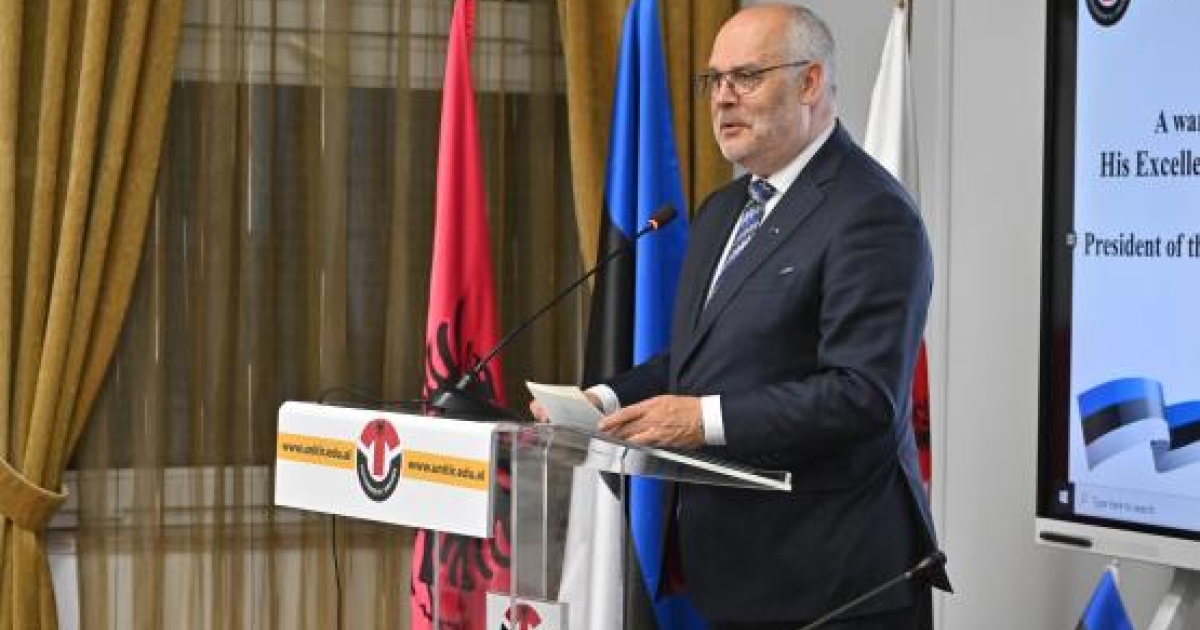
It is a great pleasure to be able to visit your wonderful university and have this discussion with you. It is a familiar feeling to be standing here. Of all the speeches I have given in my lifetime, the majority have been in an academic setting, either as Professor of Developmental Biology or as rector of a university. Now as President, it is still heart-warming to meet students and academics, and have a chance to discuss the world with them.
Estonia and Albania. We are two small countries at the opposite ends of Europe. Our relations are based on solid ground: we are steadfast NATO allies, firmly united in our position vis-a-vis the Russian aggression in Ukraine, true members of the European family. Albania has always had and is going to have our full support on its way to the European Union.
At the same time, we definitely do not know each other too well. But perhaps we should. Because small countries tend to have similar problems and they face the same kind of difficult choices in managing our societies. Therefore, we can learn from each other.
Small countries also have the same kind of need for international collaboration, and similar expectations for a rule-of-law-based international order.
I believe that Estonia owes much of its success to the fact that we made significant efforts to become deeply integrated into the Western world. Next year, we celebrate twenty years as members of European Union and NATO. Membership in these organizations and other international networks has given a huge boost to our democracy, our economy, our research and our culture.
Such deep integration, I believe, can make a small country punch above its weight, as they say. This means, it is possible to have a much greater influence on world matters than one could assume simply based on the population number. I know that you had recently a very similar experience as elected members to the Security Council of the UN. More integration opens more doors.
What is the secret? One the one hand, its commitment. Commitment to the principles of Western world, whether it means spending 2% of its GDP on defence or standing up for democratic values nationally and internationally.
On the other hand, it is always useful to bring something unique to the table. Being innovative and smart enables small countries to contribute as effectively as countries that are much richer on natural resources.
To prove the point - you may know Estonia for its success in all things digital. Indeed, we have a very digitally advanced public sector. You can do almost everything online, smoothly and without any paper. Every document can be signed with our electronic identity. Submitting your annual tax declaration takes two minutes. We have had e-elections or internet voting since 2005 and this year, for the first time, more than half of people who voted, did so via internet.
We are the first country in the world to offer e-residency – it means access to our digital public infrastructure if you wish to run your business with as little bureaucracy as possible.
In addition, we also have a very vibrant start-up scene. We have the most start-ups per capita in Europe and also the most investments per capita. Estonia has already been called the land of unicorns – so far, ten Estonian companies have achieved the value of one billion dollars.
Just to name two of them - the very first Estonian unicorn was Skype. You may also have used Wise, a money transfer service.
These are already famous examples of what we have achieved. I hope it shows that it is possible for a small country to become a global player. We gladly share all these experiences with other countries to help their digital transformation.
But let me emphasize one thing – this success was not written in stars. If you look back 30 years, we were not destined to become the global frontrunner in digital technologies. Things could have gone in a totally different direction.
We were fortunate to have some visionary people who made some very smart decisions.
At a recent exhibition about the origins and history of e-Estonia, I was struck by the fact that almost every important person shared a story about having access to computers in their high school. This is where e-Estonia started – in the basements of high schools.
This is probably the reason why in the 1990s our government launched a programme called the Tiger’s Leap. This programme equipped all schools in Estonia with computers and internet connection. The young people that benefitted from this programme are now founding start-ups and making digital innovations.
We also see how one thing leads to another. When Russia launched heavy cyber-attacks against Estonia in 2007, it was only natural for us to use our credibility as a digital nation to become the champion for cyber security. Now Estonia is hosting the NATO Cooperative Cyber Defence Centre of Excellence and I know that Albania is participating as well.
Today, the success of digital Estonia is maintained in the fact that we have a full ecosystem supporting new ideas and attracting talents globally. The next challenge is to use all the digital innovations to support the green transition of our societies.
However, you don’t have to copy our pathway to become a successful small nation. You need to find your own, based on your strengths. But no matter what it is, it needs to start with education and research.
Some 15 years ago when University of Tartu was hosting a conference about small nations’ universities, I had the honour of opening the event. I said then that “for a small society, educating its people is crucial and universities have an important role in shaping the face of the society. Universities represent an environment where new things are born. It’s a forum for discussion and circulation of ideas.”
I am now more convinced than ever that this is the case. Universities are the key for building sustainable, innovative and affluent societies. This is why research and education are one of the main pillars in European integration.
Students and researchers stand to gain the most from European integration. Over the years, thousands of Estonian students have spent a semester or two abroad and our universities have also welcomed thousands of students from other countries. Our research teams routinely collaborate with colleagues from other EU countries, joining forces to solve the most pressing problems, from climate adaptation to beating cancer.
We very much look forward to welcoming Albania in the EU family so that research and education collaboration can become much easier. I am convinced you have much to offer.
Of course, the potential of education and research can only be realized in a world that is democratic and rule-based. History has shown us repeatedly that when large countries start playing by their own rules, carnage will follow. This is why it is so crucial to stand up to any effort to dismantle the international order. This is why we are helping Ukraine. Attack on Ukraine is an attack on democracy, an attack on values that enable societies to prosper and innovate. Therefore, it is also the future of countries like Estonia or Albania that is at stake.
The war in Ukraine will end sooner or later with the victory of Ukraine, there is no alternative. Then we must gather our efforts to rebuild Ukraine – not just the buildings and the infrastructure but also the institutions, so that Ukraine can become the global champion for a democratic, liberal and just world order.
Thank you for your attention!