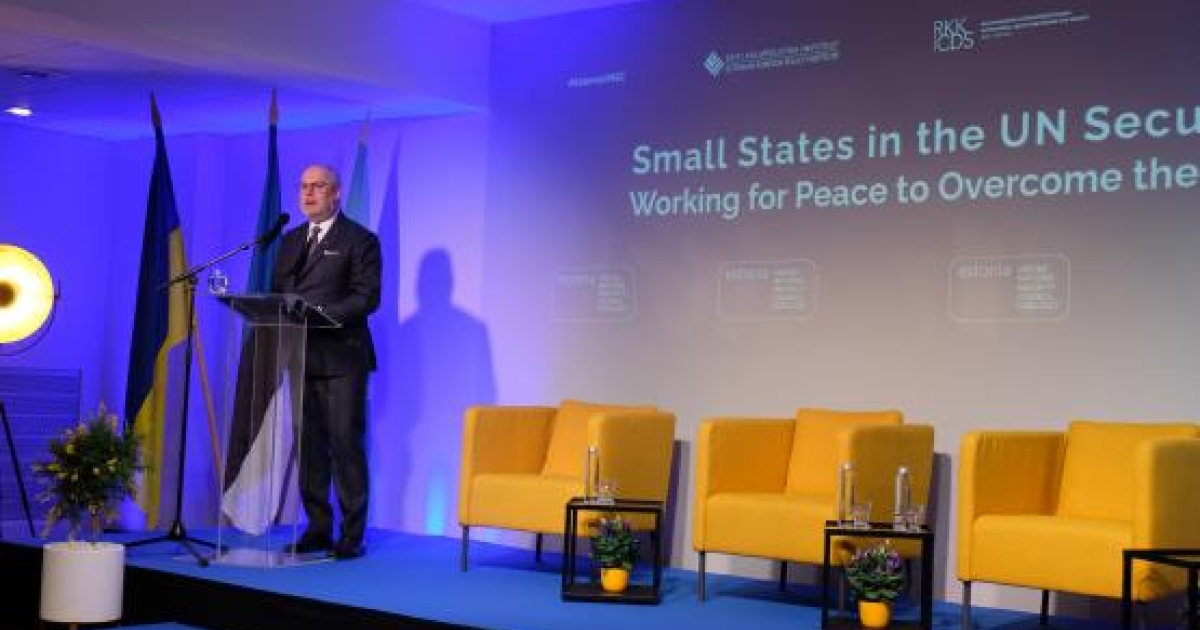
The United Nations was born almost 8 decades ago to save future generations from grave suffering and endless wars. World peace was the cornerstone ideal behind creation of this organisation. Unfortunately, we are far from achieving this objective. On the 24th of February, a permanent member of the UN Security Council attacked a democratic, peaceful nation, one of the founding members of the UN. This attack is a sign of weakness and lack of wisdom. It is also a brutal violation of everything the United Nations stands for.
Russia’s invasion in sovereign and independent Ukraine has had a dramatic impact on the regional and international security environment. It will bring famine and economic pressure to the most vulnerable countries around the world. This brutal war is a decisive moment for the UN. Therefore, it is very timely to take this opportunity today to discuss the most pressing issues of international peace and security and the future of the Security Council. How can we work for peace when one P5 country attacks a peaceful nation?
We cannot deny that Russia’s unprovoked aggression against Ukraine has put the UN system and the rules-based international order to the most serious test ever. It is challenging the founding principles and the very essence of the United Nations. The bombing of civilian targets, destroying hospitals and schools and causing extensive human suffering, is blatantly violating all the norms of international law and the principles of the UN Charter. The UN was created to prevent and settle disputes peacefully.
The former UN Secretary-General Ban Ki-moon has once said: “Peace is not an accident. Peace is not a gift. Peace is something we must all work for, every day, in every country.” According to the UN Charter, the UN Security Council has to maintain international peace and security. Unfortunately, UN is paralysed if one permanent member of the UN Security Council, Russia, remains indifferent to all calls to stop the war. Unfortunately, but not surprisingly, Russia has used its status as a veto power to block the Council from taking any action in response to its own large scale aggression. Russia has been abusing the Security Council arena to spread false narratives and lies regarding Ukraine. So, how do we, as an international community react to this? This unjust and illegal war in Ukraine has thrown the key weaknesses of the UN Security Council into sharp relief.
Dear audience,
I would like to focus on the international community´s reaction. I am proud we have shown strong unity in this crisis. The overwhelming support to the UN General Assembly resolutions on 2 March and on 24 March has sent a strong message of condemnation to Russia. We have made it clear that the international community demands in the strongest terms, the immediate end of Russia’s military operations, the protection of civilians and safe passage and access for humanitarian aid. It is of utmost importance that we sustain this unity. Russia must understand the high price of this war.
However, despite the 141 voices to end this war, it only takes 1 to ignore this call. The Security Council did not take any decisions on the military aggression and like-minded countries have been able only to put pressure on Russia by convening open meetings on Ukraine. The Security Council is a public diplomacy arena we need to use. But it is highly important that this Council also remains relevant as place where we can take actions against the aggressor, actions to end wars. This is the founding idea of this Council.
Without any doubt, it is time to give new impetus to long overdue Security Council reform. Estonia has always been a strong proponent of curbing the use of veto, including when atrocities and crimes against humanity take place. Can a country that attacks a democratic sovereign state have a place in the Security Council?
A few weeks ago the International Court of Justice explicitly ordered Russia to stop its so-called “military operation”, which Russia must comply with. There is only one aggressor in this war and there is no justification to any aggression. The International Criminal Court prosecutor has also opened an investigation into possible war crimes or crimes against humanity in Ukraine. It is our duty to see that these decisions are implemented, for international organisations to remain relevant.
Dear friends,
It is heart-breaking to see this humanitarian catastrophe unfolding before our eyes. Approximately ten million people have been forced to flee their homes because of war. It has created the fastest-growing refugee crisis in the last 70 years. To alleviate this situation, the UN has scaled up its support to Ukraine. But we often see that the NGO´s created by civilian society act much faster and with greater efficiency. It must be our duty to increase the efficiency of all relevant UN bodies, Estonia has always advocated minimizing bureaucracy.
In Estonia, the civil society and the private sector have provided more than 10 million euros worth of humanitarian assistance and we will continue to find ways to help. We are hosting more than 25 000 refugees from Ukraine in Estonia. It is our duty to help the people who flee from war and I am proud to see how open hearted Estonians have been.
Russia’s brutal war has long-term impact on European as well as global peace and security. At the same time, we cannot forget that apart from the war in Ukraine, many other crises around the world are still present: Yemen, Afghanistan and Myanmar are some of the most troubling. I do not envy current and future Security Council members who are obliged to find a way to work with Russia to solve these conflicts. I hope that our distinguished panellists will reflect on these complex questions today.
Clearly, the world will never return to 23rd of February again and there cannot be business as usual with Russia anymore. Having exposed all these challenges, should we fear the collapse of the UN system? There is no such danger. We must remain committed to standing for multilateralism and a rules-based international order with the UN at its core, rooted in respect for international law, human rights, democracy and rule of law. At the same time, we must also work on reforms long overdue, to make the UN efficient and relevant again. No country should say that some subjects cannot be taken to the Security Council as discussions on this issue would only demonstrate the lack of unity. There should be total unity while defending the core values of the UN.
Dear all,
Although the discussion on Russia’s aggression will most probably dominate today, it will not be the only topic at this conference. We are also talking about small state influence in the Security Council as well as new security challenges with the caveat that we might still hear the word aggression or war in these discussions.
Based on our experience as an elected member of the UN Security Council, I can confirm that an elected member can also have a clear impact in the Security Council. Estonia brought cybersecurity to the Council’s agenda and it was definitely one of our greatest achievements. Cautious step by step approach and outreach towards friends and partners were key for success. We stood up for international law, democratic values and human rights, including the women, peace and security agenda and the protection of children affected by armed conflict, and increasing awareness of the connections between climate and security.
Our overarching aim was to make sure grave human rights violations – be it in Ethiopia, Afghanistan, Yemen, Belarus or elsewhere – do not go unnoticed. Considering worrisome developments in our region already then, we put much effort into keeping the Security Council focused on our region - Belarus, Crimea of Ukraine, and Georgia. We organised Arria-formula meetings in order to give voice to those who have been suppressed, silenced and harassed. In this context, I am glad that Ms Sviatlana Tsikhanouskaya, who was twice a guest speaker in the Arria-formula meetings, is also here with us today.
Elected membership provides small states with an opportunity to play a role in global affairs that is disproportionate to their size. Therefore, I encourage you to be ambitious in taking your priority areas forward.
Looking back to Estonia’s two year term in the centre of global crisis diplomacy, great power rivalry was surely present throughout. I personally saw tensions, when I participated in the UN Security Council meeting on peace and security in the context of climate change at the beginning of December. A few days after this meeting, the Council, unfortunately, rejected a draft resolution on climate and security despite overwhelming support among wider UN membership (113 co-sponsors). This resolution would have been a first and necessary step towards integrating climate‑related security risk to the UN conflict-prevention strategies. Again, 113 countries to stand for an important issue and it took only one to kill this initiative.
Dear excellences,
Russia’s illegal and unjust war is presenting the international community with its greatest challenge to date. Therefore, we must act in unity and solidarity and remain committed to upholding the UN Charter. For Estonia, multilateral world and the international law remain our nuclear power. We will always stand for the UN Charter and the respect for human rights. We will never accept aggressive behaviour or the use of force to attack the sovereign states.
Before I end, I would like to warmly welcome everyone who joined us here today. My great appreciation goes to the Foreign Minister Liimets and the Ministry of Foreign Affairs as well as Kristi Raik and her team from International Centre for Defence and Security for organising this timely conference. The future of multilateralism and especially the future of the Security Council, matters to us now more than ever.
I wish you all fruitful discussions and exiting conference.
Thank You!