Professors,
Students,
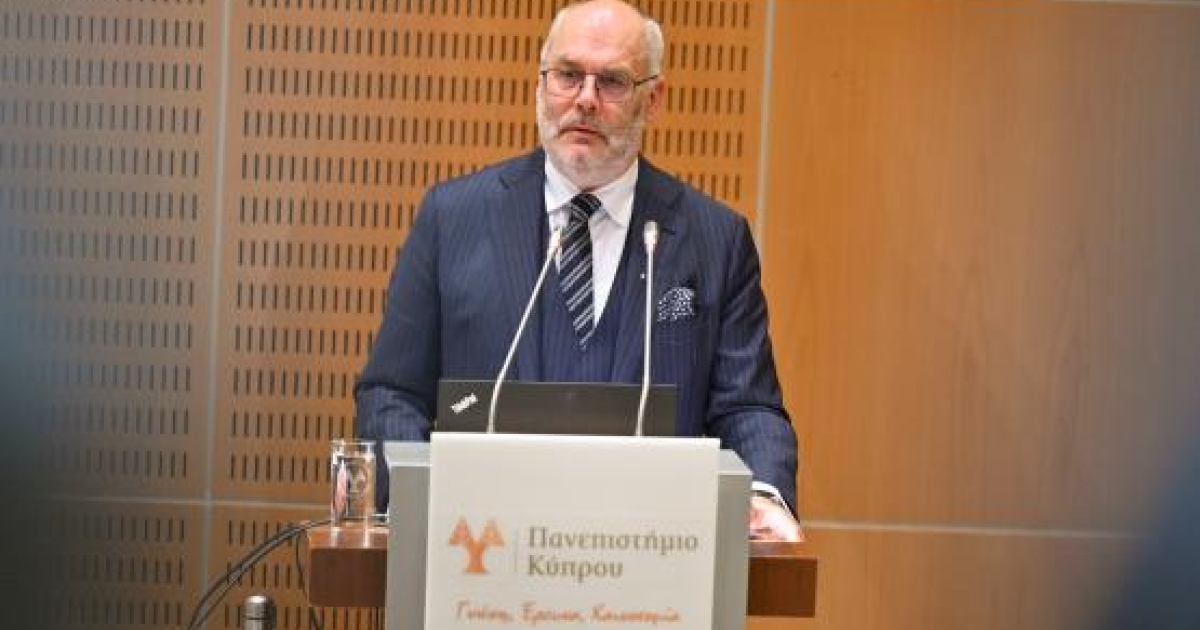
It is a great pleasure to be able to visit your inspiring university and to meet you all. Of all the speeches I have given in my life, the majority have been in academic settings, either as a professor of developmental biology or as the rector of a university myself. As such, it is a familiar feeling to be standing here. I would like to share with you some thoughts on Estonia´s path in the European Union over the last two decades. I will then talk briefly about my country as the land of digitalization and unicorns.
Lastly, I will close with some remarks on international affairs. Estonia and Cyprus are two small countries at the opposite ends of Europe. The distance between Nicosia and Tallinn, as the crow flies, is 2780 km (1727 miles). However, we enjoy excellent cooperation and solid relations: we share the same values, we are true members of the European family, we are firmly united in our position concerning the supremacy of international law, and we both contribute to security and peace in our regions and beyond.
As countries at the crossroads of cultures and civilisations, both living in challenging neighbourhoods, we know that the rules-based international order is the insurance policy for small nations. We walked side by side on the path to the European Union, of which we have now been proud members and partners for close to 20 years. We have cooperated and supported each other in various endeavours, be it in the United Nations, in the European Union itself or elsewhere, because we have seen that our decisiveness and unity carry us further as states, nations and individuals. We Europeans are different in some ways: our national cultures, languages, histories, GDP, geopolitical positions and ideas may differ, but all of this has brought us – and still brings us – closer together.
This is what Europe is about. This is what constitutes Europe. For us Estonians, it has allowed us to grow economically much more quickly than we could have achieved on our own. Through that, we have been able to invest in our security. Our accession to the European Union and NATO has provided us with security – we will never be alone again. In addition, we have gained a place at the table where crucial issues are discussed and decided, be they the pace of reducing CO2 emissions, setting telecommunication standards, shaping defence plans or the EU’s future enlargement. Since 2003, the support of Estonian citizens for Estonia´s membership of the European Union has constantly increased: today it stands at 84%. We believe that being part of a family of European nations with shared values and goals makes Estonia greater.
This means that it is possible to have much greater influence on world matters than one might assume based solely on population numbers. But I realise that things are not always so easy (viide Küprose põhjaosa üliõpilastele). Over the course of our EU membership, Estonia’s GDP per capita has increased by 64% in constant prices, while the value of our exports has increased six-fold and the average salary has almost quadrupled (from €455 in late 2003 to €1812 in Q4 2023). GDP per capita was close to 53% of the EU average just before we joined the EU; it is now around 85%. As a result, people’s purchasing power has undergone a remarkable period of growth. The increase in living standards has been inclusive and supported everybody’s participation in society, as well as in the economic sphere. Students and researchers stand to gain more than anyone else from European integration. As a small country, resources are always limited.
But smart collaborations and free movement can help to overcome this and significantly increase the impact of our research. Cyprus, Slovenia and Estonia stand out as countries that have gained most from European framework programmes such as Horizon 2020 and Erasmus+, on a per-capita basis. These collaborations have enabled our researchers to contribute to solving some of the most pressing problems we face, from climate adaptation to complex diseases such as cancer. Today we are using our experience to help others who aspire to become Member States of the European Union, such as Ukraine and Moldova, as well as countries in the Western Balkans, on their path to the EU and NATO.
Simultaneously, we have to prepare the union for this change, and we must not give false hope or false promises, nor establish new requirements. The formula for successful enlargement is quite simple: candidate countries must do their part, and the EU must do its part. The Copenhagen criteria provides the framework for the package as a whole. We hope that the enlargement process will also breathe new life into the EU itself and make it a stronger, more prosperous and more secure place for our people. My friends, The future of our common European family depends on every citizen of the union. At the start of June, the European Parliament elections will take place around Europe. These events are important, because they have a long-term influence on our lives at every level. I hope that we all will cast our vote in the elections. They are about the future of Europe and the future of EU citizens. My fellow academic family, Cyprus was the birthplace of Aphrodite, the goddess of beauty.
Estonia, for its part, has been the birthplace of 10 beautiful unicorns. You might have heard of Skype, Bolt and (Transfer)Wise. A part of Estonia’s success story has been the rapid adoption of new technologies. It is Estonia that has been the trailblazer in Europe’s digital and cyber policy, and has therefore had an influence on the future of the entire continent. My country ranks 1st in the world for unicorns per capita: to date, 10 Estonian start-ups have achieved a value of one billion dollars. A strong link with us joining the European Union is evident here, as it is based on the free movement of capital, knowledge and people. And of course we warmly welcome all innovative and brilliant minds to Estonia. Furthermore, for all those who are looking for a digital home for their business, the best place is Estonia. With eResidency, digital nomads are liberated of paperwork, bureaucracy and location.
I know that Cyprus is also placing a great deal of emphasis on and pouring significant investments into digital development, so I am confident that soon enough you will also excel in this area. You may know Estonia for its success in all things digital. Indeed, we have a very digitally advanced public sector. You can do almost everything online, smoothly and involving not a single piece of paper.
Every document can be signed using our electronic ID. Submitting your annual tax return takes two minutes. We have had e-elections or Internet voting since 2005, and last year, for the first time, more than half of those who voted in our parliamentary elections did so online. We were the first country in the world to offer e-Residency, which means access to our digital public infrastructure if you wish to run your business in the EU with as little bureaucracy as possible. These are just some examples of what we have achieved. I hope it shows that it is possible for a small country to become a global player. But let me emphasise: this success was not written in the stars. If we look back 30 years, we were not destined to become a global frontrunner in digital technologies. Things could have gone in a very different direction. We were fortunate enough to have visionary people who made some very smart decisions. They were our brave young leaders, with ambition and vision. To a great extent, Estonia’s success is a story of courage, luck and timing. But hindsight has allowed the architects of the digital state to extract a blueprint to support digitalisation in other countries.
Today we cooperate on digital issues on every continent except Antarctica. This digital cooperation also has the potential to be one of the main areas of collaboration between Estonia and Cyprus. I very much look forward to deeper cooperation on the exchange of e-prescriptions. However, you don’t have to copy other pathways to become a successful small nation. Every country needs to find its own, based on its own strengths. But no matter what it is, it needs to start with education and research. Universities are key to building sustainable, innovative and affluent societies. This applies to the University of Cyprus as well. Students, Today we see a divided world riven with wars, conflicts and tension. There is an ongoing war in Europe, unleashed by Russia’s unprovoked aggression towards Ukraine. We are all touched by it in one way or another. This is unfortunately not the only aggression – there are other autocrats out there with grand ambitions.
Cyprus knows this better than most. The escalated military conflict in the Middle East adds another layer of uncertainty to the Eastern Mediterranean region. Elections in over 60 countries around the world, not least in the transatlantic community, could bring further turbulence. The European Union has demonstrated our common decisiveness by supporting the victims. As the Latin writer Publilius Syrus stated more than 2000 years ago, where there is unity there is always victory. It is of the utmost importance that the EU maintain its unity in supporting Ukraine. We have all contributed a lot, and in many ways. I am very grateful for the understanding and support that Cyprus has offered Ukraine. Today the beleaguered country needs our military assistance and our political commitment more than ever. The Estonian government has decided to allocate 0.25% of its GDP to support Ukraine’s defence capabilities over the next four years. On top of that, we are already engaged in rebuilding and reconstructing the country, and invite others to join us. It is equally important that we cooperate closely with partner countries and engage with the global community.
The EU, as well as the international community, should increase its efforts to hold Russia accountable for its aggression in Ukraine. We also need to keep supporting Ukraine’s Peace Formula, which places the UN Charter and the restoration of territorial integrity at its core. To ensure that we build strong and resilient democracy, we need educated people. Of course, the potential of education and research can only be realised in a world that is itself democratic and rulebased. History has repeatedly shown us that when large countries start playing by their own rules, carnage follows. This is why it is crucial to stand up to any effort to dismantle the international order. For countries like Estonia and Cyprus, our past and present enable us to understand the importance of the principles of territorial integrity, sovereignty and independence as well as the rule of law and respect for human rights. And we must remain united, courageous and determined in sticking to these democratic principles and values, as well as to international law. I strongly believe that good education and commitment to research are the basis for a better future.
And as with security, we are only as strong as our friends are. As such, I urge everyone to contribute to rebuilding Ukrainian research and to help the brave Ukrainian scientists, professors and teachers who are still working in Ukraine, plus those who have had to flee the country. A recent UNESCO report estimated that more than 10,000 Ukrainian scientists have been forced to leave their homeland or relocate within Ukraine. Almost 1500 university and research buildings have been damaged or destroyed, and the cost of restoring public research infrastructure is estimated at 1.26 billion dollars.
This needs a huge collective effort, but every little helps. By providing grants and launching cooperation projects, we can help Ukraine’s educational and scientific community to survive and restore its excellence.
My friends,
We are both living in challenging times and neighbourhoods. Over the last six months we have seen the escalation of the conflict between Israel and Hamas. The humanitarian situation in Gaza remains dire. Therefore, we highly value the recent decision to open a humanitarian corridor to deliver muchneeded additional assistance by sea. This is an excellent example of how a small nation with its commitment can make a difference on a global scale. Together we can do even more. The European Union has been, and remains, the biggest donor in Gaza in terms of humanitarian assistance and financial aid. To us, alliances and cooperation are fundamental elements of guaranteeing peace. We know that if you don’t deal with problems, then the problems will deal with you. Sadly, we can see the United Nation’s obvious difficulties in ensuring peace and security in today’s world. Together, we must work to strengthen the vitality of our international bloodstream. I strongly advocate for the reform of the United Nations Security Council, as we must have a viable structure that can reliably provide peace and security for every nation. We must all do our part to achieve this. The most pressing UNSC issue today is the misuse of veto power, which paralyses the council far too often. Unfortunately, we have seen that international structures alone will not deliver peace.
Last but not least, I know that for Cyprus, time has an additional sad dimension this year: 50 years have passed since the division of the island. The longer this situation continues, the more complicated it becomes to end it and unite the island. For Cyprus, a peaceful solution must be found based on the UNSC resolutions as a bi-communal and bi-zonal federation and the common will of both communities. It is with hope that we are following the important and timely work of the UN Secretary General Envoy for Cyprus to find common ground to return to the negotiating table. We wish you courage, determination and resilience to succeed so that Cyprus can once again be united and all of its nationals feel at home and secure.
Dear students,
The European Union has strengthened through crises and developed through enlargement. That is why, in celebrating the 20th anniversary of our membership, we must remain strong advocates for our common European Union, for our values and principles. History has taught us that only our courage, willpower and unity are a path to peace, whereas weakness breeds instability and more war. Thank you!