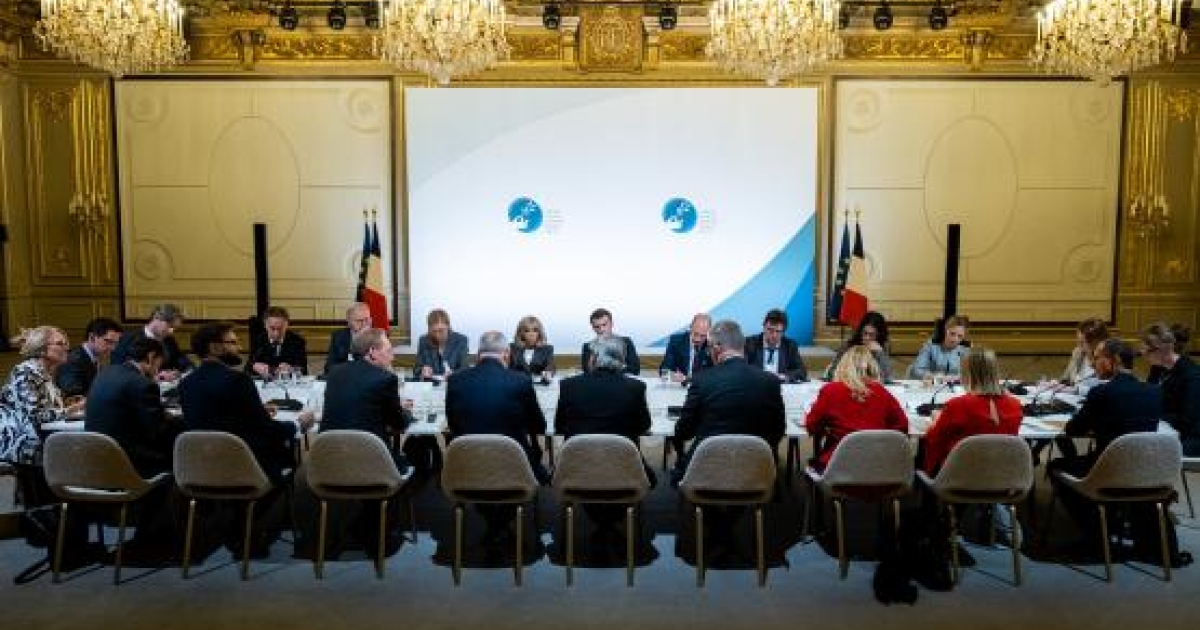
Thank you, dear colleague, President Macron (Emmanuel), for arranging this important and useful discussion. It has been a very good exchange of views.
We know that digitalization is essentially good and internet supports development and aids us in achieving the Sustainable Development Goals of Agenda 2030. However, we are here today, because not everything what comes with the internet is good.
I am pleased that the initiative on child protection online is moving to another level and I very much welcome the Charter on creation of a special Laboratory. I hope, that this will be an instrument, which will help the global community to minimize the potential harm our kids are facing online.
Clearly, this Laboratory will only be effective, if we all collaborate in this and Estonia intends to do so. It is very important that we all share expertise and our best practices, to learn from each other. I start sharing now and introduce some initiatives we have implemented in Estonia, which have demonstrated their effectiveness.
Everything starts from education. In Estonia teaching about the threats in the internet is part of the mandatory educational interdisciplinary programme to raise a new generation with the knowledge and habits, how to behave responsibly in the cyberspace and how to protect themselves there from different dangers. This is a first step, we acknowledge that ideally, it must be a separate educational programme.
We also have a specific project “Safely on the web”, it was launched to streamline the practical know-how of children’s self-defense and awareness online, with particular focus on disinformation. The project provides training sessions and seminars, with practical exercises for children, starting from kindergarten, ending with school students, parents, teachers and social workers.
All training materials are stored in online-hub, accessible for everyone. With one large telecommunications company, the project is collaborating in organizing the public awareness-raising events and campaigns against cyberbullying.
Another successful initiative is assistance and counselling for children and parents on the safe Internet and digital mobile device usage. This programme is called – the Children’s Helpline – accessible by telephone, as well as online via live chat.
In addition, we created the web-based hotline, which allows Internet users to provide information about web environments, which contain material that violates children’s right to sexual self-determination or are inappropriate for children (Vihjeliin).
Another useful tool has proven to be a “web police” – real police officers who are available on different social media platforms and with whom children can contact for advice and ask questions on internet safety.
We all must put every effort to education and training to raise the awareness of the potential threats in the cyber world and in the internet. We would suggest agreeing on standardizing some core elements of this training and creating common textbooks, as the opportunities and problems the internet brings are largely universal. This would allow us also to facilitate the exchange of teachers more effectively and train new teachers, as the gap between the demand and need in this field is massive.
I can continue, but my time is up. As my final remark, I would like to say, that much more remains to be done, therefore the Human Rights Diplomacy Action Plan, was adopted by the Estonian Government in 2021 and children in cyber space is one of the top priorities of this plan.
Estonia eagerly cooperates with other countries in implementing programs to protect children in online space and we are looking forward to the good ideas the Laboratory will provide us.