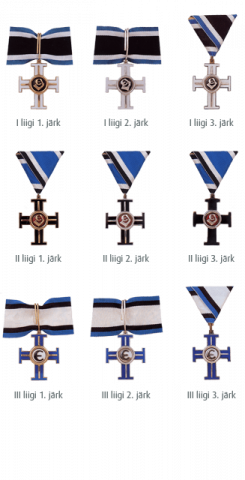
Cross of Liberty
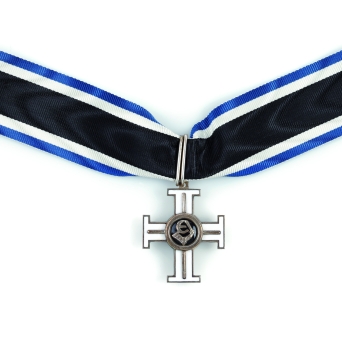
According to available accounts, Peet Aren drew inspiration for the design of the Estonian Cross of Liberty from two sources: the cross pattée motif taken from the banner of the Grand Master of the Teutonic Order, and the image of an armoured arm holding a sword, adopted from the Finnish Cross of Liberty (which in turn derives from the coat of arms of Karelia).
Until 2016, it was generally believed that the designer of the Cross of Liberty was Nikolai Triik.
The cross of the 3rd grade in each division of the Cross of Liberty measures 36 mm in height and 30 mm in width; the 2nd grade cross measures 39 mm in height and 34 mm in width; and the 1st grade cross measures 45 mm in height and 39 mm in width.
The crosses differ in their dimensions, colours, ribbon design, and manner of wear. The design incorporates combinations of Estonia's national colours, blue, black, and white. Only the decorations of the Second Division have a red centre, which is why they are known as the "Blood Cross" (vererist).
Classes and Grades
The Cross of Liberty is divided into three divisions:
- Division I – for military merit;
- Division II – for personal bravery;
- Division III – for civil merit.
Each division is further divided into three grades:
- 1st Grade
- 2nd Grade
- 3rd Grade.